 Add to Chrome
 Add to Firefox
 Add to Edge
ChronoVision: Temporal Reasoning via Latent State Reconstruction
Aug 06, 2026
Multimodal large language models excel at passive perception but struggle with complex visual cognitive tasks requiring multi-step temporal reasoning. This degradation largely stems from the inherent ambiguity of language-based reasoning, which often fails to accurately articulate continuous visual transformations. To address this, we propose ChronoVision, a multimodal framework designed to align visual logic with latent imagery. During supervised fine-tuning, a Reconstructive Visual Head predicts the latent representation of the final transformed state, while an ROI Attention Locating module focuses the model on key visual evidence via semantic span queries. In post-training, we apply reinforcement learning with an implicit process grounding mechanism, guided by a composite reward function that evaluates outcome correctness, latent process alignment, and unsupervised visual focus. Furthermore, we introduce Vbvr-VQA, a novel dataset that evaluates temporal tracking by reformulating video reasoning into a strict image-ordering task. Experiments demonstrate that ChronoVision achieves state-of-the-art performance on Vbvr-VQA with 74.8% in-domain and 71.6% out-of-domain accuracy, alongside a strong 55.0% accuracy on IntPhys2, a highly challenging cross-domain benchmark.

Motion Planning with Model-Based Diffusion via Constraint Optimization and Adaptive Scheduling
Jul 16, 2026Single-Robot Motion Planning (SRMP) in highly non-convex constrained environments, where robots must satisfy collision-free guarantees, dynamic feasibility, and task-related constraints, is challenging under complex constraints and computational limits. Recent Model-Based Diffusion (MBD) approaches recast the SRMP as trajectory optimization that samples from a posterior over trajectories, using known dynamics, and analytically estimates the score function from rollout samples to guide diffusion denoising toward a low-cost, clean trajectory without demonstration learning. While existing works further adapt MBD to constrained environments and showcase promising performance, they are still limited by (1) enforcing safety either via soft feasibility diffusion priors or hard projection operators, but lack a unified framework to integrate both, and (2) fixing safety enforcement to neglect the changing of diffusion scheduling. Therefore, we introduce Model-Based Diffusion via Constraint Optimization and Adaptive Scheduling (MD-COAS) for SRMP that unifies the inexact Augmented Lagrangian Method (iALM) soft diffusion prior with a Convex Feasible Set (CFS)-based hard projection operator, and adaptively schedules and co-optimizes safety enforcement, along with diffusion scheduling. Experiments demonstrate that our method achieves higher safety \& success rates, faster convergence, and lower final costs than baseline planners on randomly generated highly non-convex 2D benchmarks and a 7-DoF robot arm avoidance task.
Long-SCOPE: Fully Sparse Long-Range Cooperative 3D Perception
Apr 10, 2026Cooperative 3D perception via Vehicle-to-Everything communication is a promising paradigm for enhancing autonomous driving, offering extended sensing horizons and occlusion resolution. However, the practical deployment of existing methods is hindered at long distances by two critical bottlenecks: the quadratic computational scaling of dense BEV representations and the fragility of feature association mechanisms under significant observation and alignment errors. To overcome these limitations, we introduce Long-SCOPE, a fully sparse framework designed for robust long-distance cooperative 3D perception. Our method features two novel components: a Geometry-guided Query Generation module to accurately detect small, distant objects, and a learnable Context-Aware Association module that robustly matches cooperative queries despite severe positional noise. Experiments on the V2X-Seq and Griffin datasets validate that Long-SCOPE achieves state-of-the-art performance, particularly in challenging 100-150 m long-range settings, while maintaining highly competitive computation and communication costs.
Griffin: Aerial-Ground Cooperative Detection and Tracking Dataset and Benchmark
Mar 10, 2025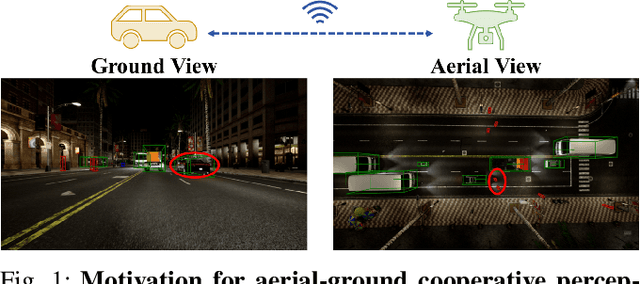
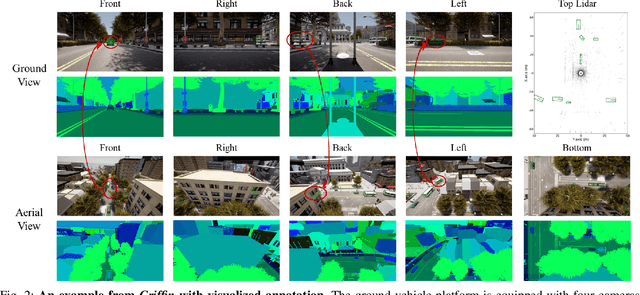
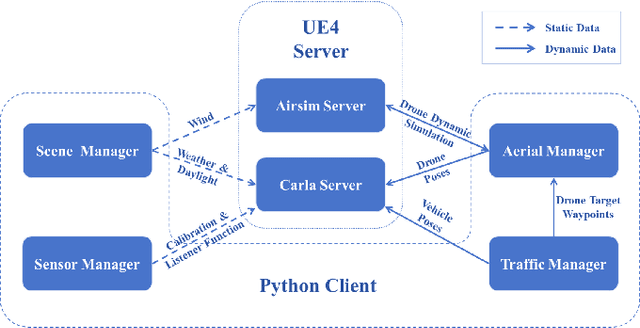
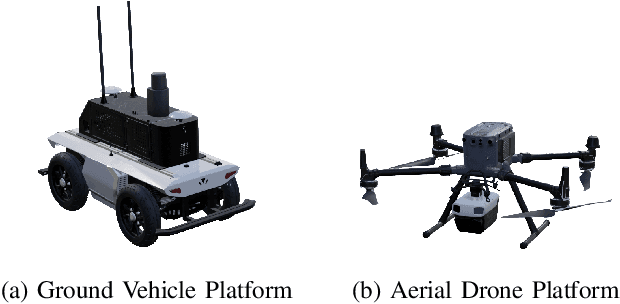
Despite significant advancements, autonomous driving systems continue to struggle with occluded objects and long-range detection due to the inherent limitations of single-perspective sensing. Aerial-ground cooperation offers a promising solution by integrating UAVs' aerial views with ground vehicles' local observations. However, progress in this emerging field has been hindered by the absence of public datasets and standardized evaluation benchmarks. To address this gap, this paper presents a comprehensive solution for aerial-ground cooperative 3D perception through three key contributions: (1) Griffin, a large-scale multi-modal dataset featuring over 200 dynamic scenes (30k+ frames) with varied UAV altitudes (20-60m), diverse weather conditions, and occlusion-aware 3D annotations, enhanced by CARLA-AirSim co-simulation for realistic UAV dynamics; (2) A unified benchmarking framework for aerial-ground cooperative detection and tracking tasks, including protocols for evaluating communication efficiency, latency tolerance, and altitude adaptability; (3) AGILE, an instance-level intermediate fusion baseline that dynamically aligns cross-view features through query-based interaction, achieving an advantageous balance between communication overhead and perception accuracy. Extensive experiments prove the effectiveness of aerial-ground cooperative perception and demonstrate the direction of further research. The dataset and codes are available at https://github.com/wang-jh18-SVM/Griffin.