 Add to Chrome
 Add to Firefox
 Add to Edge
Focus-then-Context: Subject-Centric Progressive Visual Token Reduction for Vision-Language Models
May 20, 2026
Vision-Language Models (VLMs) face a bottleneck of prohibitive computational costs arising from massive visual token sequences during inference. Existing vision token reduction methods alleviate this burden, but they unintentionally preserve the isolated visual subject strictly aligned with the user's query, which fails to substantially explore salient subjects and their contextual relationships. In this paper, we propose SPpruner, a subject-centric progressive reduction paradigm that emulates the \textit{Focus-then-Context} mechanism of the human visual perception system. Specifically, we first construct a focus identification module to explicitly model the interplay between visual saliency and semantic relevance. Herein, it can excavate the comprehensive visual subject spectrum to ensure a high-fidelity representation of visual input. Subsequently, a context-aware structural scanning module is developed to aggregate contextual cues from neighboring regions. As such, it can effectively restore global relational dependencies to uphold the structural integrity of the preserved subjects. Extensive experiments demonstrate that our paradigm consistently outperforms SOTA methods, achieving up to 2.53 times speedup with only 22.2% of visual tokens retained in Qwen2.5-VL and a 67% FLOPs reduction on LLaVA with a negligible 0.6% accuracy drop.

Towards Effective and General Graph Unlearning via Mutual Evolution
Jan 22, 2024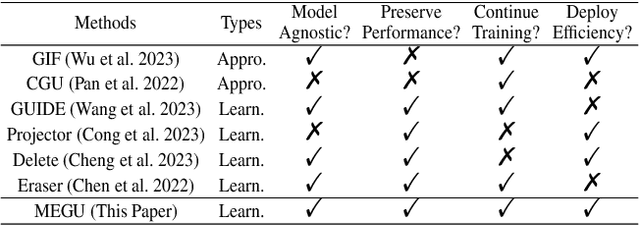
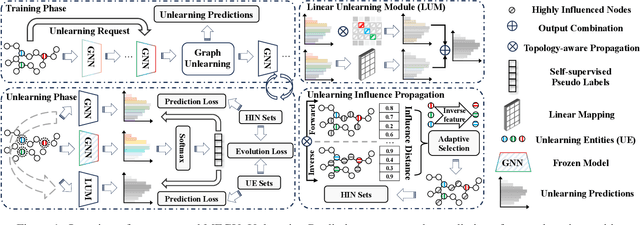
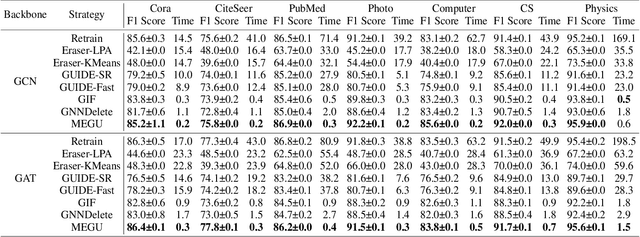
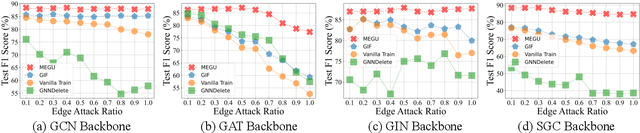
With the rapid advancement of AI applications, the growing needs for data privacy and model robustness have highlighted the importance of machine unlearning, especially in thriving graph-based scenarios. However, most existing graph unlearning strategies primarily rely on well-designed architectures or manual process, rendering them less user-friendly and posing challenges in terms of deployment efficiency. Furthermore, striking a balance between unlearning performance and framework generalization is also a pivotal concern. To address the above issues, we propose \underline{\textbf{M}}utual \underline{\textbf{E}}volution \underline{\textbf{G}}raph \underline{\textbf{U}}nlearning (MEGU), a new mutual evolution paradigm that simultaneously evolves the predictive and unlearning capacities of graph unlearning. By incorporating aforementioned two components, MEGU ensures complementary optimization in a unified training framework that aligns with the prediction and unlearning requirements. Extensive experiments on 9 graph benchmark datasets demonstrate the superior performance of MEGU in addressing unlearning requirements at the feature, node, and edge levels. Specifically, MEGU achieves average performance improvements of 2.7\%, 2.5\%, and 3.2\% across these three levels of unlearning tasks when compared to state-of-the-art baselines. Furthermore, MEGU exhibits satisfactory training efficiency, reducing time and space overhead by an average of 159.8x and 9.6x, respectively, in comparison to retraining GNN from scratch.
Efficient Training of the Memristive Deep Belief Net Immune to Non-Idealities of the Synaptic Devices
Mar 15, 2022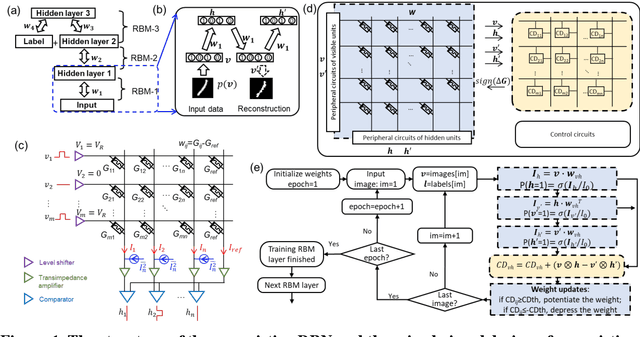
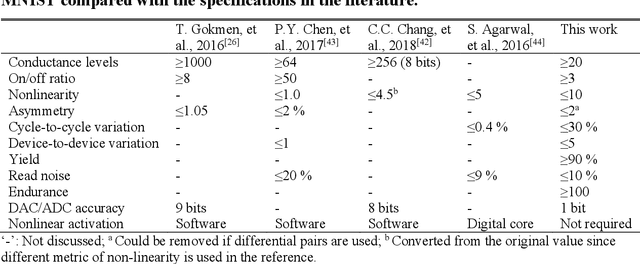
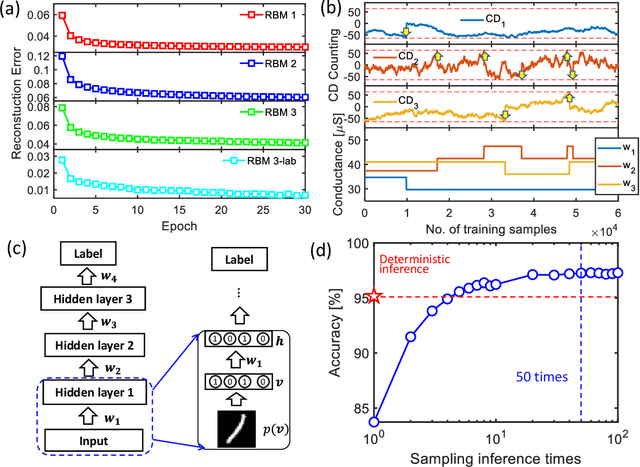
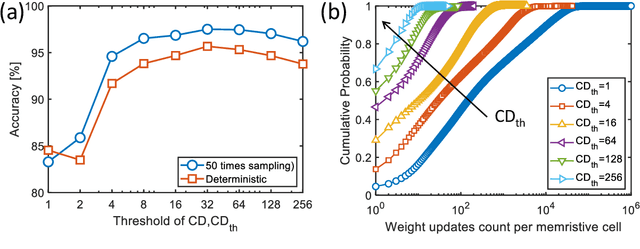
The tunability of conductance states of various emerging non-volatile memristive devices emulates the plasticity of biological synapses, making it promising in the hardware realization of large-scale neuromorphic systems. The inference of the neural network can be greatly accelerated by the vector-matrix multiplication (VMM) performed within a crossbar array of memristive devices in one step. Nevertheless, the implementation of the VMM needs complex peripheral circuits and the complexity further increases since non-idealities of memristive devices prevent precise conductance tuning (especially for the online training) and largely degrade the performance of the deep neural networks (DNNs). Here, we present an efficient online training method of the memristive deep belief net (DBN). The proposed memristive DBN uses stochastically binarized activations, reducing the complexity of peripheral circuits, and uses the contrastive divergence (CD) based gradient descent learning algorithm. The analog VMM and digital CD are performed separately in a mixed-signal hardware arrangement, making the memristive DBN high immune to non-idealities of synaptic devices. The number of write operations on memristive devices is reduced by two orders of magnitude. The recognition accuracy of 95%~97% can be achieved for the MNIST dataset using pulsed synaptic behaviors of various memristive synaptic devices.