 Add to Chrome
 Add to Firefox
 Add to Edge
Kimi K3: Open Frontier Intelligence
Jul 27, 2026
We introduce Kimi K3, a 2.8T parameter Mixture-of-Experts model with 104 billion activated parameters, native vision capabilities, and a 1-million-token context window. Kimi K3 is built on Kimi Delta Attention and Attention Residuals, which improve information flow across sequence length and model depth. Together with Stable LatentMoE, which effectively activates 16 of 896 routed experts per token, and refined training and data recipes, these advances yield an approximately 2.5x improvement in overall scaling efficiency over Kimi K2. Post-training highlights reinforcement learning across general, agentic, and coding domains and multiple reasoning-effort levels, enabling compositional generalization and robust long-horizon execution. At 2.8T scale, Kimi K3 is supported by infrastructure advances in multiple areas: algorithm-system co-design for KDA, perfectly balanced expert-parallel training with efficient memory management, million-token agentic RL with persistent rollout and sandbox states, and deployment innovations. Extensive evaluations show that Kimi K3 achieves frontier-level performance across long-horizon coding, agentic, knowledge, reasoning, and vision tasks. While its overall performance still trails the most powerful proprietary models, namely Claude Fable 5 and GPT-5.6 Sol, Kimi K3 consistently outperforms other open and proprietary models evaluated in our suite. We release the full Kimi K3 model weights to facilitate future research and accelerate the broader deployment and adoption of frontier intelligence.

ReLoop: Structured Modeling and Behavioral Verification for Reliable LLM-Based Optimization
Feb 17, 2026Large language models (LLMs) can translate natural language into optimization code, but silent failures pose a critical risk: code that executes and returns solver-feasible solutions may encode semantically incorrect formulations, creating a feasibility-correctness gap of up to 90 percentage points on compositional problems. We introduce ReLoop, addressing silent failures from two complementary directions. Structured generation decomposes code production into a four-stage reasoning chain (understand, formalize, synthesize, verify) that mirrors expert modeling practice, with explicit variable-type reasoning and self-verification to prevent formulation errors at their source. Behavioral verification detects errors that survive generation by testing whether the formulation responds correctly to solver-based parameter perturbation, without requiring ground truth -- an external semantic signal that bypasses the self-consistency problem inherent in LLM-based code review. The two mechanisms are complementary: structured generation dominates on complex compositional problems, while behavioral verification becomes the largest single contributor on problems with localized formulation defects. Together with execution recovery via IIS-enhanced diagnostics, ReLoop raises correctness from 22.6% to 31.1% and execution from 72.1% to 100.0% on the strongest model, with consistent gains across five models spanning three paradigms (foundation, SFT, RL) and three benchmarks. We additionally release RetailOpt-190, 190 compositional retail optimization scenarios targeting the multi-constraint interactions where LLMs most frequently fail.
TwistNet-2D: Learning Second-Order Channel Interactions via Spiral Twisting for Texture Recognition
Feb 06, 2026Second-order feature statistics are central to texture recognition, yet current methods face a fundamental tension: bilinear pooling and Gram matrices capture global channel correlations but collapse spatial structure, while self-attention models spatial context through weighted aggregation rather than explicit pairwise feature interactions. We introduce TwistNet-2D, a lightweight module that computes \emph{local} pairwise channel products under directional spatial displacement, jointly encoding where features co-occur and how they interact. The core component, Spiral-Twisted Channel Interaction (STCI), shifts one feature map along a prescribed direction before element-wise channel multiplication, thereby capturing the cross-position co-occurrence patterns characteristic of structured and periodic textures. Aggregating four directional heads with learned channel reweighting and injecting the result through a sigmoid-gated residual path, \TwistNet incurs only 3.5% additional parameters and 2% additional FLOPs over ResNet-18, yet consistently surpasses both parameter-matched and substantially larger baselines -- including ConvNeXt, Swin Transformer, and hybrid CNN--Transformer architectures -- across four texture and fine-grained recognition benchmarks.
CIP: A Plug-and-Play Causal Prompting Framework for Mitigating Hallucinations under Long-Context Noise
Dec 12, 2025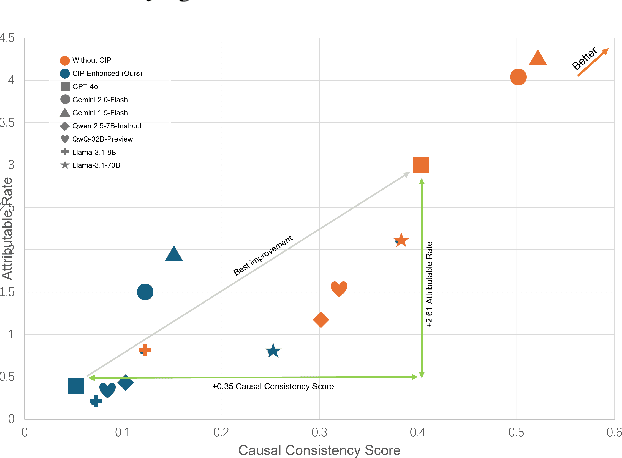
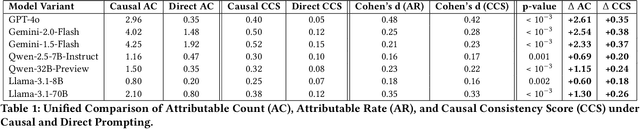
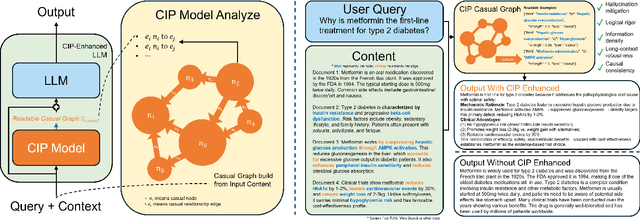
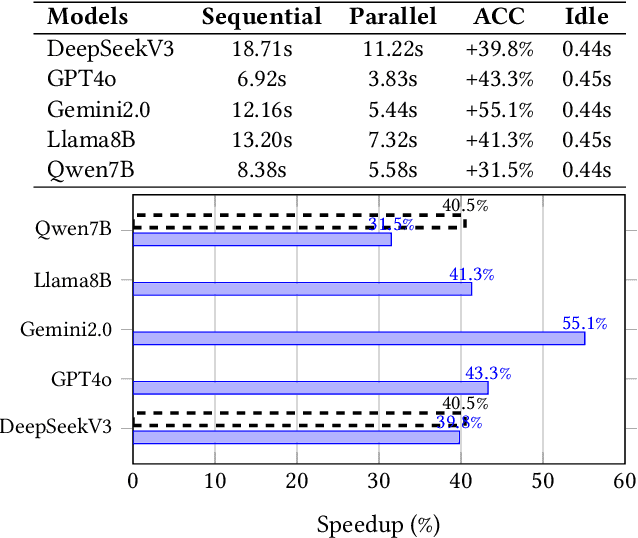
Large language models often hallucinate when processing long and noisy retrieval contexts because they rely on spurious correlations rather than genuine causal relationships. We propose CIP, a lightweight and plug-and-play causal prompting framework that mitigates hallucinations at the input stage. CIP constructs a causal relation sequence among entities, actions, and events and injects it into the prompt to guide reasoning toward causally relevant evidence. Through causal intervention and counterfactual reasoning, CIP suppresses non causal reasoning paths, improving factual grounding and interpretability. Experiments across seven mainstream language models, including GPT-4o, Gemini 2.0 Flash, and Llama 3.1, show that CIP consistently enhances reasoning quality and reliability, achieving 2.6 points improvement in Attributable Rate, 0.38 improvement in Causal Consistency Score, and a fourfold increase in effective information density. API level profiling further shows that CIP accelerates contextual understanding and reduces end to end response latency by up to 55.1 percent. These results suggest that causal reasoning may serve as a promising paradigm for improving the explainability, stability, and efficiency of large language models.