 Add to Chrome
 Add to Firefox
 Add to Edge
S$^3$-Attention:Attention-Aligned Endogenous Retrieval for Memory-Bounded Long-Context Inference
Jan 25, 2026
Large language models are increasingly applied to multi-document and long-form inputs, yet long-context inference remains memory- and noise-inefficient. Key-value (KV) caching scales linearly with context length, while external retrieval methods often return lexically similar but causally irrelevant passages. We present S3-Attention, a memory-first inference-time framework that treats long-context processing as attention-aligned endogenous retrieval. S3-Attention decodes transient key and query projections into top-k sparse feature identifiers using lightweight sparse autoencoders, and constructs a CPU-based inverted index mapping features to token positions or spans during a single streaming scan. This design allows the KV cache to be discarded entirely and bounds GPU memory usage by the scan chunk size. At generation time, feature co-activation is used to retrieve compact evidence spans, optionally fused with BM25 for exact lexical matching. Under a unified LongBench evaluation protocol with fixed prompting, decoding, and matched token budgets, S3-Hybrid closely matches full-context inference across multiple model families and improves robustness in several information-dense settings. We also report an engineering limitation of the current prototype, which incurs higher wall-clock latency than optimized full-KV baselines, motivating future kernel-level optimization.

Interpretable Safety Alignment via SAE-Constructed Low-Rank Subspace Adaptation
Dec 29, 2025Parameter-efficient fine-tuning has become the dominant paradigm for adapting large language models to downstream tasks. Low-rank adaptation methods such as LoRA operate under the assumption that task-relevant weight updates reside in a low-rank subspace, yet this subspace is learned implicitly from data in a black-box manner, offering no interpretability or direct control. We hypothesize that this difficulty stems from polysemanticity--individual dimensions encoding multiple entangled concepts. To address this, we leverage pre-trained Sparse Autoencoders (SAEs) to identify task-relevant features in a disentangled feature space, then construct an explicit, interpretable low-rank subspace to guide adapter initialization. We provide theoretical analysis proving that under monosemanticity assumptions, SAE-based subspace identification achieves arbitrarily small recovery error, while direct identification in polysemantic space suffers an irreducible error floor. On safety alignment, our method achieves up to 99.6% safety rate--exceeding full fine-tuning by 7.4 percentage points and approaching RLHF-based methods--while updating only 0.19-0.24% of parameters. Crucially, our method provides interpretable insights into the learned alignment subspace through the semantic grounding of SAE features. Our work demonstrates that incorporating mechanistic interpretability into the fine-tuning process can simultaneously improve both performance and transparency.
CIP: A Plug-and-Play Causal Prompting Framework for Mitigating Hallucinations under Long-Context Noise
Dec 12, 2025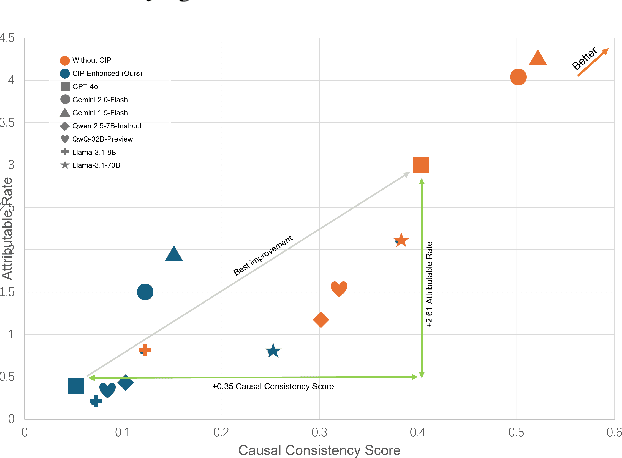
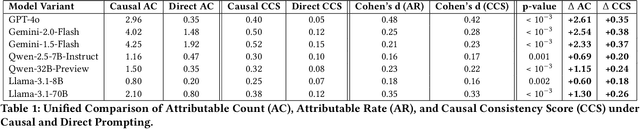
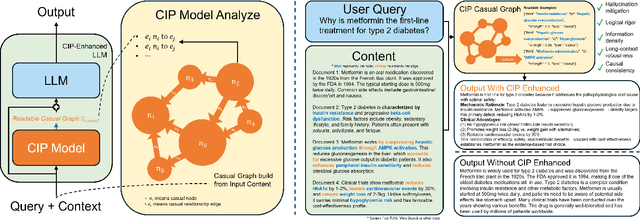
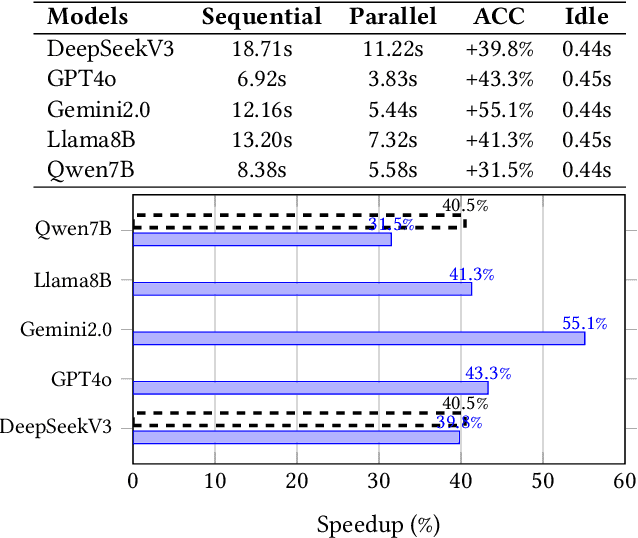
Large language models often hallucinate when processing long and noisy retrieval contexts because they rely on spurious correlations rather than genuine causal relationships. We propose CIP, a lightweight and plug-and-play causal prompting framework that mitigates hallucinations at the input stage. CIP constructs a causal relation sequence among entities, actions, and events and injects it into the prompt to guide reasoning toward causally relevant evidence. Through causal intervention and counterfactual reasoning, CIP suppresses non causal reasoning paths, improving factual grounding and interpretability. Experiments across seven mainstream language models, including GPT-4o, Gemini 2.0 Flash, and Llama 3.1, show that CIP consistently enhances reasoning quality and reliability, achieving 2.6 points improvement in Attributable Rate, 0.38 improvement in Causal Consistency Score, and a fourfold increase in effective information density. API level profiling further shows that CIP accelerates contextual understanding and reduces end to end response latency by up to 55.1 percent. These results suggest that causal reasoning may serve as a promising paradigm for improving the explainability, stability, and efficiency of large language models.
Unlocking the Address Book: Dissecting the Sparse Semantic Structure of LLM Key-Value Caches via Sparse Autoencoders
Dec 11, 2025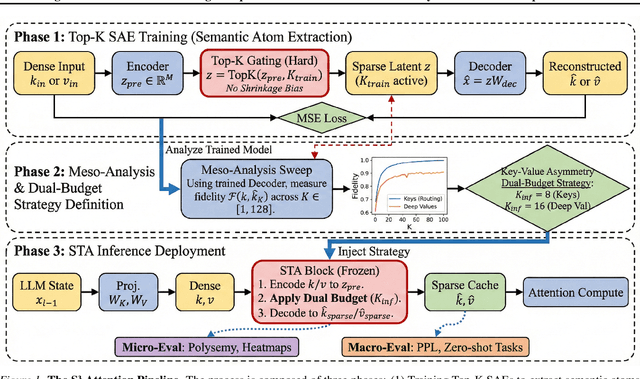
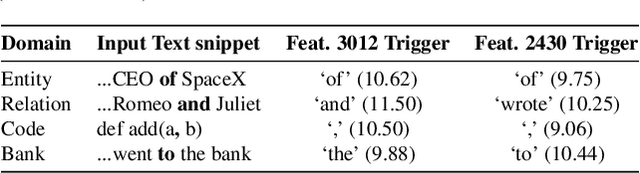
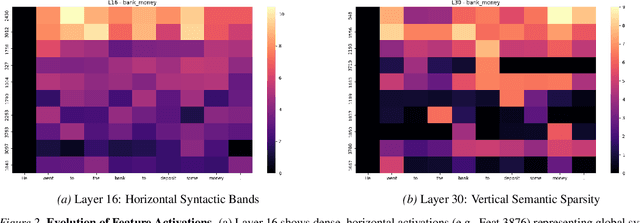
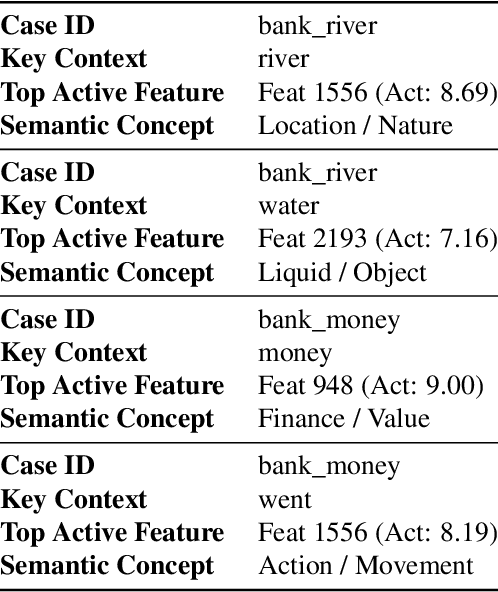
The Key-Value (KV) cache is the primary memory bottleneck in long-context Large Language Models, yet it is typically treated as an opaque numerical tensor. In this work, we propose \textbf{STA-Attention}, a framework that utilizes Top-K Sparse Autoencoders (SAEs) to decompose the KV cache into interpretable ``semantic atoms.'' Unlike standard $L_1$-regularized SAEs, our Top-K approach eliminates shrinkage bias, preserving the precise dot-product geometry required for attention. Our analysis uncovers a fundamental \textbf{Key-Value Asymmetry}: while Key vectors serve as highly sparse routers dominated by a ``Semantic Elbow,'' deep Value vectors carry dense content payloads requiring a larger budget. Based on this structure, we introduce a Dual-Budget Strategy that selectively preserves the most informative semantic components while filtering representational noise. Experiments on Yi-6B, Mistral-7B, Qwen2.5-32B, and others show that our semantic reconstructions maintain perplexity and zero-shot performance comparable to the original models, effectively bridging the gap between mechanistic interpretability and faithful attention modeling.
Beyond Darkness: Thermal-Supervised 3D Gaussian Splatting for Low-Light Novel View Synthesis
Nov 17, 2025Under extremely low-light conditions, novel view synthesis (NVS) faces severe degradation in terms of geometry, color consistency, and radiometric stability. Standard 3D Gaussian Splatting (3DGS) pipelines fail when applied directly to underexposed inputs, as independent enhancement across views causes illumination inconsistencies and geometric distortion. To address this, we present DTGS, a unified framework that tightly couples Retinex-inspired illumination decomposition with thermal-guided 3D Gaussian Splatting for illumination-invariant reconstruction. Unlike prior approaches that treat enhancement as a pre-processing step, DTGS performs joint optimization across enhancement, geometry, and thermal supervision through a cyclic enhancement-reconstruction mechanism. A thermal supervisory branch stabilizes both color restoration and geometry learning by dynamically balancing enhancement, structural, and thermal losses. Moreover, a Retinex-based decomposition module embedded within the 3DGS loop provides physically interpretable reflectance-illumination separation, ensuring consistent color and texture across viewpoints. To evaluate our method, we construct RGBT-LOW, a new multi-view low-light thermal dataset capturing severe illumination degradation. Extensive experiments show that DTGS significantly outperforms existing low-light enhancement and 3D reconstruction baselines, achieving superior radiometric consistency, geometric fidelity, and color stability under extreme illumination.