 Add to Chrome
 Add to Firefox
 Add to Edge
Unleashing the Potential of Sparse Attention on Long-term Behaviors for CTR Prediction
Jan 25, 2026
In recent years, the success of large language models (LLMs) has driven the exploration of scaling laws in recommender systems. However, models that demonstrate scaling laws are actually challenging to deploy in industrial settings for modeling long sequences of user behaviors, due to the high computational complexity of the standard self-attention mechanism. Despite various sparse self-attention mechanisms proposed in other fields, they are not fully suited for recommendation scenarios. This is because user behaviors exhibit personalization and temporal characteristics: different users have distinct behavior patterns, and these patterns change over time, with data from these users differing significantly from data in other fields in terms of distribution. To address these challenges, we propose SparseCTR, an efficient and effective model specifically designed for long-term behaviors of users. To be precise, we first segment behavior sequences into chunks in a personalized manner to avoid separating continuous behaviors and enable parallel processing of sequences. Based on these chunks, we propose a three-branch sparse self-attention mechanism to jointly identify users' global interests, interest transitions, and short-term interests. Furthermore, we design a composite relative temporal encoding via learnable, head-specific bias coefficients, better capturing sequential and periodic relationships among user behaviors. Extensive experimental results show that SparseCTR not only improves efficiency but also outperforms state-of-the-art methods. More importantly, it exhibits an obvious scaling law phenomenon, maintaining performance improvements across three orders of magnitude in FLOPs. In online A/B testing, SparseCTR increased CTR by 1.72\% and CPM by 1.41\%. Our source code is available at https://github.com/laiweijiang/SparseCTR.

Prove Your Point!: Bringing Proof-Enhancement Principles to Argumentative Essay Generation
Oct 30, 2024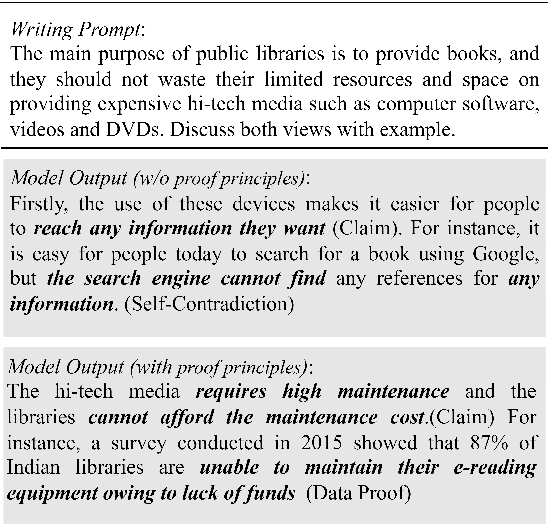
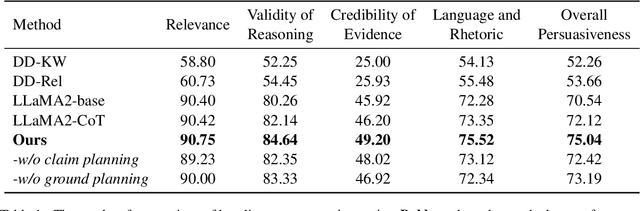
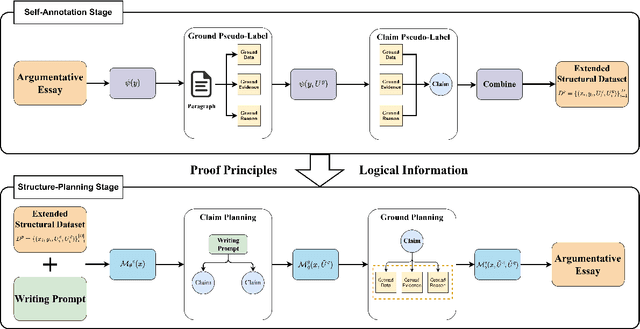
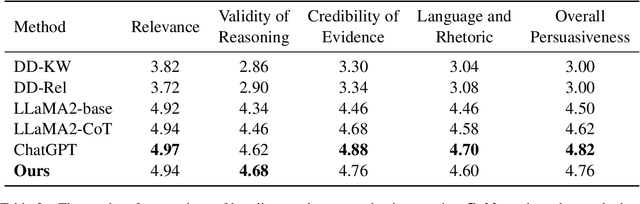
Argumentative essay generation (AEG) aims to generate complete texts on specific controversial topics or debates. Although current AEG methods can generate individual opinions, they often overlook the high-level connections between these opinions. This often leads to the generated results being mired in logical confusion, unable to proof their own arguments effectively. The generated essay may present evidence that contradicts the claims or they may fail to assemble the claims into logical flow. In this paper, we present a unified two-stage framework: Proof-Enhancement and Self-Annotation (PESA) for AEG with a focus on logical enhancement. Specifically, we first construct pseudo-labels for logical information,claims and grounds, using a large language model. We then propose a tree planning approach that introduces proof principles and ensures logical consistency. Extensive experimental results show that, benefiting from proof principle guidance, PESA generates argumentative essays with better logical validity and persuasiveness than strong baseline models.