 Add to Chrome
 Add to Firefox
 Add to Edge
When Prompts Become Pixels: Prompt-Region Grounding for Multimodal Reasoning
Aug 05, 2026
Multimodal large language models increasingly reason over screenshots and documents where the task itself may be written in pixels. Yet benchmarks usually place questions in text, leaving it unclear whether models use the same instruction equally well across channels. We introduce Visualized Task Semantics (VTS), a controlled intervention that moves the question into the image while keeping the source problem and answer fixed. Across six MLLMs and four benchmarks, accuracy drops in all 24 model-task pairs, by 17.8 points on average. Models often transcribe the visual question correctly yet fail to use it, exposing a semantic channel gap beyond OCR. To reduce this gap, we present prompt-region grounding, whose core design aligns the question region with typed semantics and recovers its clean representation from a masked view. At matched training cost, our method raises four-benchmark VTS accuracy from 58.0 to 66.3 while preserving accuracy on the original interface, and requires no OCR or region metadata at inference. Reading task-bearing text and grounding it as an instruction for reasoning are distinct capabilities.

SeePhys Pro: Diagnosing Modality Transfer and Blind-Training Effects in Multimodal RLVR for Physics Reasoning
May 10, 2026We introduce SeePhys Pro, a fine-grained modality transfer benchmark that studies whether models preserve the same reasoning capability when critical information is progressively transferred from text to image. Unlike standard vision-essential benchmarks that evaluate a single input form, SeePhys Pro features four semantically aligned variants for each problem with progressively increasing visual elements. Our evaluation shows that current frontier models are far from representation-invariant reasoners: performance degrades on average as information moves from language to diagrams, with visual variable grounding as the most critical bottleneck. Motivated by this inference-time fragility, we further develop large training corpora for multimodal RLVR and use blind training as a diagnostic control, finding that RL with all training images masked can still improve performance on unmasked validation sets. To analyze this effect, text-deletion, image-mask-rate, and format-saturation controls suggest that such gains can arise from residual textual and distributional cues rather than valid visual evidence. Our results highlight the need to evaluate multimodal reasoning not only by final-answer accuracy, but also by robustness under modality transfer and by diagnostics that test whether improvements rely on task-critical visual evidence.
Aligning Perception, Reasoning, Modeling and Interaction: A Survey on Physical AI
Oct 06, 2025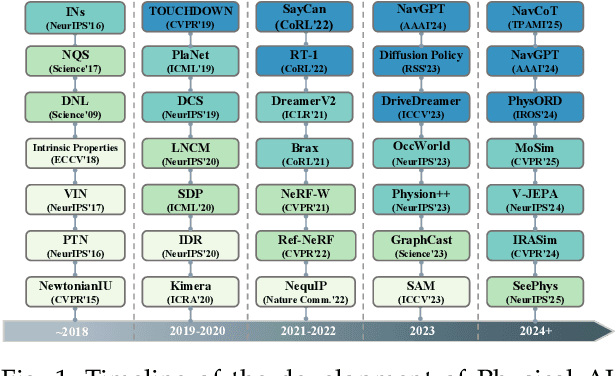
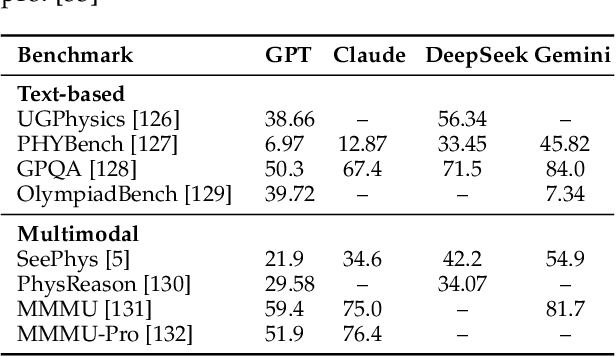
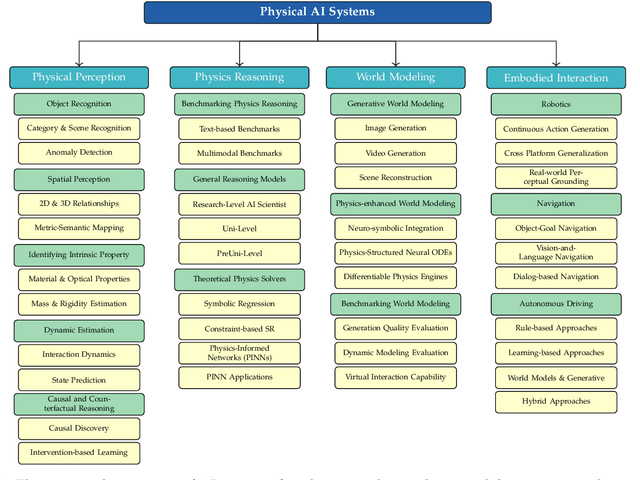
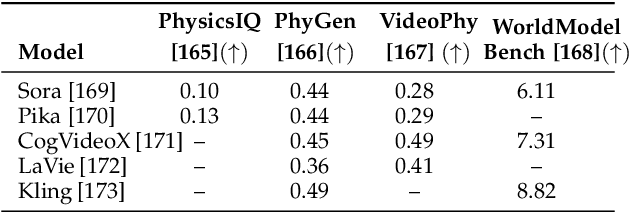
The rapid advancement of embodied intelligence and world models has intensified efforts to integrate physical laws into AI systems, yet physical perception and symbolic physics reasoning have developed along separate trajectories without a unified bridging framework. This work provides a comprehensive overview of physical AI, establishing clear distinctions between theoretical physics reasoning and applied physical understanding while systematically examining how physics-grounded methods enhance AI's real-world comprehension across structured symbolic reasoning, embodied systems, and generative models. Through rigorous analysis of recent advances, we advocate for intelligent systems that ground learning in both physical principles and embodied reasoning processes, transcending pattern recognition toward genuine understanding of physical laws. Our synthesis envisions next-generation world models capable of explaining physical phenomena and predicting future states, advancing safe, generalizable, and interpretable AI systems. We maintain a continuously updated resource at https://github.com/AI4Phys/Awesome-AI-for-Physics.