 Add to Chrome
 Add to Firefox
 Add to Edge
From Pixels to Digital Agents: An Empirical Study on the Taxonomy and Technological Trends of Reinforcement Learning Environments
Mar 25, 2026
The remarkable progress of reinforcement learning (RL) is intrinsically tied to the environments used to train and evaluate artificial agents. Moving beyond traditional qualitative reviews, this work presents a large-scale, data-driven empirical investigation into the evolution of RL environments. By programmatically processing a massive corpus of academic literature and rigorously distilling over 2,000 core publications, we propose a quantitative methodology to map the transition from isolated physical simulations to generalist, language-driven foundation agents. Implementing a novel, multi-dimensional taxonomy, we systematically analyze benchmarks against diverse application domains and requisite cognitive capabilities. Our automated semantic and statistical analysis reveals a profound, data-verified paradigm shift: the bifurcation of the field into a "Semantic Prior" ecosystem dominated by Large Language Models (LLMs) and a "Domain-Specific Generalization" ecosystem. Furthermore, we characterize the "cognitive fingerprints" of these distinct domains to uncover the underlying mechanisms of cross-task synergy, multi-domain interference, and zero-shot generalization. Ultimately, this study offers a rigorous, quantitative roadmap for designing the next generation of Embodied Semantic Simulators, bridging the gap between continuous physical control and high-level logical reasoning.

Aligning Perception, Reasoning, Modeling and Interaction: A Survey on Physical AI
Oct 06, 2025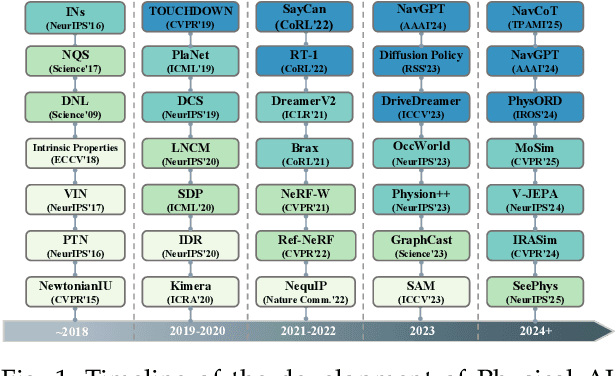
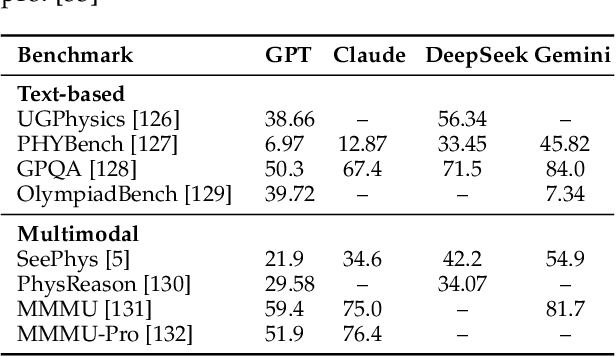
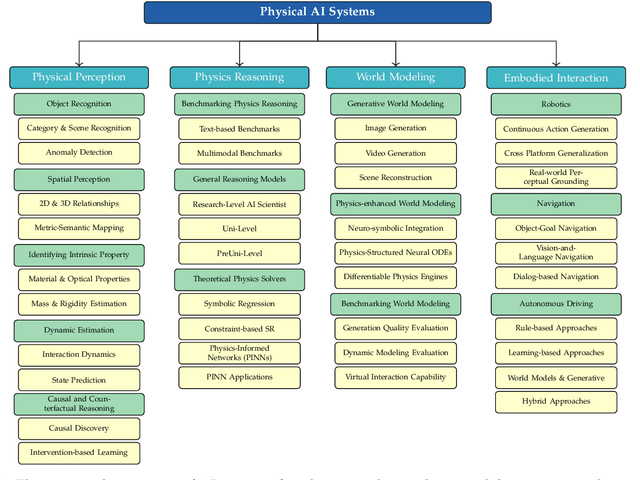
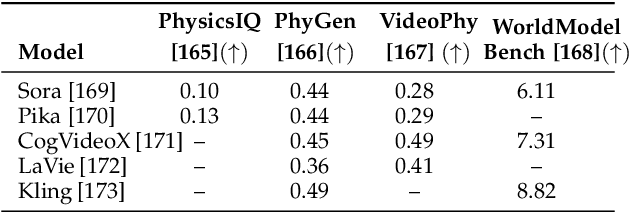
The rapid advancement of embodied intelligence and world models has intensified efforts to integrate physical laws into AI systems, yet physical perception and symbolic physics reasoning have developed along separate trajectories without a unified bridging framework. This work provides a comprehensive overview of physical AI, establishing clear distinctions between theoretical physics reasoning and applied physical understanding while systematically examining how physics-grounded methods enhance AI's real-world comprehension across structured symbolic reasoning, embodied systems, and generative models. Through rigorous analysis of recent advances, we advocate for intelligent systems that ground learning in both physical principles and embodied reasoning processes, transcending pattern recognition toward genuine understanding of physical laws. Our synthesis envisions next-generation world models capable of explaining physical phenomena and predicting future states, advancing safe, generalizable, and interpretable AI systems. We maintain a continuously updated resource at https://github.com/AI4Phys/Awesome-AI-for-Physics.