 Add to Chrome
 Add to Firefox
 Add to Edge
Sparse Hypergraph-Enhanced Frame-Event Object Detection with Fine-Grained MoE
Apr 13, 2026
Integrating frame-based RGB cameras with event streams offers a promising solution for robust object detection under challenging dynamic conditions. However, the inherent heterogeneity and data redundancy of these modalities often lead to prohibitive computational overhead or suboptimal feature fusion. In this paper, we propose Hyper-FEOD, a high-performance and efficient detection framework, which synergistically optimizes multi-modal interaction through two core components. First, we introduce Sparse Hypergraph-enhanced Cross-Modal Fusion (S-HCF), which leverages the inherent sparsity of event streams to construct an event-guided activity map. By performing high-order hypergraph modeling exclusively on selected motion-critical sparse tokens, S-HCF captures complex non-local dependencies between RGB and event data while overcoming the traditional complexity bottlenecks of hypergraph computation. Second, we design a Fine-Grained Mixture of Experts (FG-MoE) Enhancement module to address the diverse semantic requirements of different image regions. This module employs specialized hypergraph experts tailored for object boundaries, internal textures, and backgrounds, utilizing a pixel-level spatial gating mechanism to adaptively route and enhance features. Combined with a load-balancing loss and zero-initialization strategy, FG-MoE ensures stable training and precise feature refinement without disrupting the pre-trained backbone's distribution. Experimental results on mainstream RGB-Event benchmarks demonstrate that Hyper-FEOD achieves a superior accuracy-efficiency trade-off, outperforming state-of-the-art methods while maintaining a lightweight footprint suitable for real-time edge deployment.

Omni-Line-of-Sight Imaging for Holistic Shape Reconstruction
Apr 21, 2023

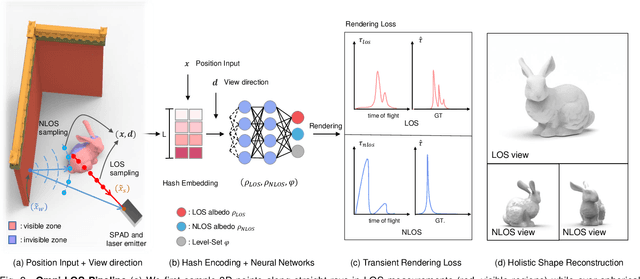

We introduce Omni-LOS, a neural computational imaging method for conducting holistic shape reconstruction (HSR) of complex objects utilizing a Single-Photon Avalanche Diode (SPAD)-based time-of-flight sensor. As illustrated in Fig. 1, our method enables new capabilities to reconstruct near-$360^\circ$ surrounding geometry of an object from a single scan spot. In such a scenario, traditional line-of-sight (LOS) imaging methods only see the front part of the object and typically fail to recover the occluded back regions. Inspired by recent advances of non-line-of-sight (NLOS) imaging techniques which have demonstrated great power to reconstruct occluded objects, Omni-LOS marries LOS and NLOS together, leveraging their complementary advantages to jointly recover the holistic shape of the object from a single scan position. The core of our method is to put the object nearby diffuse walls and augment the LOS scan in the front view with the NLOS scans from the surrounding walls, which serve as virtual ``mirrors'' to trap lights toward the object. Instead of separately recovering the LOS and NLOS signals, we adopt an implicit neural network to represent the object, analogous to NeRF and NeTF. While transients are measured along straight rays in LOS but over the spherical wavefronts in NLOS, we derive differentiable ray propagation models to simultaneously model both types of transient measurements so that the NLOS reconstruction also takes into account the direct LOS measurements and vice versa. We further develop a proof-of-concept Omni-LOS hardware prototype for real-world validation. Comprehensive experiments on various wall settings demonstrate that Omni-LOS successfully resolves shape ambiguities caused by occlusions, achieves high-fidelity 3D scan quality, and manages to recover objects of various scales and complexity.
High-resolution tomographic reconstruction of optical absorbance through scattering media using neural fields
Apr 04, 2023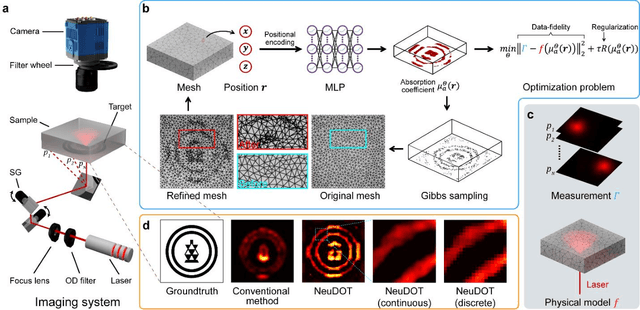
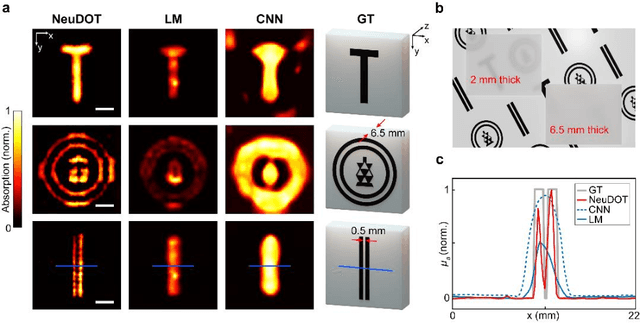
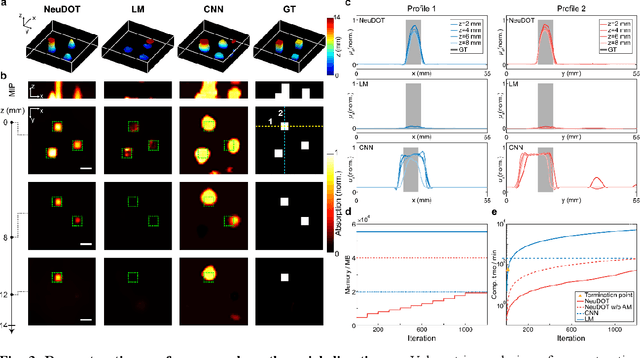
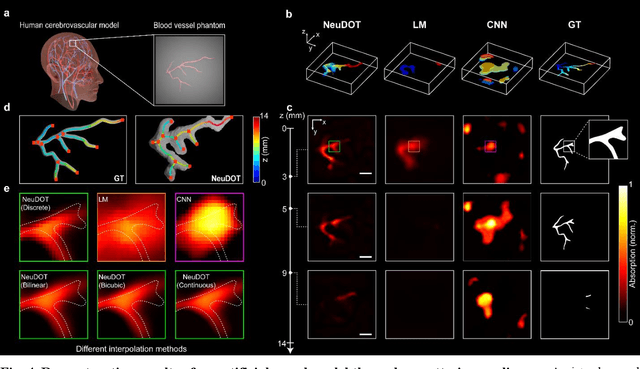
Light scattering imposes a major obstacle for imaging objects seated deeply in turbid media, such as biological tissues and foggy air. Diffuse optical tomography (DOT) tackles scattering by volumetrically recovering the optical absorbance and has shown significance in medical imaging, remote sensing and autonomous driving. A conventional DOT reconstruction paradigm necessitates discretizing the object volume into voxels at a pre-determined resolution for modelling diffuse light propagation and the resulting spatial resolution of the reconstruction is generally limited. We propose NeuDOT, a novel DOT scheme based on neural fields (NF) to continuously encode the optical absorbance within the volume and subsequently bridge the gap between model accuracy and high resolution. Comprehensive experiments demonstrate that NeuDOT achieves submillimetre lateral resolution and resolves complex 3D objects at 14 mm-depth, outperforming the state-of-the-art methods. NeuDOT is a non-invasive, high-resolution and computationally efficient tomographic method, and unlocks further applications of NF involving light scattering.