 Add to Chrome
 Add to Firefox
 Add to Edge
UniVTAC: A Unified Simulation Platform for Visuo-Tactile Manipulation Data Generation, Learning, and Benchmarking
Feb 10, 2026
Robotic manipulation has seen rapid progress with vision-language-action (VLA) policies. However, visuo-tactile perception is critical for contact-rich manipulation, as tasks such as insertion are difficult to complete robustly using vision alone. At the same time, acquiring large-scale and reliable tactile data in the physical world remains costly and challenging, and the lack of a unified evaluation platform further limits policy learning and systematic analysis. To address these challenges, we propose UniVTAC, a simulation-based visuo-tactile data synthesis platform that supports three commonly used visuo-tactile sensors and enables scalable and controllable generation of informative contact interactions. Based on this platform, we introduce the UniVTAC Encoder, a visuo-tactile encoder trained on large-scale simulation-synthesized data with designed supervisory signals, providing tactile-centric visuo-tactile representations for downstream manipulation tasks. In addition, we present the UniVTAC Benchmark, which consists of eight representative visuo-tactile manipulation tasks for evaluating tactile-driven policies. Experimental results show that integrating the UniVTAC Encoder improves average success rates by 17.1% on the UniVTAC Benchmark, while real-world robotic experiments further demonstrate a 25% improvement in task success. Our webpage is available at https://univtac.github.io/.

Exploring the impact of weather on Metro demand forecasting using machine learning method
Oct 24, 2022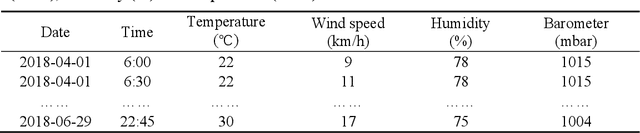

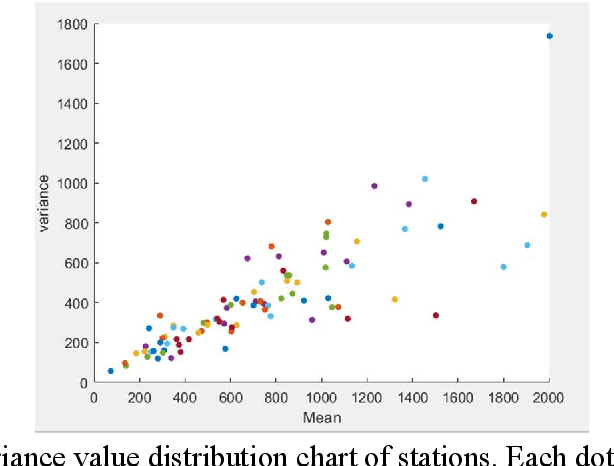
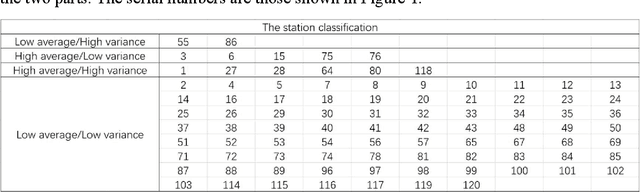
Urban rail transit provides significant comprehensive benefits such as large traffic volume and high speed, serving as one of the most important components of urban traffic construction management and congestion solution. Using real passenger flow data of an Asian subway system from April to June of 2018, this work analyzes the space-time distribution of the passenger flow using short-term traffic flow prediction. Stations are divided into four types for passenger flow forecasting, and meteorological records are collected for the same period. Then, machine learning methods with different inputs are applied and multivariate regression is performed to evaluate the improvement effect of each weather element on passenger flow forecasting of representative metro stations on hourly basis. Our results show that by inputting weather variables the precision of prediction on weekends enhanced while the performance on weekdays only improved marginally, while the contribution of different elements of weather differ. Also, different categories of stations are affected differently by weather. This study provides a possible method to further improve other prediction models, and attests to the promise of data-driven analytics for optimization of short-term scheduling in transit management.