 Add to Chrome
 Add to Firefox
 Add to Edge
Rethinking the Diffusion Model from a Langevin Perspective
Apr 12, 2026
Diffusion models are often introduced from multiple perspectives, such as VAEs, score matching, or flow matching, accompanied by dense and technically demanding mathematics that can be difficult for beginners to grasp. One classic question is: how does the reverse process invert the forward process to generate data from pure noise? This article systematically organizes the diffusion model from a fresh Langevin perspective, offering a simpler, clearer, and more intuitive answer. We also address the following questions: how can ODE-based and SDE-based diffusion models be unified under a single framework? Why are diffusion models theoretically superior to ordinary VAEs? Why is flow matching not fundamentally simpler than denoising or score matching, but equivalent under maximum-likelihood? We demonstrate that the Langevin perspective offers clear and straightforward answers to these questions, bridging existing interpretations of diffusion models, showing how different formulations can be converted into one another within a common framework, and offering pedagogical value for both learners and experienced researchers seeking deeper intuition.

TextBoost: Boosting Scene Text Fidelity in Ultra-low Bitrate Image Compression
Mar 04, 2026Ultra-low bitrate image compression faces a critical challenge: preserving small-font scene text while maintaining overall visual quality. Region-of-interest (ROI) bit allocation can prioritize text but often degrades global fidelity, leading to a trade-off between local accuracy and overall image quality. Instead of relying on ROI coding, we incorporate auxiliary textual information extracted by OCR and transmitted with negligible overhead, enabling the decoder to leverage this semantic guidance. Our method, TextBoost, operationalizes this idea through three strategic designs: (i) adaptively filtering OCR outputs and rendering them into a guidance map; (ii) integrating this guidance with decoder features in a calibrated manner via an attention-guided fusion block; and (iii) enforcing guidance-consistent reconstruction in text regions with a regularizing loss that promotes natural blending with the scene. Extensive experiments on TextOCR and ICDAR 2015 demonstrate that TextBoost yields up to 60.6% higher text-recognition F1 at comparable Peak Signal-to-Noise Ratio (PSNR) and bits per pixel (bpp), producing sharper small-font text while preserving global image quality and effectively decoupling text enhancement from global rate-distortion optimization.
Constructing Industrial-Scale Optimization Modeling Benchmark
Feb 11, 2026Optimization modeling underpins decision-making in logistics, manufacturing, energy, and finance, yet translating natural-language requirements into correct optimization formulations and solver-executable code remains labor-intensive. Although large language models (LLMs) have been explored for this task, evaluation is still dominated by toy-sized or synthetic benchmarks, masking the difficulty of industrial problems with $10^{3}$--$10^{6}$ (or more) variables and constraints. A key bottleneck is the lack of benchmarks that align natural-language specifications with reference formulations/solver code grounded in real optimization models. To fill in this gap, we introduce MIPLIB-NL, built via a structure-aware reverse construction methodology from real mixed-integer linear programs in MIPLIB~2017. Our pipeline (i) recovers compact, reusable model structure from flat solver formulations, (ii) reverse-generates natural-language specifications explicitly tied to this recovered structure under a unified model--data separation format, and (iii) performs iterative semantic validation through expert review and human--LLM interaction with independent reconstruction checks. This yields 223 one-to-one reconstructions that preserve the mathematical content of the original instances while enabling realistic natural-language-to-optimization evaluation. Experiments show substantial performance degradation on MIPLIB-NL for systems that perform strongly on existing benchmarks, exposing failure modes invisible at toy scale.
Lanpaint: Training-Free Diffusion Inpainting with Exact and Fast Conditional Inference
Feb 05, 2025
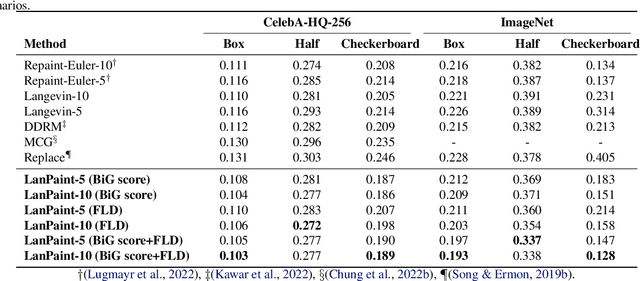

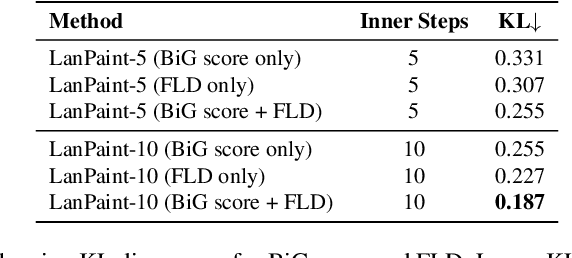
Diffusion models generate high-quality images but often lack efficient and universally applicable inpainting capabilities, particularly in community-trained models. We introduce LanPaint, a training-free method tailored for widely adopted ODE-based samplers, which leverages Langevin dynamics to perform exact conditional inference, enabling precise and visually coherent inpainting. LanPaint addresses two key challenges in Langevin-based inpainting: (1) the risk of local likelihood maxima trapping and (2) slow convergence. By proposing a guided score function and a fast-converging Langevin framework, LanPaint achieves high-fidelity results in very few iterations. Experiments demonstrate that LanPaint outperforms existing training-free inpainting techniques, outperforming in challenging tasks such as outpainting with Stable Diffusion.
Characteristic Guidance: Non-linear Correction for Diffusion Model at Large Guidance Scale
Jan 01, 2024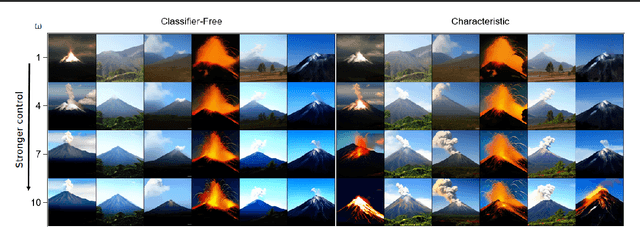
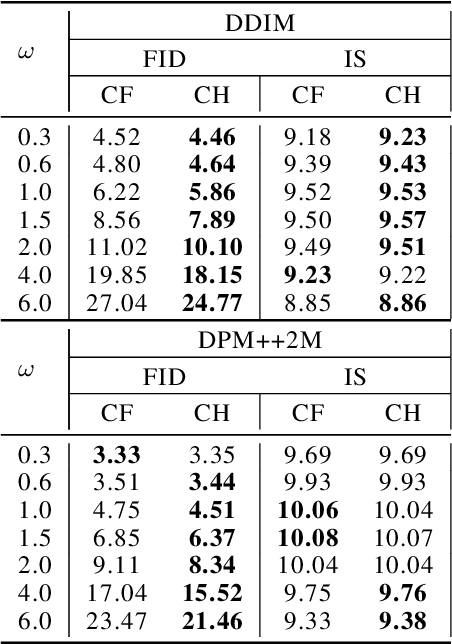
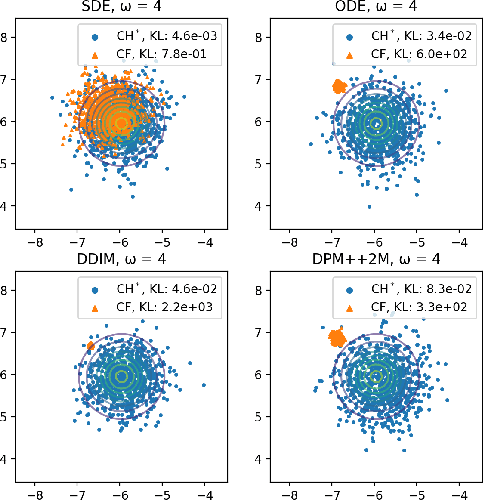
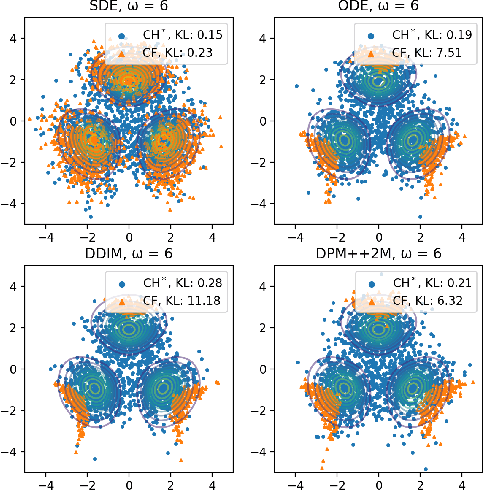
Popular guidance for denoising diffusion probabilistic model (DDPM) linearly combines distinct conditional models together to provide enhanced control over samples. However, this approach overlooks nonlinear effects that become significant when guidance scale is large. To address this issue, we propose characteristic guidance, a sampling method that provides first-principle non-linear correction for classifier-free guided DDPMs. Such correction forces the guided DDPMs to respect the Fokker-Planck equation of their underlying diffusion process, in a way that is training-free, derivative-free, and compatible with existing sampling methods. Experiments show that characteristic guidance enhances control and reduces color and exposure issues in image generation, proving effective in diverse applications ranging from latent space sampling to solving physics problems like magnet phase transitions.
ElasticLaneNet: A Geometry-Flexible Approach for Lane Detection
Dec 16, 2023The task of lane detection involves identifying the boundaries of driving areas. Recognizing lanes with complex and variable geometric structures remains a challenge. In this paper, we introduce a new lane detection framework named ElasticLaneNet (Elastic-interaction-energy guided Lane detection Network). A novel and flexible way of representing lanes, namely, implicit representation is proposed. The training strategy considers predicted lanes as moving curves that being attracted to the ground truth guided by an elastic interaction energy based loss function (EIE loss). An auxiliary feature refinement (AFR) module is designed to gather information from different layers. The method performs well in complex lane scenarios, including those with large curvature, weak geometric features at intersections, complicated cross lanes, Y-shapes lanes, dense lanes, etc. We apply our approach on three datasets: SDLane, CULane, and TuSimple. The results demonstrate the exceptional performance of our method, with the state-of-the-art results on the structure-diversity dataset SDLane, achieving F1-score of 89.51, Recall rate of 87.50, and Precision of 91.61.
Elastic Interaction Energy Loss for Traffic Image Segmentation
Oct 02, 2023Segmentation is a pixel-level classification of images. The accuracy and fast inference speed of image segmentation are crucial for autonomous driving safety. Fine and complex geometric objects are the most difficult but important recognition targets in traffic scene, such as pedestrians, traffic signs and lanes. In this paper, a simple and efficient geometry-sensitive energy-based loss function is proposed to Convolutional Neural Network (CNN) for multi-class segmentation on real-time traffic scene understanding. To be specific, the elastic interaction energy (EIE) between two boundaries will drive the prediction moving toward the ground truth until completely overlap. The EIE loss function is incorporated into CNN to enhance accuracy on fine-scale structure segmentation. In particular, small or irregularly shaped objects can be identified more accurately, and discontinuity issues on slender objects can be improved. Our approach can be applied to different segmentation-based problems, such as urban scene segmentation and lane detection. We quantitatively and qualitatively analyze our method on three traffic datasets, including urban scene data Cityscapes, lane data TuSimple and CULane. The results show that our approach consistently improves performance, especially when using real-time, lightweight networks as the backbones, which is more suitable for autonomous driving.
Energy stable neural network for gradient flow equations
Sep 17, 2023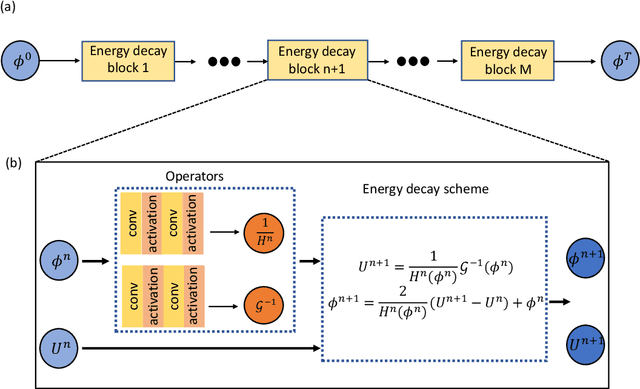
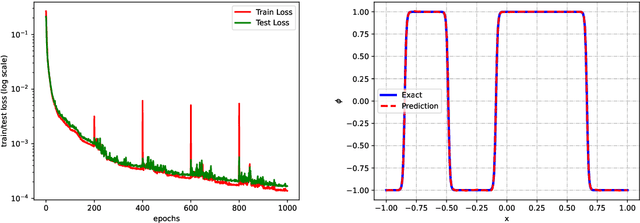
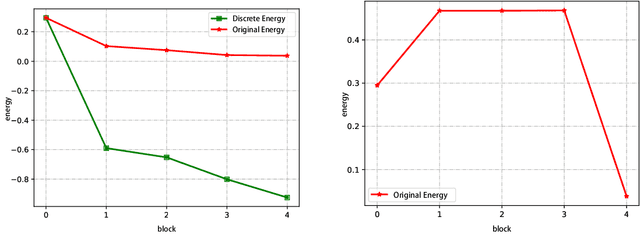
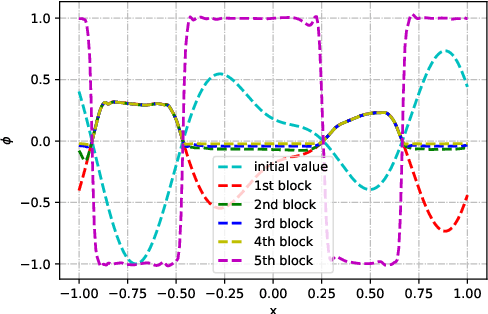
In this paper, we propose an energy stable network (EStable-Net) for solving gradient flow equations. The solution update scheme in our neural network EStable-Net is inspired by a proposed auxiliary variable based equivalent form of the gradient flow equation. EStable-Net enables decreasing of a discrete energy along the neural network, which is consistent with the property in the evolution process of the gradient flow equation. The architecture of the neural network EStable-Net consists of a few energy decay blocks, and the output of each block can be interpreted as an intermediate state of the evolution process of the gradient flow equation. This design provides a stable, efficient and interpretable network structure. Numerical experimental results demonstrate that our network is able to generate high accuracy and stable predictions.
Large Transformers are Better EEG Learners
Aug 20, 2023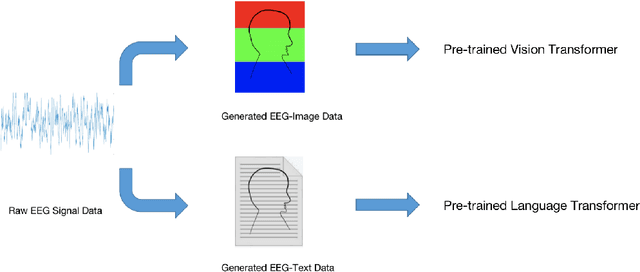
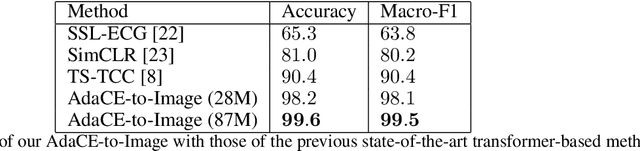
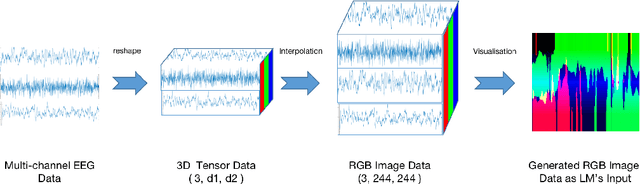
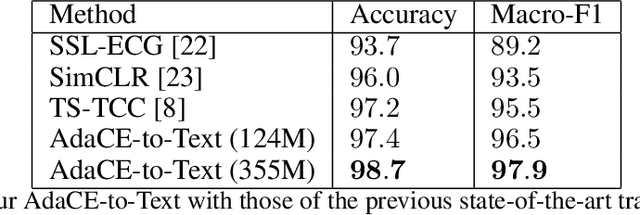
Pre-trained large transformer models have achieved remarkable performance in the fields of natural language processing and computer vision. Since the magnitude of available labeled electroencephalogram (EEG) data is much lower than that of text and image data, it is difficult for transformer models pre-trained from EEG to be developed as large as GPT-4 100T to fully unleash the potential of this architecture. In this paper, we show that transformers pre-trained from images as well as text can be directly fine-tuned for EEG-based prediction tasks. We design AdaCE, plug-and-play Adapters for Converting EEG data into image as well as text forms, to fine-tune pre-trained vision and language transformers. The proposed AdaCE module is highly effective for fine-tuning pre-trained transformers while achieving state-of-the-art performance on diverse EEG-based prediction tasks. For example, AdaCE on the pre-trained Swin-Transformer achieves 99.6%, an absolute improvement of 9.2%, on the EEG-decoding task of human activity recognition (UCI HAR). Furthermore, we empirically show that applying the proposed AdaCE to fine-tune larger pre-trained models can achieve better performance on EEG-based predicting tasks, indicating the potential of our adapters for even larger transformers. The plug-and-play AdaCE module can be applied to fine-tuning most of the popular pre-trained transformers on many other time-series data with multiple channels, not limited to EEG data and the models we use. Our code will be available at https://github.com/wangbxj1234/AdaCE.
DOSnet as a Non-Black-Box PDE Solver: When Deep Learning Meets Operator Splitting
Dec 11, 2022Deep neural networks (DNNs) recently emerged as a promising tool for analyzing and solving complex differential equations arising in science and engineering applications. Alternative to traditional numerical schemes, learning-based solvers utilize the representation power of DNNs to approximate the input-output relations in an automated manner. However, the lack of physics-in-the-loop often makes it difficult to construct a neural network solver that simultaneously achieves high accuracy, low computational burden, and interpretability. In this work, focusing on a class of evolutionary PDEs characterized by having decomposable operators, we show that the classical ``operator splitting'' numerical scheme of solving these equations can be exploited to design neural network architectures. This gives rise to a learning-based PDE solver, which we name Deep Operator-Splitting Network (DOSnet). Such non-black-box network design is constructed from the physical rules and operators governing the underlying dynamics contains learnable parameters, and is thus more flexible than the standard operator splitting scheme. Once trained, it enables the fast solution of the same type of PDEs. To validate the special structure inside DOSnet, we take the linear PDEs as the benchmark and give the mathematical explanation for the weight behavior. Furthermore, to demonstrate the advantages of our new AI-enhanced PDE solver, we train and validate it on several types of operator-decomposable differential equations. We also apply DOSnet to nonlinear Schr\"odinger equations (NLSE) which have important applications in the signal processing for modern optical fiber transmission systems, and experimental results show that our model has better accuracy and lower computational complexity than numerical schemes and the baseline DNNs.