 Add to Chrome
 Add to Firefox
 Add to Edge
SAGA: Scene-Aware, Goal-Evolving Agents for Long-Horizon CivRealm Strategy Planning
Jun 29, 2026
Long-horizon strategic planning in complex strategy games demands concurrent reasoning across multiple decision domains under imperfect information and sparse reward. Existing LLM-based agents suffer from three systematic failures: scene blindness from raw tile coordinates, context overflow and domain coupling from monolithic state dumps, and shallow cross-game learning that treats each episode in isolation. We present SAGA, an LLM multi-agent framework with three mechanisms each directly targeting one class of failure: (i) a Map-Semantic Scene Graph that encodes typed spatial relations among game entities into per-unit natural-language context, resolving spatial blindness without global token inflation; (ii) a Tool-Augmented Planner that pulls fine-grained domain state on demand and dispatches per-domain directives to dedicated specialist controllers, eliminating context overflow, domain coupling, and mechanical constraint violations; and (iii) a Dual-Horizon Feedback Loop that combines periodic within-game goal generation with structured cross-game causal post-mortem, enabling principled strategic evolution without manual reward engineering. Evaluated on FreeCiv, SAGA attains the highest mean civilization score -- the environment's sole sparse objective reward -- with lower variance than the two strongest baselines, and is the only method that significantly surpasses every baseline on infrastructure construction, the resource axis most readily sacrificed under multi-objective conflict. It outscores the two strongest baselines in most head-to-head games while cutting output tokens (the dominant decoding cost) by 27%. Equipped with the cross-game evolution module, SAGA reaches the highest end-of-chain score across five successive episodes. Ablation studies confirm that each architectural component contributes independently to this advantage.

A fast neural hybrid Newton solver adapted to implicit methods for nonlinear dynamics
Jul 04, 2024


The use of implicit time-stepping schemes for the numerical approximation of solutions to stiff nonlinear time-evolution equations brings well-known advantages including, typically, better stability behaviour and corresponding support of larger time steps, and better structure preservation properties. However, this comes at the price of having to solve a nonlinear equation at every time step of the numerical scheme. In this work, we propose a novel operator learning based hybrid Newton's method to accelerate this solution of the nonlinear time step system for stiff time-evolution nonlinear equations. We propose a targeted learning strategy which facilitates robust unsupervised learning in an offline phase and provides a highly efficient initialisation for the Newton iteration leading to consistent acceleration of Newton's method. A quantifiable rate of improvement in Newton's method achieved by improved initialisation is provided and we analyse the upper bound of the generalisation error of our unsupervised learning strategy. These theoretical results are supported by extensive numerical results, demonstrating the efficiency of our proposed neural hybrid solver both in one- and two-dimensional cases.
Energy stable neural network for gradient flow equations
Sep 17, 2023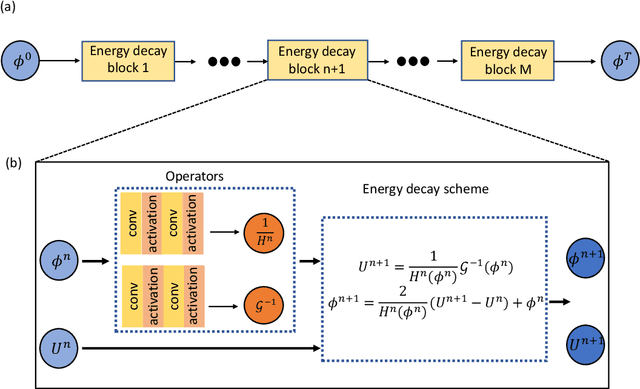
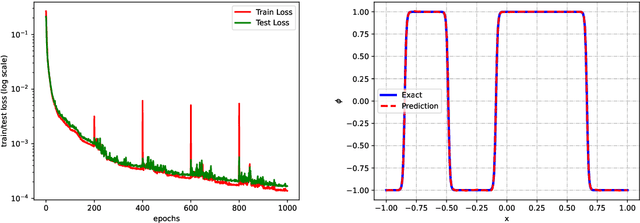
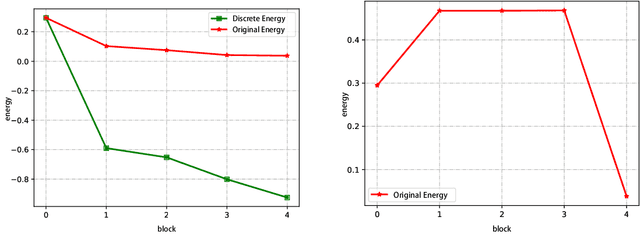
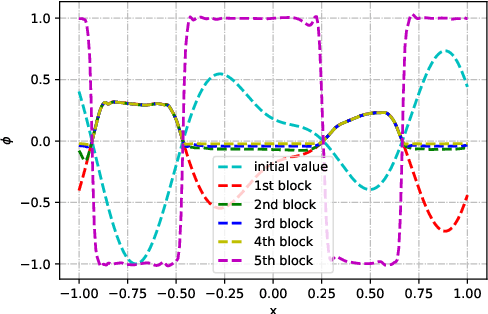
In this paper, we propose an energy stable network (EStable-Net) for solving gradient flow equations. The solution update scheme in our neural network EStable-Net is inspired by a proposed auxiliary variable based equivalent form of the gradient flow equation. EStable-Net enables decreasing of a discrete energy along the neural network, which is consistent with the property in the evolution process of the gradient flow equation. The architecture of the neural network EStable-Net consists of a few energy decay blocks, and the output of each block can be interpreted as an intermediate state of the evolution process of the gradient flow equation. This design provides a stable, efficient and interpretable network structure. Numerical experimental results demonstrate that our network is able to generate high accuracy and stable predictions.