 Add to Chrome
 Add to Firefox
 Add to Edge
TextBoost: Boosting Scene Text Fidelity in Ultra-low Bitrate Image Compression
Mar 04, 2026
Ultra-low bitrate image compression faces a critical challenge: preserving small-font scene text while maintaining overall visual quality. Region-of-interest (ROI) bit allocation can prioritize text but often degrades global fidelity, leading to a trade-off between local accuracy and overall image quality. Instead of relying on ROI coding, we incorporate auxiliary textual information extracted by OCR and transmitted with negligible overhead, enabling the decoder to leverage this semantic guidance. Our method, TextBoost, operationalizes this idea through three strategic designs: (i) adaptively filtering OCR outputs and rendering them into a guidance map; (ii) integrating this guidance with decoder features in a calibrated manner via an attention-guided fusion block; and (iii) enforcing guidance-consistent reconstruction in text regions with a regularizing loss that promotes natural blending with the scene. Extensive experiments on TextOCR and ICDAR 2015 demonstrate that TextBoost yields up to 60.6% higher text-recognition F1 at comparable Peak Signal-to-Noise Ratio (PSNR) and bits per pixel (bpp), producing sharper small-font text while preserving global image quality and effectively decoupling text enhancement from global rate-distortion optimization.

Large Transformers are Better EEG Learners
Aug 20, 2023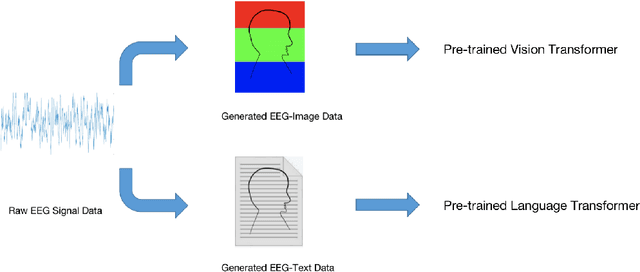
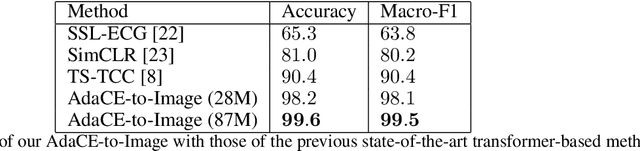
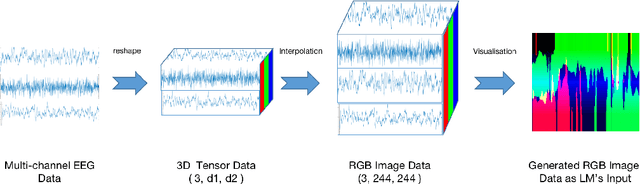
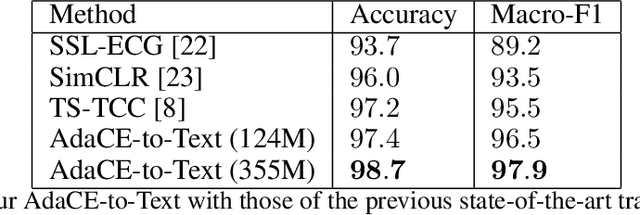
Pre-trained large transformer models have achieved remarkable performance in the fields of natural language processing and computer vision. Since the magnitude of available labeled electroencephalogram (EEG) data is much lower than that of text and image data, it is difficult for transformer models pre-trained from EEG to be developed as large as GPT-4 100T to fully unleash the potential of this architecture. In this paper, we show that transformers pre-trained from images as well as text can be directly fine-tuned for EEG-based prediction tasks. We design AdaCE, plug-and-play Adapters for Converting EEG data into image as well as text forms, to fine-tune pre-trained vision and language transformers. The proposed AdaCE module is highly effective for fine-tuning pre-trained transformers while achieving state-of-the-art performance on diverse EEG-based prediction tasks. For example, AdaCE on the pre-trained Swin-Transformer achieves 99.6%, an absolute improvement of 9.2%, on the EEG-decoding task of human activity recognition (UCI HAR). Furthermore, we empirically show that applying the proposed AdaCE to fine-tune larger pre-trained models can achieve better performance on EEG-based predicting tasks, indicating the potential of our adapters for even larger transformers. The plug-and-play AdaCE module can be applied to fine-tuning most of the popular pre-trained transformers on many other time-series data with multiple channels, not limited to EEG data and the models we use. Our code will be available at https://github.com/wangbxj1234/AdaCE.