 Add to Chrome
 Add to Firefox
 Add to Edge
Timely Information Updating for Mobile Devices Without and With ML Advice
Dec 19, 2025
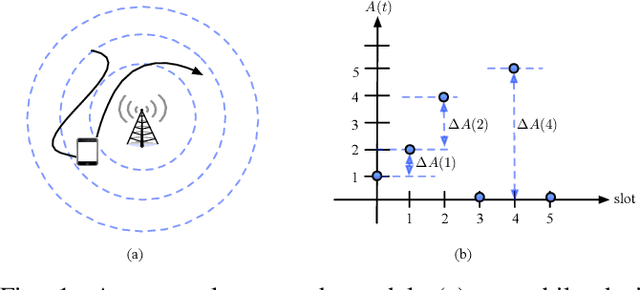

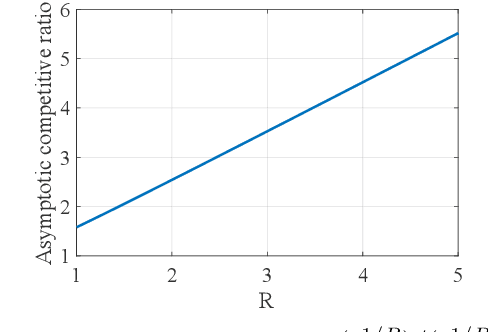
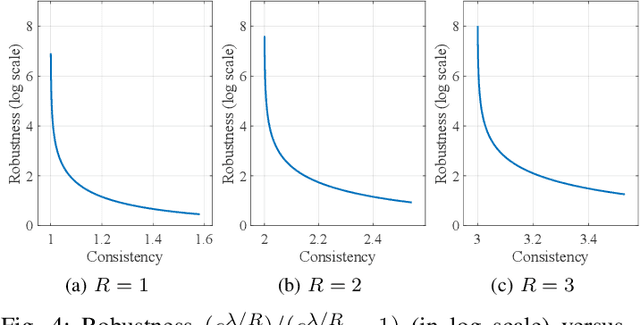
This paper investigates an information update system in which a mobile device monitors a physical process and sends status updates to an access point (AP). A fundamental trade-off arises between the timeliness of the information maintained at the AP and the update cost incurred at the device. To address this trade-off, we propose an online algorithm that determines when to transmit updates using only available observations. The proposed algorithm asymptotically achieves the optimal competitive ratio against an adversary that can simultaneously manipulate multiple sources of uncertainty, including the operation duration, the information staleness, the update cost, and the availability of update opportunities. Furthermore, by incorporating machine learning (ML) advice of unknown reliability into the design, we develop an ML-augmented algorithm that asymptotically attains the optimal consistency-robustness trade-off, even when the adversary can additionally corrupt the ML advice. The optimal competitive ratio scales linearly with the range of update costs, but is unaffected by other uncertainties. Moreover, an optimal competitive online algorithm exhibits a threshold-like response to the ML advice: it either fully trusts or completely ignores the ML advice, as partially trusting the advice cannot improve the consistency without severely degrading the robustness. Extensive simulations in stochastic settings further validate the theoretical findings in the adversarial environment.

Age Aware Scheduling for Differentially-Private Federated Learning
May 09, 2024


This paper explores differentially-private federated learning (FL) across time-varying databases, delving into a nuanced three-way tradeoff involving age, accuracy, and differential privacy (DP). Emphasizing the potential advantages of scheduling, we propose an optimization problem aimed at meeting DP requirements while minimizing the loss difference between the aggregated model and the model obtained without DP constraints. To harness the benefits of scheduling, we introduce an age-dependent upper bound on the loss, leading to the development of an age-aware scheduling design. Simulation results underscore the superior performance of our proposed scheme compared to FL with classic DP, which does not consider scheduling as a design factor. This research contributes insights into the interplay of age, accuracy, and DP in federated learning, with practical implications for scheduling strategies.