 Add to Chrome
 Add to Firefox
 Add to Edge
Hybrid Beamforming for Subarray-Level Movable Antenna Enhanced MU-MIMO Communications
Apr 21, 2026
This study investigates subarray-level movable antenna (MA) architecture for multi-user MIMO (MU-MIMO) systems. Unlike conventional systems with fixed-position antennas (FPAs), the proposed scheme harnesses the additional positional degrees of freedom (DoFs) of movable subarrays to enhance spatial multiplexing capabilities for both multi-user and multi-stream communications. Our objective is to maximize the overall system spectral efficiency by jointly optimizing the hybrid beamforming design and the positions of all subarrays. To tackle this challenging non-convex optimization problem, we first adopt a block diagonalization (BD) based digital precoder to effectively eliminate multi-user interference. Subsequently, the joint optimization of the analog beamformer and the subarray positions is efficiently solved using a sequential interference cancellation (SIC)-based algorithm. Simulation results demonstrate that the proposed SIC-MA method significantly outperforms the benchmark SIC-FPA scheme where subarrays are fixed.

Extremely Large-Scale Dynamic Metasurface Antennas (XL-DMAs): Near-Field Modeling and Channel Estimation
Jul 06, 2024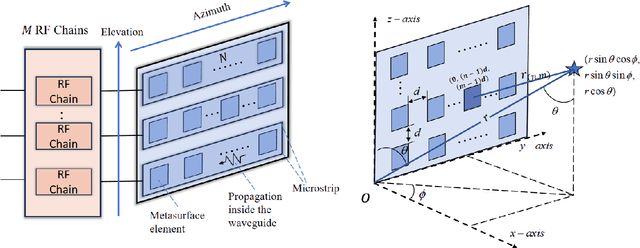
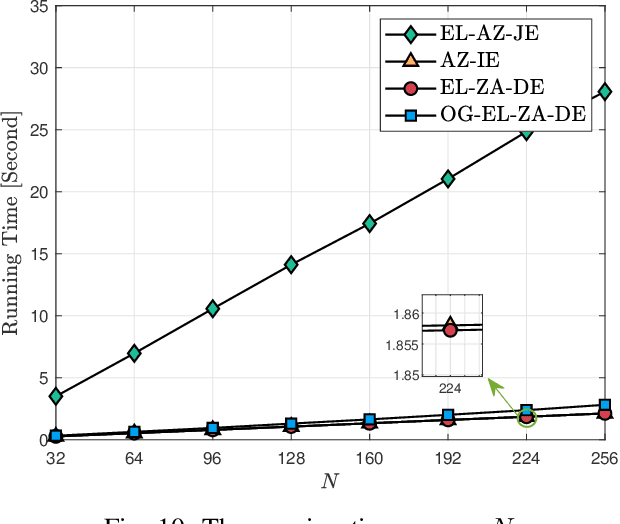
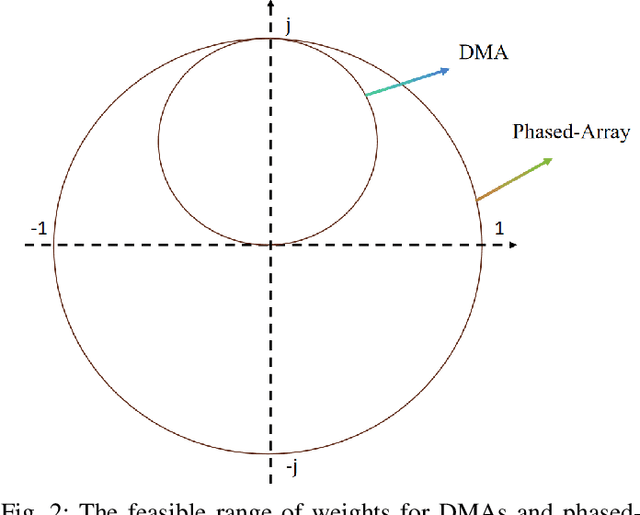
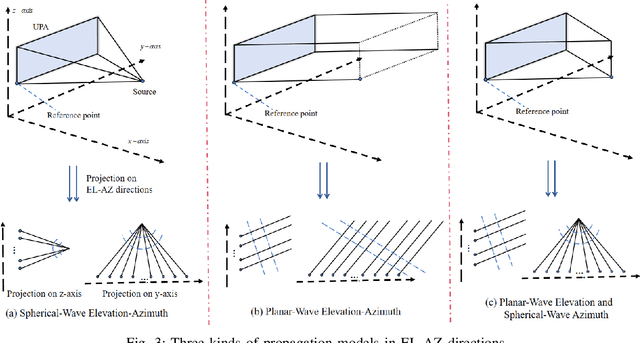
Dynamic metasurface antennas (DMAs) represent a novel transceiver array architecture for extremely large-scale (XL) communications, offering the advantages of reduced power consumption and lower hardware costs compared to conventional arrays. This paper focuses on near-field channel estimation for XL-DMAs. We begin by analyzing the near-field characteristics of uniform planar arrays (UPAs) and introducing the Oblong Approx. model. This model decouples elevation-azimuth (EL-AZ) parameters for XL-DMAs, providing an effective means to characterize the near-field effect. It offers simpler mathematical expressions than the second-order Taylor expansion model, all while maintaining negligible model errors for oblong-shaped arrays. Building on the Oblong Approx. model, we propose an EL-AZ-decoupled estimation framework that involves near- and far-field parameter estimation for AZ/EL and EL/AZ directions, respectively. The former is formulated as a distributed compressive sensing problem, addressed using the proposed off-grid distributed orthogonal least squares algorithm, while the latter involves a straightforward parallelizable search. Crucially, we illustrate the viability of decoupled EL-AZ estimation for near-field UPAs, exhibiting commendable performance and linear complexity correlated with the number of metasurface elements. Moreover, we design an measurement matrix optimization method with the Lorentzian constraint on DMAs and highlight the estimation performance degradation resulting from this constraint.