 Add to Chrome
 Add to Firefox
 Add to Edge
Limitations of Synthetic Data Generation in Specialized Data-Scarce Domains
Aug 13, 2026
Advances in diffusion-based generative models have motivated the use of synthetic image generation to alleviate data scarcity in vision tasks. While this strategy has shown promise in natural image benchmarks such as ImageNet, its effectiveness in sparse, high-variance real-world domains remains unclear. In this work, we focus on domains where images differ substantially from common image datasets and additional data are expensive to obtain. Against non-generative data augmentation baselines, we evaluate the downstream classifier performance improvements yielded by two schools of generative sparse data extension: distribution modeling and sample perturbation. Across five trauma classification tasks using subject-wise train--validation splits, no generative approach consistently outperforms a strong non-generative baseline. Feature-space analysis reveals recurring failure modes: memorization or collapse, distributional drift, and generation of visually plausible but simplified canonical instances that are easier to classify than real data.

MarkovScale: Towards Optimal Sequential Scaling at Inference Time
Feb 01, 2026Sequential scaling is a prominent inference-time scaling paradigm, yet its performance improvements are typically modest and not well understood, largely due to the prevalence of heuristic, non-principled approaches that obscure clear optimality bounds. To address this, we propose a principled framework that models sequential scaling as a two-state Markov process. This approach reveals the underlying properties of sequential scaling and yields closed-form solutions for essential aspects, such as the specific conditions under which accuracy is improved and the theoretical upper, neutral, and lower performance bounds. Leveraging this formulation, we develop MarkovScale, a practical system that applies these optimality criteria to achieve a theoretically grounded balance between accuracy and efficiency. Comprehensive experiments across 3 backbone LLMs, 5 benchmarks, and over 20 configurations show that MarkovScale consistently outperforms state-of-the-art parallel and sequential scaling methods, representing a significant step toward optimal and resource-efficient inference in LLMs. The source code will be open upon acceptance at https://open-upon-acceptance.
A Multi-Robot Platform for Robotic Triage Combining Onboard Sensing and Foundation Models
Dec 09, 2025
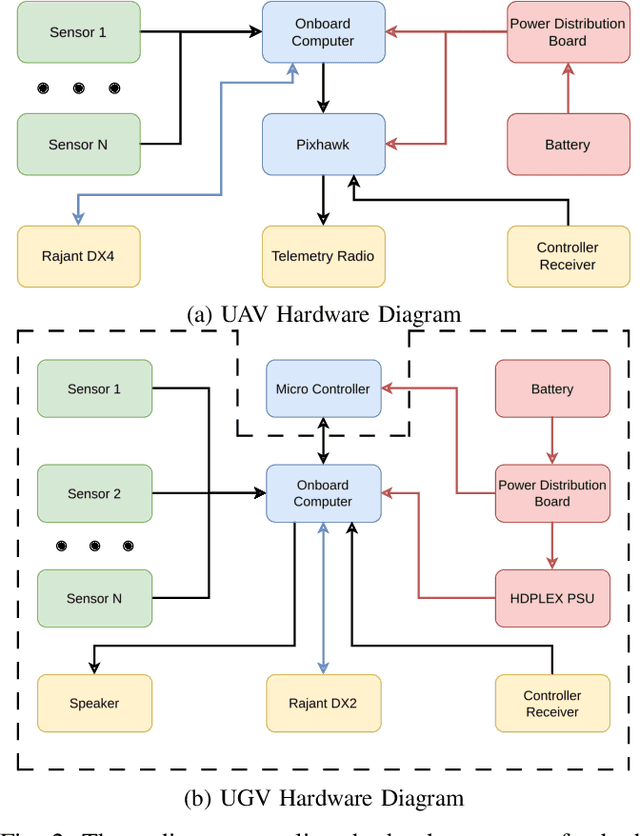
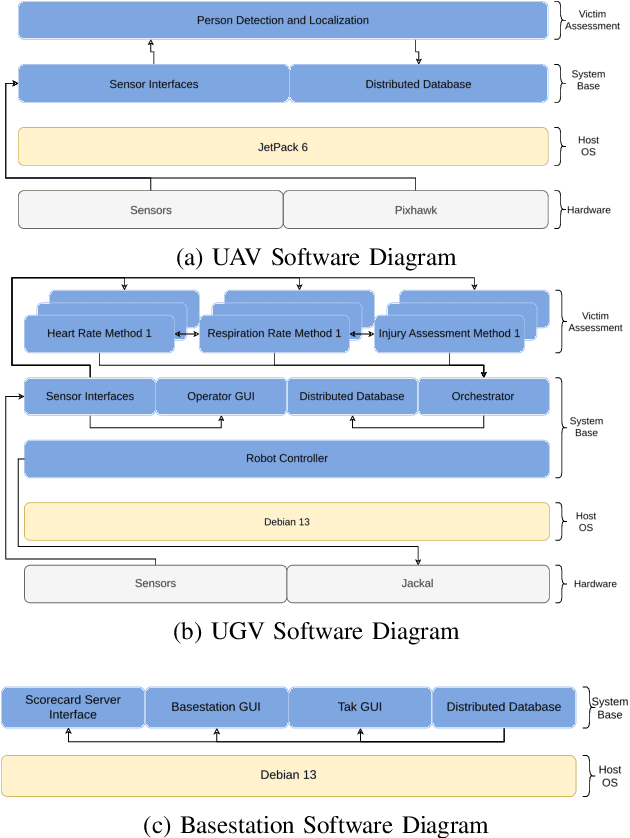
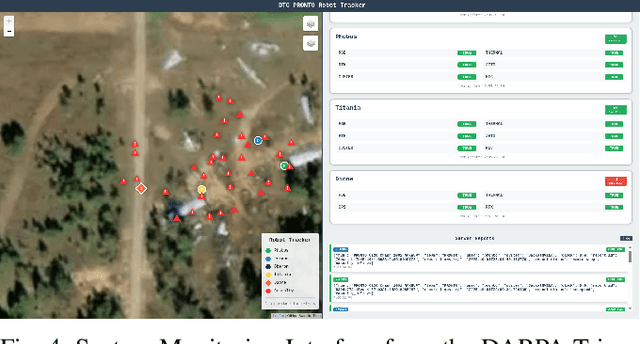
This report presents a heterogeneous robotic system designed for remote primary triage in mass-casualty incidents (MCIs). The system employs a coordinated air-ground team of unmanned aerial vehicles (UAVs) and unmanned ground vehicles (UGVs) to locate victims, assess their injuries, and prioritize medical assistance without risking the lives of first responders. The UAV identify and provide overhead views of casualties, while UGVs equipped with specialized sensors measure vital signs and detect and localize physical injuries. Unlike previous work that focused on exploration or limited medical evaluation, this system addresses the complete triage process: victim localization, vital sign measurement, injury severity classification, mental status assessment, and data consolidation for first responders. Developed as part of the DARPA Triage Challenge, this approach demonstrates how multi-robot systems can augment human capabilities in disaster response scenarios to maximize lives saved.