 Add to Chrome
 Add to Firefox
 Add to Edge
GeoDistill-Refine: Silhouette-First Geometry Distillation for Annotation-Free Spacecraft Segmentation
Aug 07, 2026
Foundation segmentation models can provide supervision for spacecraft imagery without manual training masks, but their predictions vary with textual prompts and may contain geometric errors that are amplified during distillation. This paper presents GeoDistill-Refine, a two-stage framework that transfers offline SAM 3 pseudo-masks to a compact segmentation network. Six fixed prompts are fused by an unweighted 50% vote to stabilize the teacher output. The student first learns the foreground silhouette and is then refined with signed-distance-field, skeleton, and area objectives derived from the pseudo-mask. A sample-level gate, computed from prompt agreement, the valid-prompt ratio, and pseudo-mask area plausibility, reduces the influence of unreliable pseudo-geometry. On the SpaceSense-Bench HJM lockbox set, GeoDistill-Refine improves Image IoU and Boundary F1 by 0.0456 and 0.1380, respectively, over a plain pseudo-label student. External evaluations on the SPEED+ Lightbox and Sunlamp domains and on TANGO show competitive regional overlap together with gains in boundary quality or foreground precision. The deployed TinyUNet contains 0.263 M parameters and requires approximately 1.1 ms per image on an RTX 4090; SAM 3 pseudo-mask construction and the auxiliary geometry branches are used only during training.

HCPG-Flow:Hierarchical Contact-Progress Guidance for Flow-Policy Robot Manipulation
Jul 20, 2026Flow policies can represent multimodal action distributions for robot manipulation, yet a robot must execute one action at each control step. When several proposals are sampled, critic-based ranking makes data collection depend on value estimates over candidate actions that may be weakly represented in replay. We introduce HCPG-Flow, an analytic rollout-time selector that augments SAC-Flow with hierarchical, object-centric contact-progress guidance while preserving its actor and critic objectives. HCPG switches from end-effector approach to task progress after contact, scores each proposal by the first-order reduction of a task-relevant distance, standardizes scores within the candidate set, and executes a temperature-controlled action embedding. Across ten simulated tasks, HCPG improves mean success over SAC-Flow on both benchmarks, including a 9.5 percentage-point gain on Maniskill. Four physical tasks further show high success with a 17.4% reduction in successful completion steps.Project page: https://hitxraz.github.io/HCPG-Flow/
GAP-GDRNet: Geometry-aware monocular 6D pose estimation for spacecraft using synthetic geometric supervision
Jul 10, 2026Monocular spacecraft 6D pose estimation remains difficult under weak texture, thin structures, illumination variation, and occlusion. This article presents GAP-GDRNet, a geometry-aware RGB framework built on GDR-Net for a single-target synthetic spacecraft benchmark. The method strengthens the geometry-guided regression pipeline at two points. First, AFR is placed before dense geometric prediction to combine global structural attention with local weak-texture enhancement. Second, PGSA is inserted into Patch-PnP to relate downsampled geometric regions before final pose regression. Dense supervision is obtained from a Blender-based rendering and annotation process that provides masks, model-coordinate maps, camera intrinsics, and 6D pose labels. On the self-built spacecraft dataset, GAP-GDRNet achieves a rotation error of 1.96°, a translation error of 0.0165 m,and 95.16% ADD@0.02 m, outperforming the reproduced GDR-Net baseline by 3.88 percentage points while running at 35.97 FPS. Tests on T-LESS and LM-O further show consistent gains over the reproduced baseline on textureless and occluded non-spacecraft objects.
GAP-GDRNet: Geometry-Aware Monocular Visual Pose Sensing on a Single-Target Synthetic Spacecraft Dataset
Jul 02, 2026Monocular relative pose sensing is a central perception problem in non-cooperative rendezvous and on-orbit servicing. In spacecraft images, however, weak surface texture, thin appendages, illumination changes, and partial occlusion often leave only sparse and unstable geometric evidence. This article presents GAP-GDRNet, a geometry-aware attention-enhanced framework for monocular RGB-based 6D pose sensing. The method follows the geometry-guided direct regression paradigm of GDR-Net and modifies two points in the pipeline: an attention-based feature refinement (AFR) module is placed before dense geometric prediction, and a patch-level geometric self-attention (PGSA) module is inserted into Patch-PnP. AFR reinforces global spacecraft structure together with local weak-texture cues; PGSA then relates downsampled geometric patches before final pose regression. A Blender-based annotation process supplies target masks, visible-region masks, dense model-coordinate maps, camera intrinsics, and 6D pose labels for supervised training.
Precision-Aware Illumination-Disentangled Vision Transformer for Spacecraft 6D Pose Estimation
Jun 10, 2026Vision sensors provide a lightweight solution for spacecraft proximity operations, but monocular spacecraft 6D pose estimation remains difficult under illumination variation, specular reflection, shadowing, weak texture, and background interference. These factors make local visual evidence spatially unreliable and can destabilize pose regression. This article proposes a Precision-Aware Illumination-Disentangled Vision Transformer (PAID-ViT) for robust spacecraft pose estimation.The proposed model separates pose-relevant structure tokens from illumination-sensitive appearance tokens, estimates patch reliability before pose aggregation, and uses foreground mask supervision to preserve silhouette cues. A parameter-free geometric recovery module converts normalized crop coordinates, log-depth, and a continuous 6D rotation representation into camera-frame rotation and translation. Experiments on SPEED+ V2, the SPEED+ validation/lightbox/sunlamp evaluation configuration used in this study, suggest that PAID-ViT reduces translation error and improves robustness in the challenging sunlamp domain, while ablation studies support the complementary roles of illumination disentanglement, reliability-aware token aggregation, mask supervision, and training-side regularization.
Component-Aware Structure-Preserving Style Transfer for Satellite Visual Sim2Real Data Construction
May 20, 2026For camera-based satellite visual sensing, Sim2Real data construction requires images that approach real-domain sensor appearance while retaining the annotations inherited from simulation. Real sensor images of satellite targets with reliable pose labels and component-level masks are difficult to acquire at scale, whereas synthetic rendering provides exact geometric annotations but suffers from a visible appearance gap. This paper presents a component-aware structure-preserving style transfer framework for satellite visual synthetic-to-real data construction. The method builds weakly paired real--synthetic samples from calibrated real acquisition, ArUco-based camera-pose measurement, CAD rendering, and component masks. It then extracts part-wise real-domain style codes from unlabeled real images and injects them into corresponding synthetic satellite regions through mask-aligned modulation. To keep the generated images usable for downstream sensor-data supervision, adversarial training is combined with local contrastive consistency, self-regularization, and edge-preserving constraints. Experiments are conducted on 5,000 rendered satellite images and 100 real images captured in a calibrated setup. The real images provide target-domain appearance references and final evaluation images, while the downstream GDRNet pose estimator is trained only on synthetic or translated synthetic images. Compared with representative image-translation baselines, the proposed method achieves the lowest image distribution discrepancy, with an FID of 54.32 and a KID of 0.048. When the translated data are used to train GDRNet in this target-domain adaptation setting, the ADD pass rate improves to 0.260 and the AUC improves to 0.611. These results indicate that component-level appearance transfer can improve annotation-preserving satellite visual Sim2Real data generation in the considered calibrated setup.
DCIRNet: Depth Completion with Iterative Refinement for Dexterous Grasping of Transparent and Reflective Objects
Jun 11, 2025Transparent and reflective objects in everyday environments pose significant challenges for depth sensors due to their unique visual properties, such as specular reflections and light transmission. These characteristics often lead to incomplete or inaccurate depth estimation, which severely impacts downstream geometry-based vision tasks, including object recognition, scene reconstruction, and robotic manipulation. To address the issue of missing depth information in transparent and reflective objects, we propose DCIRNet, a novel multimodal depth completion network that effectively integrates RGB images and depth maps to enhance depth estimation quality. Our approach incorporates an innovative multimodal feature fusion module designed to extract complementary information between RGB images and incomplete depth maps. Furthermore, we introduce a multi-stage supervision and depth refinement strategy that progressively improves depth completion and effectively mitigates the issue of blurred object boundaries. We integrate our depth completion model into dexterous grasping frameworks and achieve a $44\%$ improvement in the grasp success rate for transparent and reflective objects. We conduct extensive experiments on public datasets, where DCIRNet demonstrates superior performance. The experimental results validate the effectiveness of our approach and confirm its strong generalization capability across various transparent and reflective objects.
HTMNet: A Hybrid Network with Transformer-Mamba Bottleneck Multimodal Fusion for Transparent and Reflective Objects Depth Completion
May 28, 2025Transparent and reflective objects pose significant challenges for depth sensors, resulting in incomplete depth information that adversely affects downstream robotic perception and manipulation tasks. To address this issue, we propose HTMNet, a novel hybrid model integrating Transformer, CNN, and Mamba architectures. The encoder is based on a dual-branch CNN-Transformer framework, the bottleneck fusion module adopts a Transformer-Mamba architecture, and the decoder is built upon a multi-scale fusion module. We introduce a novel multimodal fusion module grounded in self-attention mechanisms and state space models, marking the first application of the Mamba architecture in the field of transparent object depth completion and revealing its promising potential. Additionally, we design an innovative multi-scale fusion module for the decoder that combines channel attention, spatial attention, and multi-scale feature extraction techniques to effectively integrate multi-scale features through a down-fusion strategy. Extensive evaluations on multiple public datasets demonstrate that our model achieves state-of-the-art(SOTA) performance, validating the effectiveness of our approach.
Commenting Higher-level Code Unit: Full Code, Reduced Code, or Hierarchical Code Summarization
Mar 13, 2025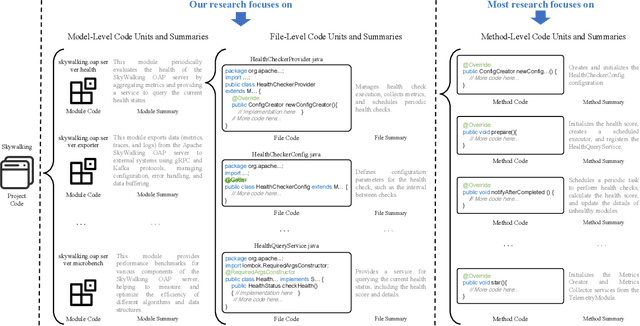
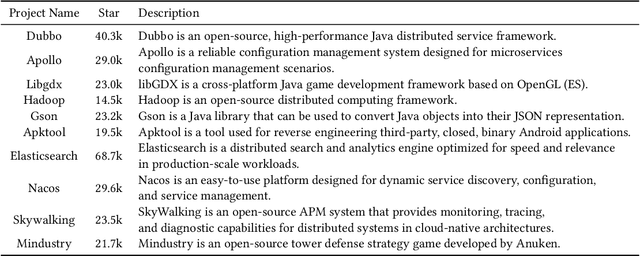
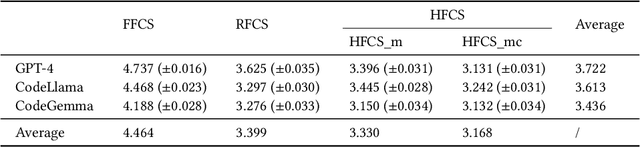
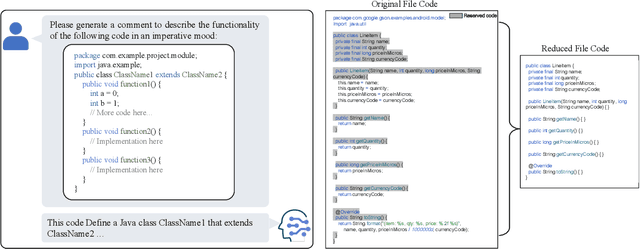
Commenting code is a crucial activity in software development, as it aids in facilitating future maintenance and updates. To enhance the efficiency of writing comments and reduce developers' workload, researchers has proposed various automated code summarization (ACS) techniques to automatically generate comments/summaries for given code units. However, these ACS techniques primarily focus on generating summaries for code units at the method level. There is a significant lack of research on summarizing higher-level code units, such as file-level and module-level code units, despite the fact that summaries of these higher-level code units are highly useful for quickly gaining a macro-level understanding of software components and architecture. To fill this gap, in this paper, we conduct a systematic study on how to use LLMs for commenting higher-level code units, including file level and module level. These higher-level units are significantly larger than method-level ones, which poses challenges in handling long code inputs within LLM constraints and maintaining efficiency. To address these issues, we explore various summarization strategies for ACS of higher-level code units, which can be divided into three types: full code summarization, reduced code summarization, and hierarchical code summarization. The experimental results suggest that for summarizing file-level code units, using the full code is the most effective approach, with reduced code serving as a cost-efficient alternative. However, for summarizing module-level code units, hierarchical code summarization becomes the most promising strategy. In addition, inspired by the research on method-level ACS, we also investigate using the LLM as an evaluator to evaluate the quality of summaries of higher-level code units. The experimental results demonstrate that the LLM's evaluation results strongly correlate with human evaluations.
Continuous Concepts Removal in Text-to-image Diffusion Models
Nov 30, 2024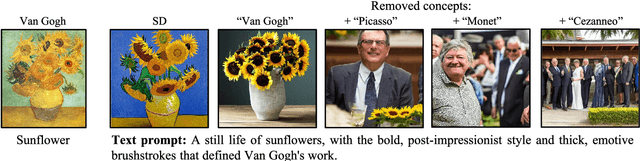
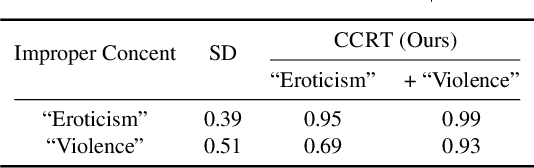
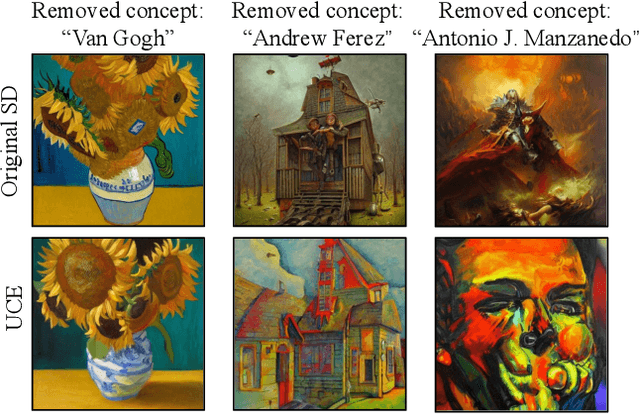
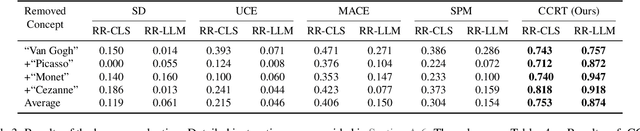
Text-to-image diffusion models have shown an impressive ability to generate high-quality images from input textual descriptions. However, concerns have been raised about the potential for these models to create content that infringes on copyrights or depicts disturbing subject matter. Removing specific concepts from these models is a promising potential solution to this problem. However, existing methods for concept removal do not work well in practical but challenging scenarios where concepts need to be continuously removed. Specifically, these methods lead to poor alignment between the text prompts and the generated image after the continuous removal process. To address this issue, we propose a novel approach called CCRT that includes a designed knowledge distillation paradigm. It constrains the text-image alignment behavior during the continuous concept removal process by using a set of text prompts generated through our genetic algorithm, which employs a designed fuzzing strategy. We conduct extensive experiments involving the removal of various concepts. The results evaluated through both algorithmic metrics and human studies demonstrate that our CCRT can effectively remove the targeted concepts in a continuous manner while maintaining the high generation quality (e.g., text-image alignment) of the model.