 Add to Chrome
 Add to Firefox
 Add to Edge
PExA: Parallel Exploration Agent for Complex Text-to-SQL
Apr 24, 2026
LLM-based agents for text-to-SQL often struggle with latency-performance trade-off, where performance improvements come at the cost of latency or vice versa. We reformulate text-to-SQL generation within the lens of software test coverage where the original query is prepared with a suite of test cases with simpler, atomic SQLs that are executed in parallel and together ensure semantic coverage of the original query. After iterating on test case coverage, the final SQL is generated only when enough information is gathered, leveraging the explored test case SQLs to ground the final generation. We validated our framework on a state-of-the-art benchmark for text-to-SQL, Spider 2.0, achieving a new state-of-the-art with 70.2% execution accuracy.

Dense Retrieval Adaptation using Target Domain Description
Jul 06, 2023
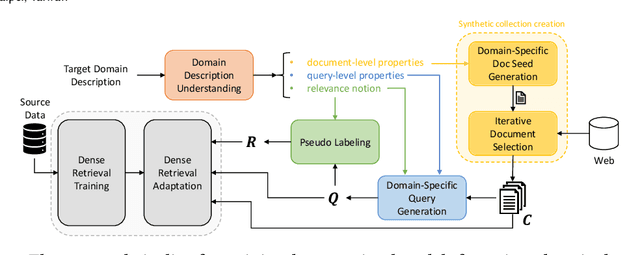
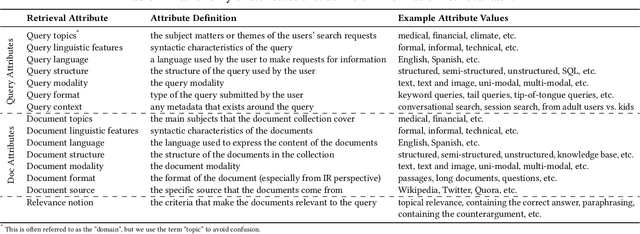
In information retrieval (IR), domain adaptation is the process of adapting a retrieval model to a new domain whose data distribution is different from the source domain. Existing methods in this area focus on unsupervised domain adaptation where they have access to the target document collection or supervised (often few-shot) domain adaptation where they additionally have access to (limited) labeled data in the target domain. There also exists research on improving zero-shot performance of retrieval models with no adaptation. This paper introduces a new category of domain adaptation in IR that is as-yet unexplored. Here, similar to the zero-shot setting, we assume the retrieval model does not have access to the target document collection. In contrast, it does have access to a brief textual description that explains the target domain. We define a taxonomy of domain attributes in retrieval tasks to understand different properties of a source domain that can be adapted to a target domain. We introduce a novel automatic data construction pipeline that produces a synthetic document collection, query set, and pseudo relevance labels, given a textual domain description. Extensive experiments on five diverse target domains show that adapting dense retrieval models using the constructed synthetic data leads to effective retrieval performance on the target domain.