 Add to Chrome
 Add to Firefox
 Add to Edge
WorldReasoner: Evaluating Whether Language Model Agents Forecast Events with Valid Reasoning
Jun 10, 2026
Forecasting real-world events requires language-model agents to reason under uncertainty from incomplete, time-bounded information. Yet evaluating whether agents genuinely forecast requires more than final-answer accuracy: a model may be correct by recalling memorized training facts, citing fabricated evidence, or producing an unsupported causal story. We present WorldReasoner, an evaluation framework for temporally valid event forecasting. Each task gives an agent a resolved forecasting question, a simulated forecast date, and access only to evidence available before that date; after resolution, the framework scores the submitted probability, cited evidence, and optional causal event graph. WorldReasoner reports three complementary axes: outcome quality against resolved answers, evidence quality over cited sources, and reasoning quality against post-resolution hindsight graphs. The benchmark is built by an agentic construction pipeline that generates forecasting questions, collects time-stamped evidence, and builds hindsight reference graphs at scale, yielding 345 resolved tasks derived from 14,141 articles with graphs covering 8,087 extracted events. Across six controlled agent settings, temporally valid retrieval is the strongest driver of outcome accuracy; causal graph construction improves key-event recovery; and correct graph-enabled forecasts are more strongly grounded in key events and relevant sources, yet agents still struggle to convert grounded evidence into calibrated probabilities.

SciPaths: Forecasting Pathways to Scientific Discovery
May 14, 2026Scientific progress depends on sequences of enabling contributions, yet existing AI4Science benchmarks largely focus on citation prediction, literature retrieval, or idea generation rather than the dependencies that make progress possible. In this paper, we introduce discovery pathway forecasting: given a target scientific contribution and the prior literature available at a specified time, the task is to (1) identify the enabling contributions required to realize it and (2) ground each in prior work when such prior work exists. We present SciPaths, a benchmark of 262 expert-annotated gold pathways and 2,444 silver pathways constructed from machine learning and natural language processing papers, where each pathway records enabling contributions, roles, rationales, and prior-work groundings or unmapped decisions. Evaluating frontier and open-weight language models, we find that the best model reaches only 0.189 F1 under strict semantic matching, with core methodological dependencies hardest to recover. Prior-work grounding improves substantially when gold enabling contributions are provided, showing that decomposition quality is a major bottleneck for end-to-end pathway recovery. SciPaths therefore shifts evaluation toward a missing capability in scientific forecasting: reasoning backward from a target contribution to the enabling scientific building blocks and prior-work dependencies that make it feasible.
Social Good or Scientific Curiosity? Uncovering the Research Framing Behind NLP Artefacts
May 24, 2025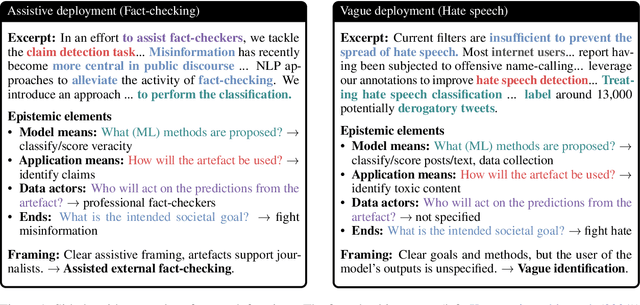
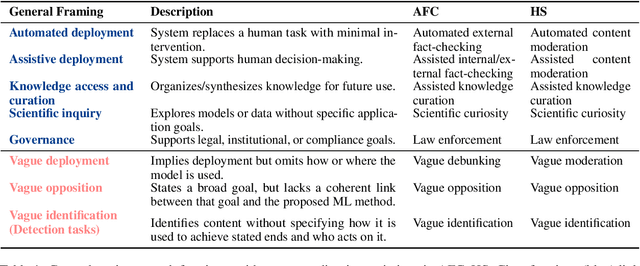
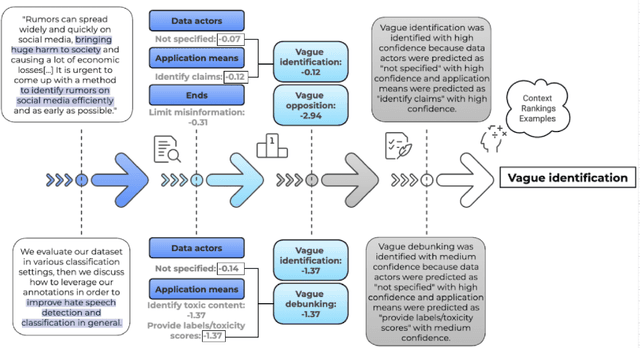

Clarifying the research framing of NLP artefacts (e.g., models, datasets, etc.) is crucial to aligning research with practical applications. Recent studies manually analyzed NLP research across domains, showing that few papers explicitly identify key stakeholders, intended uses, or appropriate contexts. In this work, we propose to automate this analysis, developing a three-component system that infers research framings by first extracting key elements (means, ends, stakeholders), then linking them through interpretable rules and contextual reasoning. We evaluate our approach on two domains: automated fact-checking using an existing dataset, and hate speech detection for which we annotate a new dataset-achieving consistent improvements over strong LLM baselines. Finally, we apply our system to recent automated fact-checking papers and uncover three notable trends: a rise in vague or underspecified research goals, increased emphasis on scientific exploration over application, and a shift toward supporting human fact-checkers rather than pursuing full automation.
Automated Focused Feedback Generation for Scientific Writing Assistance
Jun 04, 2024Scientific writing is a challenging task, particularly for novice researchers who often rely on feedback from experienced peers. Recent work has primarily focused on improving surface form and style rather than manuscript content. In this paper, we propose a novel task: automated focused feedback generation for scientific writing assistance. We present SWIF$^{2}$T: a Scientific WrIting Focused Feedback Tool. It is designed to generate specific, actionable and coherent comments, which identify weaknesses in a scientific paper and/or propose revisions to it. Our approach consists of four components - planner, investigator, reviewer and controller - leveraging multiple Large Language Models (LLMs) to implement them. We compile a dataset of 300 peer reviews citing weaknesses in scientific papers and conduct human evaluation. The results demonstrate the superiority in specificity, reading comprehension, and overall helpfulness of SWIF$^{2}$T's feedback compared to other approaches. In our analysis, we also identified cases where automatically generated reviews were judged better than human ones, suggesting opportunities for integration of AI-generated feedback in scientific writing.
PRobELM: Plausibility Ranking Evaluation for Language Models
Apr 04, 2024This paper introduces PRobELM (Plausibility Ranking Evaluation for Language Models), a benchmark designed to assess language models' ability to discern more plausible from less plausible scenarios through their parametric knowledge. While benchmarks such as TruthfulQA emphasise factual accuracy or truthfulness, and others such as COPA explore plausible scenarios without explicitly incorporating world knowledge, PRobELM seeks to bridge this gap by evaluating models' capabilities to prioritise plausible scenarios that leverage world knowledge over less plausible alternatives. This design allows us to assess the potential of language models for downstream use cases such as literature-based discovery where the focus is on identifying information that is likely but not yet known. Our benchmark is constructed from a dataset curated from Wikidata edit histories, tailored to align the temporal bounds of the training data for the evaluated models. PRobELM facilitates the evaluation of language models across multiple prompting types, including statement, text completion, and question-answering. Experiments with 10 models of various sizes and architectures on the relationship between model scales, training recency, and plausibility performance, reveal that factual accuracy does not directly correlate with plausibility performance and that up-to-date training data enhances plausibility assessment across different model architectures.
Automated Fact-Checking in Dialogue: Are Specialized Models Needed?
Nov 14, 2023Prior research has shown that typical fact-checking models for stand-alone claims struggle with claims made in dialogues. As a solution, fine-tuning these models on labelled dialogue data has been proposed. However, creating separate models for each use case is impractical, and we show that fine-tuning models for dialogue results in poor performance on typical fact-checking. To overcome this challenge, we present techniques that allow us to use the same models for both dialogue and typical fact-checking. These mainly focus on retrieval adaptation and transforming conversational inputs so that they can be accurately predicted by models trained on stand-alone claims. We demonstrate that a typical fact-checking model incorporating these techniques is competitive with state-of-the-art models fine-tuned for dialogue, while maintaining its accuracy on stand-alone claims.