 Add to Chrome
 Add to Firefox
 Add to Edge
NTIRE 2026 Challenge on Short-form UGC Video Restoration in the Wild with Generative Models: Datasets, Methods and Results
Apr 12, 2026
This paper presents an overview of the NTIRE 2026 Challenge on Short-form UGC Video Restoration in the Wild with Generative Models. This challenge utilizes a new short-form UGC (S-UGC) video restoration benchmark, termed KwaiVIR, which is contributed by USTC and Kuaishou Technology. It contains both synthetically distorted videos and real-world short-form UGC videos in the wild. For this edition, the released data include 200 synthetic training videos, 48 wild training videos, 11 validation videos, and 20 testing videos. The primary goal of this challenge is to establish a strong and practical benchmark for restoring short-form UGC videos under complex real-world degradations, especially in the emerging paradigm of generative-model-based S-UGC video restoration. This challenge has two tracks: (i) the primary track is a subjective track, where the evaluation is based on a user study; (ii) the second track is an objective track. These two tracks enable a comprehensive assessment of restoration quality. In total, 95 teams have registered for this competition. And 12 teams submitted valid final solutions and fact sheets for the testing phase. The submitted methods achieved strong performance on the KwaiVIR benchmark, demonstrating encouraging progress in short-form UGC video restoration in the wild.

Explainability in Graph Neural Networks: An Experimental Survey
Mar 17, 2022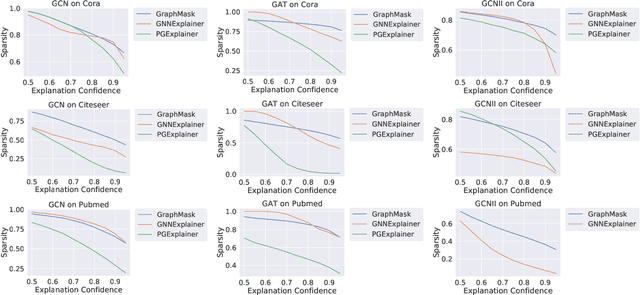

Graph neural networks (GNNs) have been extensively developed for graph representation learning in various application domains. However, similar to all other neural networks models, GNNs suffer from the black-box problem as people cannot understand the mechanism underlying them. To solve this problem, several GNN explainability methods have been proposed to explain the decisions made by GNNs. In this survey, we give an overview of the state-of-the-art GNN explainability methods and how they are evaluated. Furthermore, we propose a new evaluation metric and conduct thorough experiments to compare GNN explainability methods on real world datasets. We also suggest future directions for GNN explainability.