 Add to Chrome
 Add to Firefox
 Add to Edge
MindMemOS: A Portable and Self-Evolving Memory Operating Layer for AI Agents
Aug 12, 2026
Memory is a core component of AI agents, enabling them to accumulate experience, maintain personalization, and adapt over long-term interactions. However, existing memory systems often remain fixed after development, limiting their ability to adapt their memory models, organization strategies, and procedural knowledge through continued use. We present MindMemOS, a portable and self-evolving memory operating layer that organizes open-world information using a unified entity property timestructure. MindMemOS supports scenario-adaptive memory modeling, higher-order pattern discovery, autonomous memory refinement, and continuous skill evolution. Its MindMemEvolve algorithm employs validation-driven evolutionary search to optimize memory schemas for target scenarios, whiledreaming consolidates accumulated memories by merging redundant records and resolving conflicts. In addition, implicit corrective feedback serves as a human-in-the-loop signal for identifying and revising potentially inaccurate or misaligned memories. Its MindSkillEvolve algorithm further transforms agent execution trajectories into reusable and progressively refined skills. MindMemOS achieves 94.03% accuracy on LOCOMO and 70.63% on PersonaMem. MindSkillEvolve improves SpreadsheetBench success by 9.2 percentage points over the initial-skill baseline.

HumanOmni: A Large Vision-Speech Language Model for Human-Centric Video Understanding
Jan 25, 2025


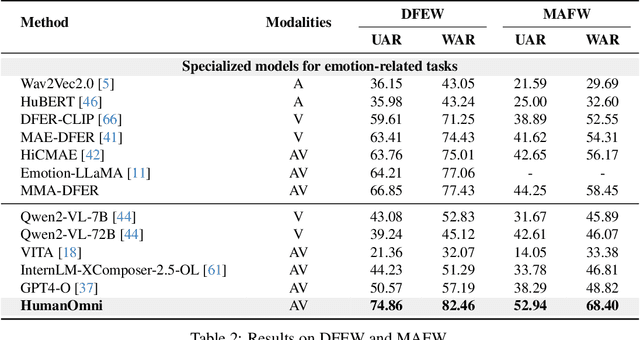
In human-centric scenes, the ability to simultaneously understand visual and auditory information is crucial. While recent omni models can process multiple modalities, they generally lack effectiveness in human-centric scenes due to the absence of large-scale, specialized datasets and non-targeted architectures. In this work, we developed HumanOmni, the industry's first human-centric Omni-multimodal large language model. We constructed a dataset containing over 2.4 million human-centric video clips with detailed captions and more than 14 million instructions, facilitating the understanding of diverse human-centric scenes. HumanOmni includes three specialized branches for understanding different types of scenes. It adaptively fuses features from these branches based on user instructions, significantly enhancing visual understanding in scenes centered around individuals. Moreover, HumanOmni integrates audio features to ensure a comprehensive understanding of environments and individuals. Our experiments validate HumanOmni's advanced capabilities in handling human-centric scenes across a variety of tasks, including emotion recognition, facial expression description, and action understanding. Our model will be open-sourced to facilitate further development and collaboration within both academia and industry.
Cross-Modal Adaptive Dual Association for Text-to-Image Person Retrieval
Dec 04, 2023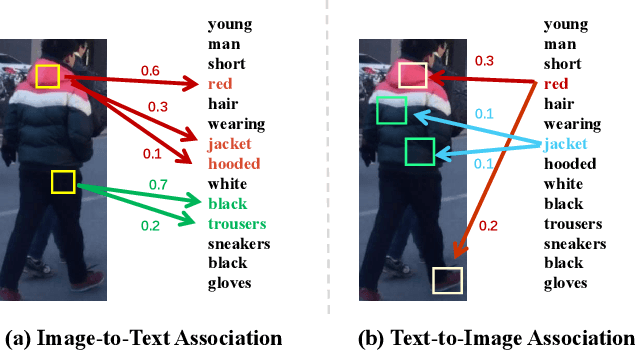
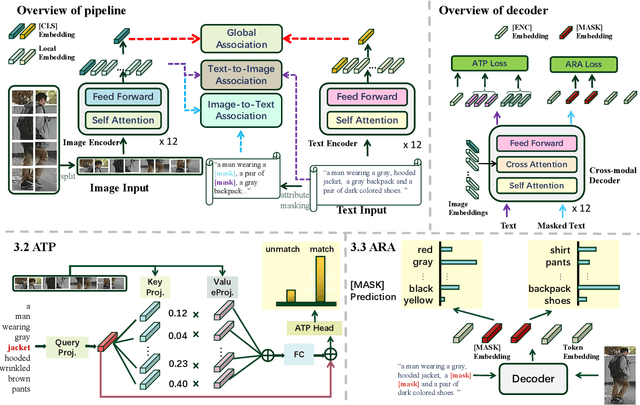
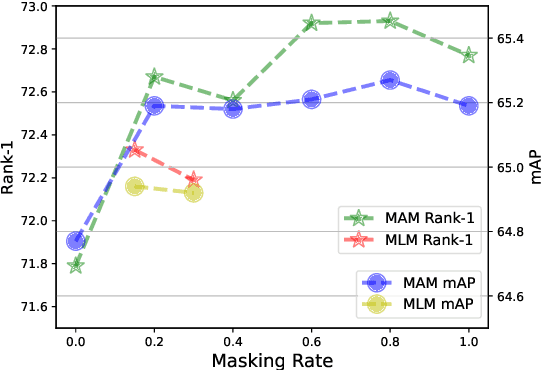
Text-to-image person re-identification (ReID) aims to retrieve images of a person based on a given textual description. The key challenge is to learn the relations between detailed information from visual and textual modalities. Existing works focus on learning a latent space to narrow the modality gap and further build local correspondences between two modalities. However, these methods assume that image-to-text and text-to-image associations are modality-agnostic, resulting in suboptimal associations. In this work, we show the discrepancy between image-to-text association and text-to-image association and propose CADA: Cross-Modal Adaptive Dual Association that finely builds bidirectional image-text detailed associations. Our approach features a decoder-based adaptive dual association module that enables full interaction between visual and textual modalities, allowing for bidirectional and adaptive cross-modal correspondence associations. Specifically, the paper proposes a bidirectional association mechanism: Association of text Tokens to image Patches (ATP) and Association of image Regions to text Attributes (ARA). We adaptively model the ATP based on the fact that aggregating cross-modal features based on mistaken associations will lead to feature distortion. For modeling the ARA, since the attributes are typically the first distinguishing cues of a person, we propose to explore the attribute-level association by predicting the masked text phrase using the related image region. Finally, we learn the dual associations between texts and images, and the experimental results demonstrate the superiority of our dual formulation. Codes will be made publicly available.