 Add to Chrome
 Add to Firefox
 Add to Edge
HumanOmni-Speaker: Identifying Who said What and When
Mar 23, 2026
While Omni-modal Large Language Models have made strides in joint sensory processing, they fundamentally struggle with a cornerstone of human interaction: deciphering complex, multi-person conversational dynamics to accurately answer ``Who said what and when.'' Current models suffer from an ``illusion of competence'' -- they exploit visual biases in conventional benchmarks to bypass genuine cross-modal alignment, while relying on sparse, low-frame-rate visual sampling that destroys crucial high-frequency dynamics like lip movements. To shatter this illusion, we introduce Visual-Registered Speaker Diarization and Recognition (VR-SDR) and the HumanOmni-Speaker Benchmark. By strictly eliminating visual shortcuts, this rigorous paradigm demands true end-to-end spatio-temporal identity binding using only natural language queries. To overcome the underlying architectural perception gap, we propose HumanOmni-Speaker, powered by a Visual Delta Encoder. By sampling raw video at 25 fps and explicitly compressing inter-frame motion residuals into just 6 tokens per frame, it captures fine-grained visemes and speaker trajectories without triggering a catastrophic token explosion. Ultimately, HumanOmni-Speaker demonstrates strong multimodal synergy, natively enabling end-to-end lip-reading and high-precision spatial localization without intrusive cropping, and achieving superior performance across a wide spectrum of speaker-centric tasks.

HumanOmni: A Large Vision-Speech Language Model for Human-Centric Video Understanding
Jan 25, 2025


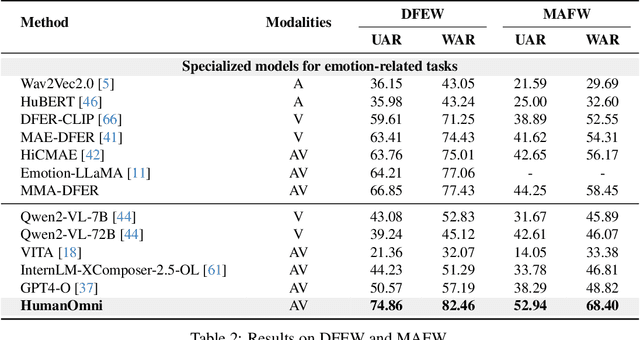
In human-centric scenes, the ability to simultaneously understand visual and auditory information is crucial. While recent omni models can process multiple modalities, they generally lack effectiveness in human-centric scenes due to the absence of large-scale, specialized datasets and non-targeted architectures. In this work, we developed HumanOmni, the industry's first human-centric Omni-multimodal large language model. We constructed a dataset containing over 2.4 million human-centric video clips with detailed captions and more than 14 million instructions, facilitating the understanding of diverse human-centric scenes. HumanOmni includes three specialized branches for understanding different types of scenes. It adaptively fuses features from these branches based on user instructions, significantly enhancing visual understanding in scenes centered around individuals. Moreover, HumanOmni integrates audio features to ensure a comprehensive understanding of environments and individuals. Our experiments validate HumanOmni's advanced capabilities in handling human-centric scenes across a variety of tasks, including emotion recognition, facial expression description, and action understanding. Our model will be open-sourced to facilitate further development and collaboration within both academia and industry.