 Add to Chrome
 Add to Firefox
 Add to Edge
DEFLECT: Delay-Robust Execution via Flow-matching Likelihood-Estimated Counterfactual Tuning for VLA Policies
May 19, 2026
Vision-Language-Action (VLA) policies are typically deployed with asynchronous inference: the robot executes a previously predicted action chunk while the model computes the next one. This creates a prediction-execution misalignment: the chunk is conditioned on the observation taken before inference began, but executes in a physical state that has already drifted forward by several control steps; naive asynchronous rollover collapses from 89% to under 1% on Kinetix as the inference cycle covers up to seven control steps. We introduce DEFLECT, a fully offline post-training refinement that applies as a near drop-in upgrade to existing async-VLA stacks by converting latency itself into a label-free preference signal: counterfactual fresh/stale action pairs are constructed from a frozen reference policy and scored under the deployment-time conditioning via an implicit flow-matching likelihood-ratio surrogate, with no human labels, reward models, or online rollouts. DEFLECT substantially extends the usable delay envelope of async VLA control, with +6.4 success-rate gain in the high-latency regime (5-7 control steps), +4.6 when transferred to a real-scale VLA at the longest delay, and consistent improvements on two real-robot tasks (a bimanual conveyor pick-and-place and a reactive whack-a-mole).

EEG-Features for Generalized Deepfake Detection
May 14, 2024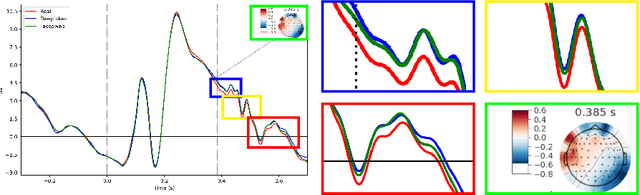
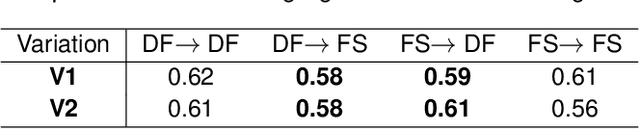
Since the advent of Deepfakes in digital media, the development of robust and reliable detection mechanism is urgently called for. In this study, we explore a novel approach to Deepfake detection by utilizing electroencephalography (EEG) measured from the neural processing of a human participant who viewed and categorized Deepfake stimuli from the FaceForensics++ datset. These measurements serve as input features to a binary support vector classifier, trained to discriminate between real and manipulated facial images. We examine whether EEG data can inform Deepfake detection and also if it can provide a generalized representation capable of identifying Deepfakes beyond the training domain. Our preliminary results indicate that human neural processing signals can be successfully integrated into Deepfake detection frameworks and hint at the potential for a generalized neural representation of artifacts in computer generated faces. Moreover, our study provides next steps towards the understanding of how digital realism is embedded in the human cognitive system, possibly enabling the development of more realistic digital avatars in the future.