 Add to Chrome
 Add to Firefox
 Add to Edge
Pitfalls of Administrative Censoring in Survival Models with Time-Indexed Inputs
Jul 11, 2026
Survival models can model time-to-event outcomes using partially observed data. They are widely used in clinical prediction, including cancer risk, disease progression, treatment response, and mortality. Recent models often rely on rich inputs collected at a specific clinical encounter, such as medical images, laboratory tests, electronic health record snapshots, or sensor measurements. In large retrospective datasets, these inputs are usually collected over many calendar years. As a result, they may contain clues about when they were acquired through changes in devices, protocols, documentation, patient mix, or clinical practice. This creates a potential failure mode when outcomes are observed only up to a fixed study end date. More recent records necessarily have less potential follow-up than older records. A model that can infer the record date from the input may therefore learn to predict how much follow-up was available rather than the patient's true risk of experiencing the event. We call this failure mode administrative-cutoff leakage. In this paper, we characterize when this leakage can occur, distinguish it from classical informative censoring and genuine temporal changes in risk, and propose practical ways to detect it. In simulations, we show that administrative-cutoff leakage can inflate fixed-horizon AUC and can also affect Harrell's C-index under realistic follow-up patterns. We then demonstrate the same behavior in a real mammography cohort. These results motivate a simple design principle for survival prediction: for an n-year prediction task, the dataset should provide at least n years of potential follow-up after the latest input date. Otherwise, the models may be subject to bias induced by administrative-cutoff leakage.

Revealing Mammographic Phenotypes in Deep Learning Breast Cancer Risk Models
Jun 24, 2026Mammogram-based deep learning models have improved breast cancer risk prediction, but the learned imaging patterns remain underexplored. Existing interpretability methods rely on single-image saliency maps, failing to identify recurring mammographic phenotypes across large patient cohorts. By clustering patch embeddings from a pre-trained model, Mirai, we isolate recurring phenotypes linked to 5-year cancer risk. Analyses show risk-increasing phenotypes capture complex structures (e.g., dense tissue, microcalcifications) and shortcut artifacts (e.g., clips). These phenotypes correlate strongly with older age and higher BI-RADS density. Our framework connects tissue patterns to AI risk scores, revealing clinical signatures and potential latent model confounders.
External Validation of Deep Learning Models for BI-RADS Breast Density Prediction from Ultrasound Images
May 06, 2026We externally validated three deep learning models (DenseNet121, ViT-B/32, and ResNet50) for predicting mammographic breast density from breast ultrasound exams on an independent cohort. The external validation set comprised 2,000 ultrasound exams, including 500 cancer cases defined by an initial negative exam (BI-RADS 1 or 2) followed by a cancer diagnosis within 6 months to 10 years, and 1,500 negative controls matched by manufacturer and study year. Performance was measured using patient-level AUROC across four density categories: A (fatty), B (scattered), C (heterogeneous), and D (extremely dense). As a downstream assessment, we also evaluated 10-year risk prediction by incorporating age and AI-derived density into the Tyrer-Cuzick model and comparing performance against a reference model using age and mammography-reported density. All three models performed best in extremely dense breasts (AUROC 0.868-0.899), with strong performance in fatty (0.814-0.838) and scattered density (0.764-0.799), and lower performance in heterogeneously dense breasts (0.699-0.729). DenseNet121 achieved the highest overall performance (micro-averaged AUROC 0.885), and performance across categories was comparable between internal and external testing. For risk modeling, age combined with AI-derived density yielded a lower AUROC than age combined with mammography-reported density (0.541 vs. 0.570; p = 0.23), with no statistically significant difference. These findings indicate that deep learning models generalize well to external data with different racial composition for breast density assessment. While performance is strongest in extremely dense breasts, heterogeneously dense remains more challenging, highlighting the need for targeted optimization.
A Task-Centric Theory for Iterative Self-Improvement with Easy-to-Hard Curricula
Feb 10, 2026Iterative self-improvement fine-tunes an autoregressive large language model (LLM) on reward-verified outputs generated by the LLM itself. In contrast to the empirical success of self-improvement, the theoretical foundation of this generative, iterative procedure in a practical, finite-sample setting remains limited. We make progress toward this goal by modeling each round of self-improvement as maximum-likelihood fine-tuning on a reward-filtered distribution and deriving finite-sample guarantees for the expected reward. Our analysis reveals an explicit feedback loop where better models accept more data per iteration, supporting sustained self-improvement while explaining eventual saturation of such improvement. Adopting a task-centric view by considering reasoning tasks with multiple difficulty levels, we further prove quantifiable conditions on model initialization, task difficulty, and sample budget where easy-to-hard curricula provably achieve better guarantees than training on fixed mixtures of tasks. Our analyses are validated via Monte-Carlo simulations and controlled experiments on graph-based reasoning tasks.
Superclass-Guided Representation Disentanglement for Spurious Correlation Mitigation
Aug 12, 2025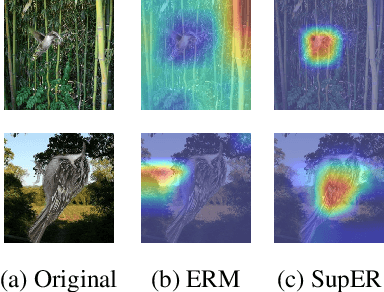
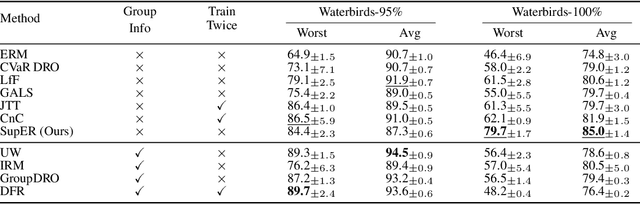
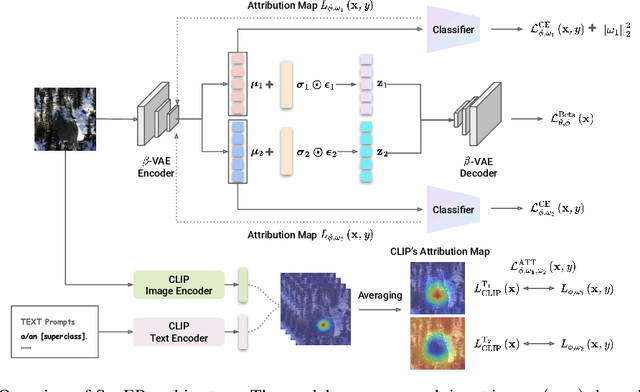
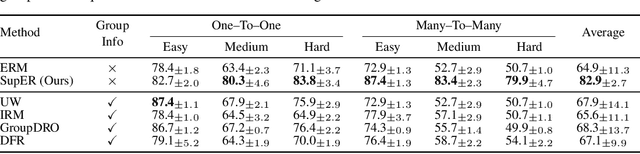
To enhance group robustness to spurious correlations, prior work often relies on auxiliary annotations for groups or spurious features and assumes identical sets of groups across source and target domains. These two requirements are both unnatural and impractical in real-world settings. To overcome these limitations, we propose a method that leverages the semantic structure inherent in class labels--specifically, superclass information--to naturally reduce reliance on spurious features. Our model employs gradient-based attention guided by a pre-trained vision-language model to disentangle superclass-relevant and irrelevant features. Then, by promoting the use of all superclass-relevant features for prediction, our approach achieves robustness to more complex spurious correlations without the need to annotate any source samples. Experiments across diverse datasets demonstrate that our method significantly outperforms baselines in domain generalization tasks, with clear improvements in both quantitative metrics and qualitative visualizations.
Fine-Tuning In-House Large Language Models to Infer Differential Diagnosis from Radiology Reports
Oct 11, 2024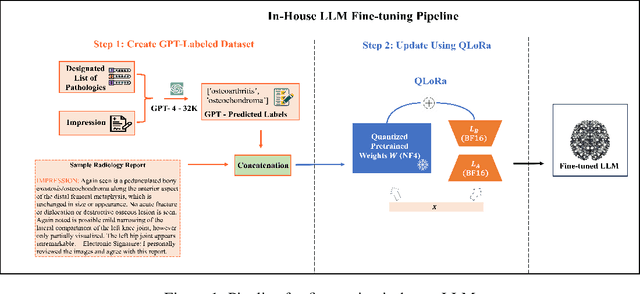
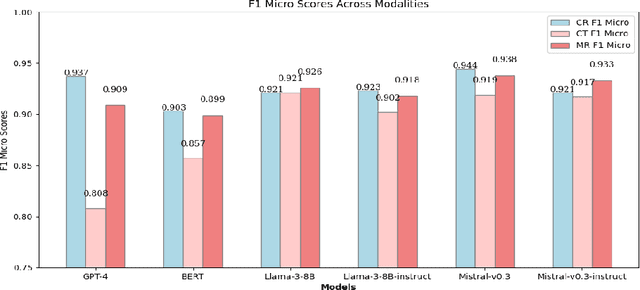
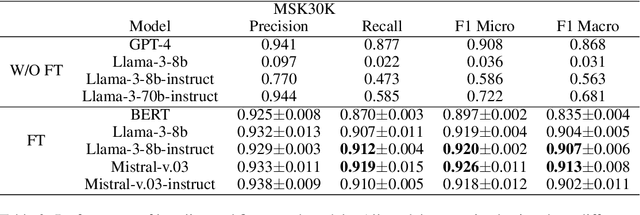
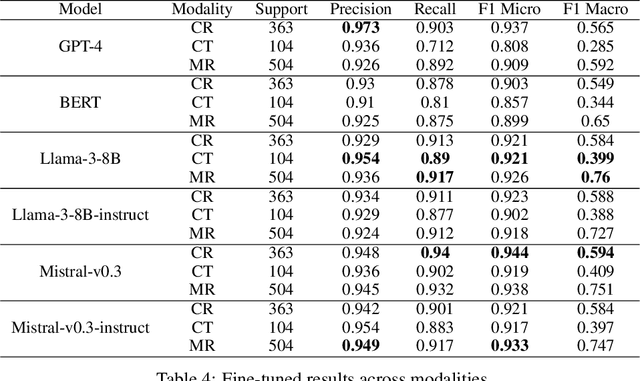
Radiology reports summarize key findings and differential diagnoses derived from medical imaging examinations. The extraction of differential diagnoses is crucial for downstream tasks, including patient management and treatment planning. However, the unstructured nature of these reports, characterized by diverse linguistic styles and inconsistent formatting, presents significant challenges. Although proprietary large language models (LLMs) such as GPT-4 can effectively retrieve clinical information, their use is limited in practice by high costs and concerns over the privacy of protected health information (PHI). This study introduces a pipeline for developing in-house LLMs tailored to identify differential diagnoses from radiology reports. We first utilize GPT-4 to create 31,056 labeled reports, then fine-tune open source LLM using this dataset. Evaluated on a set of 1,067 reports annotated by clinicians, the proposed model achieves an average F1 score of 92.1\%, which is on par with GPT-4 (90.8\%). Through this study, we provide a methodology for constructing in-house LLMs that: match the performance of GPT, reduce dependence on expensive proprietary models, and enhance the privacy and security of PHI.
BURExtract-Llama: An LLM for Clinical Concept Extraction in Breast Ultrasound Reports
Aug 21, 2024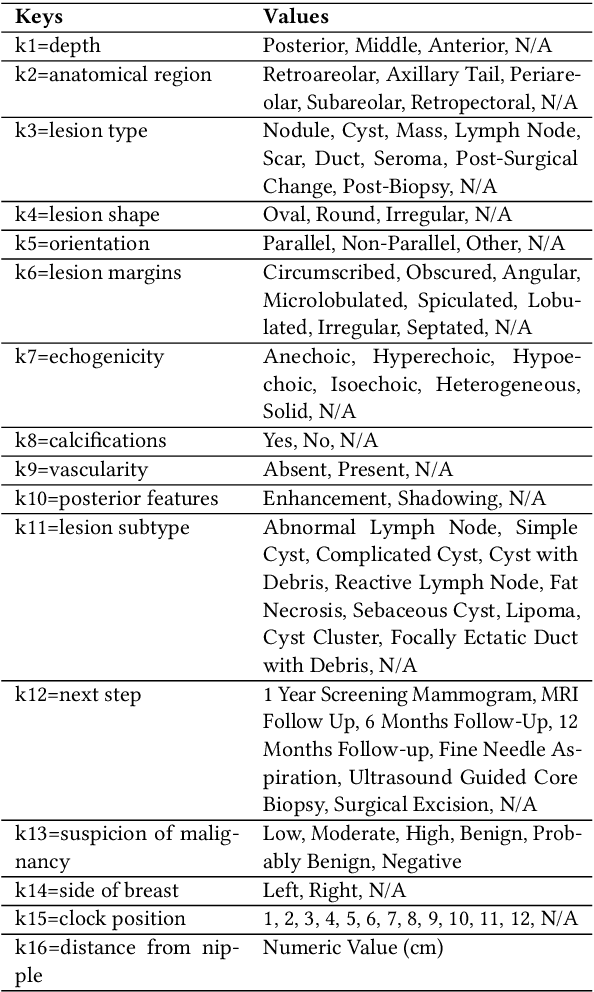


Breast ultrasound is essential for detecting and diagnosing abnormalities, with radiology reports summarizing key findings like lesion characteristics and malignancy assessments. Extracting this critical information is challenging due to the unstructured nature of these reports, with varied linguistic styles and inconsistent formatting. While proprietary LLMs like GPT-4 are effective, they are costly and raise privacy concerns when handling protected health information. This study presents a pipeline for developing an in-house LLM to extract clinical information from radiology reports. We first use GPT-4 to create a small labeled dataset, then fine-tune a Llama3-8B model on it. Evaluated on clinician-annotated reports, our model achieves an average F1 score of 84.6%, which is on par with GPT-4. Our findings demonstrate the feasibility of developing an in-house LLM that not only matches GPT-4's performance but also offers cost reductions and enhanced data privacy.
Understanding differences in applying DETR to natural and medical images
May 27, 2024Transformer-based detectors have shown success in computer vision tasks with natural images. These models, exemplified by the Deformable DETR, are optimized through complex engineering strategies tailored to the typical characteristics of natural scenes. However, medical imaging data presents unique challenges such as extremely large image sizes, fewer and smaller regions of interest, and object classes which can be differentiated only through subtle differences. This study evaluates the applicability of these transformer-based design choices when applied to a screening mammography dataset that represents these distinct medical imaging data characteristics. Our analysis reveals that common design choices from the natural image domain, such as complex encoder architectures, multi-scale feature fusion, query initialization, and iterative bounding box refinement, do not improve and sometimes even impair object detection performance in medical imaging. In contrast, simpler and shallower architectures often achieve equal or superior results. This finding suggests that the adaptation of transformer models for medical imaging data requires a reevaluation of standard practices, potentially leading to more efficient and specialized frameworks for medical diagnosis.
Leveraging Transformers to Improve Breast Cancer Classification and Risk Assessment with Multi-modal and Longitudinal Data
Nov 15, 2023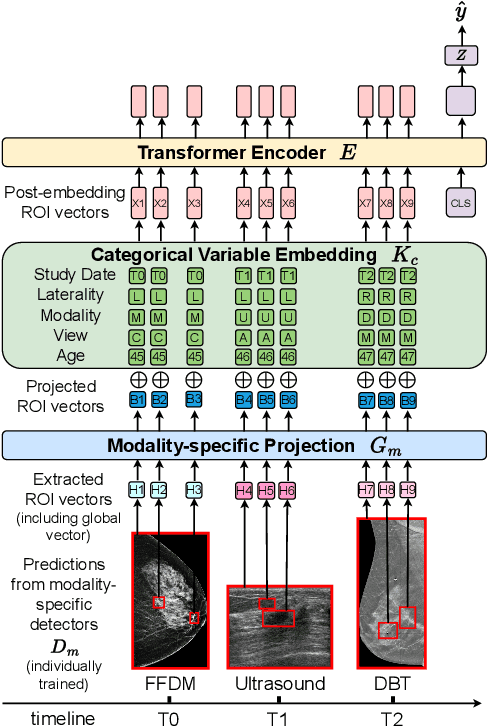
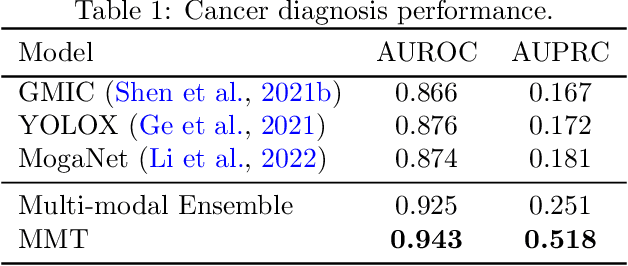
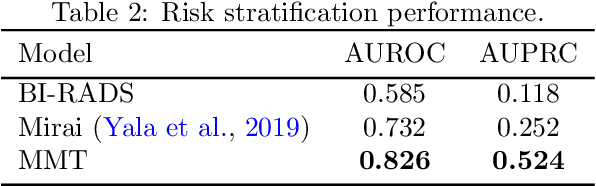
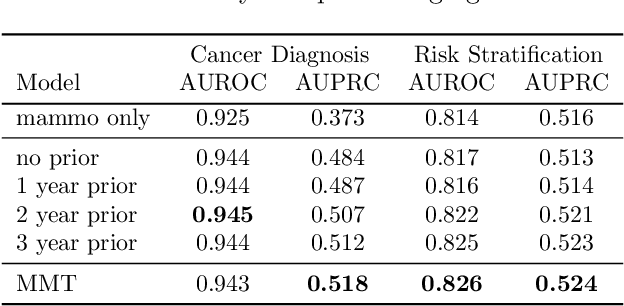
Breast cancer screening, primarily conducted through mammography, is often supplemented with ultrasound for women with dense breast tissue. However, existing deep learning models analyze each modality independently, missing opportunities to integrate information across imaging modalities and time. In this study, we present Multi-modal Transformer (MMT), a neural network that utilizes mammography and ultrasound synergistically, to identify patients who currently have cancer and estimate the risk of future cancer for patients who are currently cancer-free. MMT aggregates multi-modal data through self-attention and tracks temporal tissue changes by comparing current exams to prior imaging. Trained on 1.3 million exams, MMT achieves an AUROC of 0.943 in detecting existing cancers, surpassing strong uni-modal baselines. For 5-year risk prediction, MMT attains an AUROC of 0.826, outperforming prior mammography-based risk models. Our research highlights the value of multi-modal and longitudinal imaging in cancer diagnosis and risk stratification.
Multiple Instance Learning via Iterative Self-Paced Supervised Contrastive Learning
Oct 17, 2022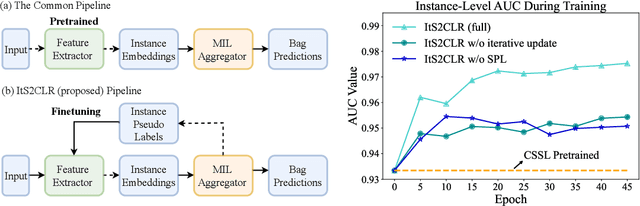
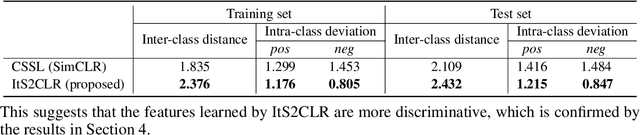
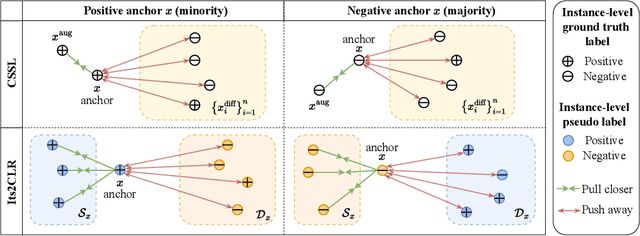

Learning representations for individual instances when only bag-level labels are available is a fundamental challenge in multiple instance learning (MIL). Recent works have shown promising results using contrastive self-supervised learning (CSSL), which learns to push apart representations corresponding to two different randomly-selected instances. Unfortunately, in real-world applications such as medical image classification, there is often class imbalance, so randomly-selected instances mostly belong to the same majority class, which precludes CSSL from learning inter-class differences. To address this issue, we propose a novel framework, Iterative Self-paced Supervised Contrastive Learning for MIL Representations (ItS2CLR), which improves the learned representation by exploiting instance-level pseudo labels derived from the bag-level labels. The framework employs a novel self-paced sampling strategy to ensure the accuracy of pseudo labels. We evaluate ItS2CLR on three medical datasets, showing that it improves the quality of instance-level pseudo labels and representations, and outperforms existing MIL methods in terms of both bag and instance level accuracy.