 Add to Chrome
 Add to Firefox
 Add to Edge
A Task-Centric Theory for Iterative Self-Improvement with Easy-to-Hard Curricula
Feb 10, 2026
Iterative self-improvement fine-tunes an autoregressive large language model (LLM) on reward-verified outputs generated by the LLM itself. In contrast to the empirical success of self-improvement, the theoretical foundation of this generative, iterative procedure in a practical, finite-sample setting remains limited. We make progress toward this goal by modeling each round of self-improvement as maximum-likelihood fine-tuning on a reward-filtered distribution and deriving finite-sample guarantees for the expected reward. Our analysis reveals an explicit feedback loop where better models accept more data per iteration, supporting sustained self-improvement while explaining eventual saturation of such improvement. Adopting a task-centric view by considering reasoning tasks with multiple difficulty levels, we further prove quantifiable conditions on model initialization, task difficulty, and sample budget where easy-to-hard curricula provably achieve better guarantees than training on fixed mixtures of tasks. Our analyses are validated via Monte-Carlo simulations and controlled experiments on graph-based reasoning tasks.

Superclass-Guided Representation Disentanglement for Spurious Correlation Mitigation
Aug 12, 2025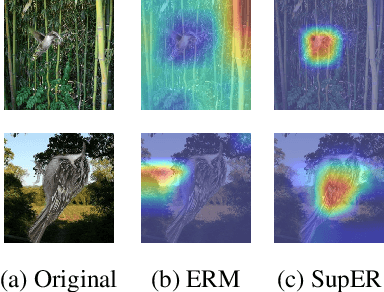
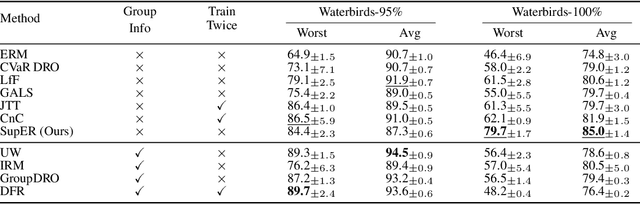
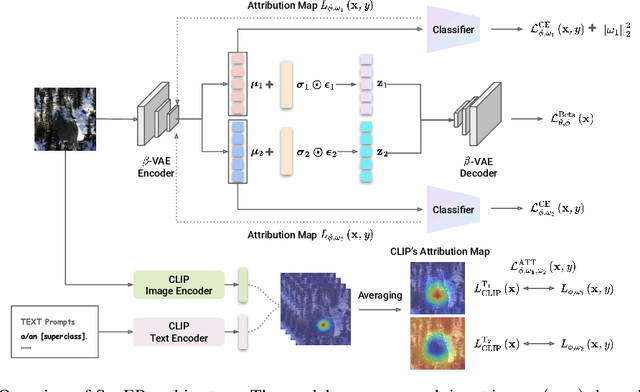
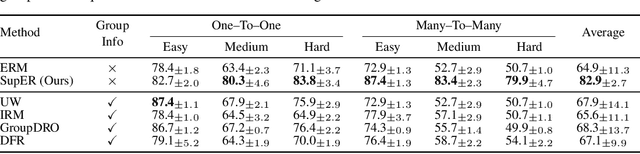
To enhance group robustness to spurious correlations, prior work often relies on auxiliary annotations for groups or spurious features and assumes identical sets of groups across source and target domains. These two requirements are both unnatural and impractical in real-world settings. To overcome these limitations, we propose a method that leverages the semantic structure inherent in class labels--specifically, superclass information--to naturally reduce reliance on spurious features. Our model employs gradient-based attention guided by a pre-trained vision-language model to disentangle superclass-relevant and irrelevant features. Then, by promoting the use of all superclass-relevant features for prediction, our approach achieves robustness to more complex spurious correlations without the need to annotate any source samples. Experiments across diverse datasets demonstrate that our method significantly outperforms baselines in domain generalization tasks, with clear improvements in both quantitative metrics and qualitative visualizations.
Bridging Distribution Shift and AI Safety: Conceptual and Methodological Synergies
May 28, 2025This paper bridges distribution shift and AI safety through a comprehensive analysis of their conceptual and methodological synergies. While prior discussions often focus on narrow cases or informal analogies, we establish two types connections between specific causes of distribution shift and fine-grained AI safety issues: (1) methods addressing a specific shift type can help achieve corresponding safety goals, or (2) certain shifts and safety issues can be formally reduced to each other, enabling mutual adaptation of their methods. Our findings provide a unified perspective that encourages fundamental integration between distribution shift and AI safety research.