 Add to Chrome
 Add to Firefox
 Add to Edge
AMR-SD: Asymmetric Meta-Reflective Self-Distillation for Token-Level Credit Assignment
May 18, 2026
The alignment of Large Language Models (LLMs) for complex reasoning heavily relies on Reinforcement Learning with Verifiable Rewards (RLVR). However, standard algorithms like GRPO apply sequence-level rewards uniformly to all tokens, creating a severe credit-assignment bottleneck. While on-policy self-distillation attempts to resolve this by conditioning a self-teacher on privileged contexts, direct exposure to raw oracle solutions often induces over-conditioned teacher distributions, implicit answer leakage, and late-stage training collapse. To overcome these limitations, we propose Asymmetric Meta-Reflective Self-Distillation (AMR-SD). Instead of conditioning directly on raw reference traces, AMR-SD inserts a reflection bottleneck: it compresses diagnostic signals -- from verifier outcomes, peer rollouts, or reference feedback -- into concise, self-generated Socratic hints and critiques. Furthermore, we introduce Causal Information Gain (CIG) with an asymmetric, ReLU-gated threshold to translate these reflections into sparse, highly precise token-level advantage modulations. Combined with temporal annealing, this mechanism preserves the base environmental reward while filtering out distributional noise. Experiments across scientific, mathematical, and tool-use benchmarks demonstrate that AMR-SD significantly outperforms existing baselines, achieving robust long-horizon stability and successfully preventing late-stage collapse.

TokAlign++: Advancing Vocabulary Adaptation via Better Token Alignment
May 13, 2026Tokenization is a foundational step in the text process of Large Language Models (LLMs). Texts must be first tokenized into token IDs, which are then input to LLMs. Inefficient tokenization results in long token-ID sequences and will slow down the training and inference of LLMs. The fine-grained knowledge transfer between LLMs, like token-level distillation, is also impeded by the mismatch in vocabulary. To bridge this gap, we introduce a method named TokAlign++ to improve vocabulary adaptation performance by learning better token alignment lexicon. The source and target vocabularies are taken as two different languages, and the bilingual token alignment lexicon is learned from monolingual token representations. Model parameters are rearranged following this bilingual lexicon for new vocabulary, and progressively fine-tuned for adaptation. Experimental results on 15 languages show that our method boosts the multilingual text compression rates and preserves most of the multilingual ability of vanilla models. It costs as few as 1k steps to restore the performance of the vanilla model. After unifying vocabularies between vanilla models, token-level distillation remarkably improves the base model with only 235M tokens.
Group then Scale: Dynamic Mixture-of-Experts Multilingual Language Model
Jun 14, 2025The curse of multilinguality phenomenon is a fundamental problem of multilingual Large Language Models (LLMs), where the competition between massive languages results in inferior performance. It mainly comes from limited capacity and negative transfer between dissimilar languages. To address this issue, we propose a method to dynamically group and scale up the parameters of multilingual LLM while boosting positive transfer among similar languages. Specifically, the model is first tuned on monolingual corpus to determine the parameter deviation in each layer and quantify the similarity between languages. Layers with more deviations are extended to mixture-of-experts layers to reduce competition between languages, where one expert module serves one group of similar languages. Experimental results on 18 to 128 languages show that our method reduces the negative transfer between languages and significantly boosts multilingual performance with fewer parameters. Such language group specialization on experts benefits the new language adaptation and reduces the inference on the previous multilingual knowledge learned.
Robust Principal Component Analysis via Discriminant Sample Weight Learning
Aug 22, 2024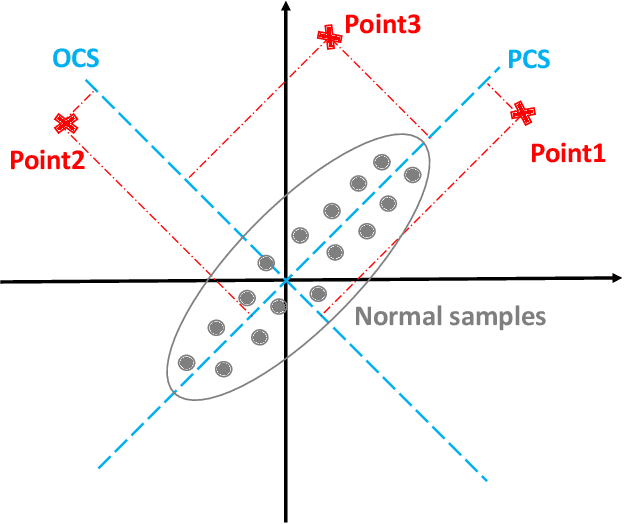
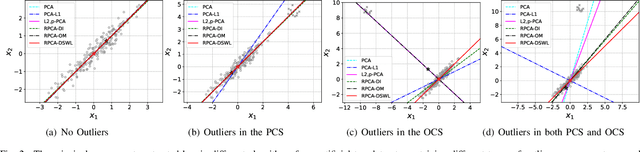
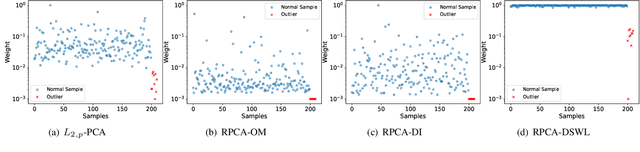
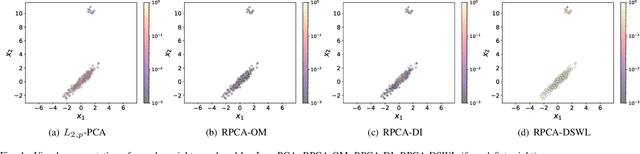
Principal component analysis (PCA) is a classical feature extraction method, but it may be adversely affected by outliers, resulting in inaccurate learning of the projection matrix. This paper proposes a robust method to estimate both the data mean and the PCA projection matrix by learning discriminant sample weights from data containing outliers. Each sample in the dataset is assigned a weight, and the proposed algorithm iteratively learns the weights, the mean, and the projection matrix, respectively. Specifically, when the mean and the projection matrix are available, via fine-grained analysis of outliers, a weight for each sample is learned hierarchically so that outliers have small weights while normal samples have large weights. With the learned weights available, a weighted optimization problem is solved to estimate both the data mean and the projection matrix. Because the learned weights discriminate outliers from normal samples, the adverse influence of outliers is mitigated due to the corresponding small weights. Experiments on toy data, UCI dataset, and face dataset demonstrate the effectiveness of the proposed method in estimating the mean and the projection matrix from the data containing outliers.