 Add to Chrome
 Add to Firefox
 Add to Edge
SAIF: A Stability-Aware Inference Framework for Medical Image Segmentation with Segment Anything Model
Mar 13, 2026
Segment Anything Model (SAM) enable scalable medical image segmentation but suffer from inference-time instability when deployed as a frozen backbone. In practice, bounding-box prompts often contain localization errors, and fixed threshold binarization introduces additional decision uncertainty. These factors jointly cause high prediction variance, especially near object boundaries, degrading reliability. We propose the Stability-Aware Inference Framework (SAIF), a training-free and plug-and-play inference framework that improves robustness by explicitly modeling prompt and threshold uncertainty. SAIF constructs a joint uncertainty space via structured box perturbations and threshold variations, evaluates each hypothesis using decision stability and boundary consistency, and introduces a stability-consistency score to filter unstable candidates and perform stability-weighted fusion in probability space. Experiments on Synapse, CVC-ClinicDB, Kvasir-SEG, and CVC-300 demonstrate that SAIF consistently improves segmentation accuracy and robustness, achieving state-of-the-art performance without retraining or architectural modification. Our anonymous code is released at https://anonymous.4open.science/r/SAIF.

Semantic Class Distribution Learning for Debiasing Semi-Supervised Medical Image Segmentation
Mar 05, 2026Medical image segmentation is critical for computer-aided diagnosis. However, dense pixel-level annotation is time-consuming and expensive, and medical datasets often exhibit severe class imbalance. Such imbalance causes minority structures to be overwhelmed by dominant classes in feature representations, hindering the learning of discriminative features and making reliable segmentation particularly challenging. To address this, we propose the Semantic Class Distribution Learning (SCDL) framework, a plug-and-play module that mitigates supervision and representation biases by learning structured class-conditional feature distributions. SCDL integrates Class Distribution Bidirectional Alignment (CDBA) to align embeddings with learnable class proxies and leverages Semantic Anchor Constraints (SAC) to guide proxies using labeled data. Experiments on the Synapse and AMOS datasets demonstrate that SCDL significantly improves segmentation performance across both overall and class-level metrics, with particularly strong gains on minority classes, achieving state-of-the-art results. Our code is released at https://github.com/Zyh55555/SCDL.
Toward Modality Gap: Vision Prototype Learning for Weakly-supervised Semantic Segmentation with CLIP
Dec 27, 2024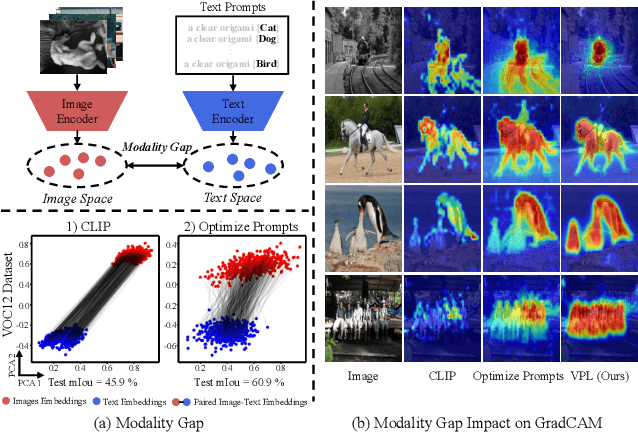
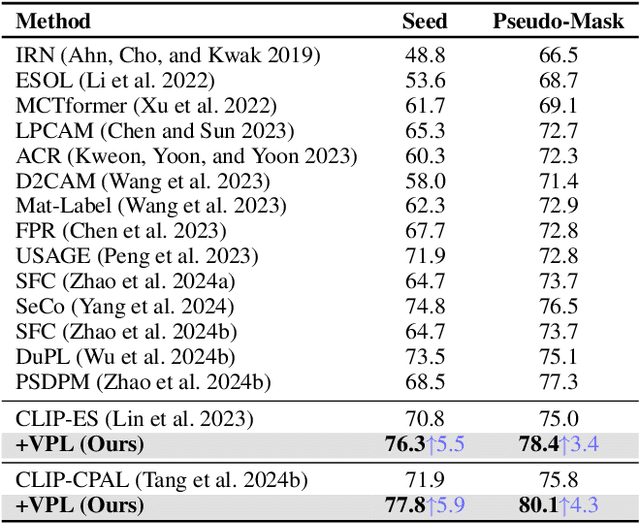
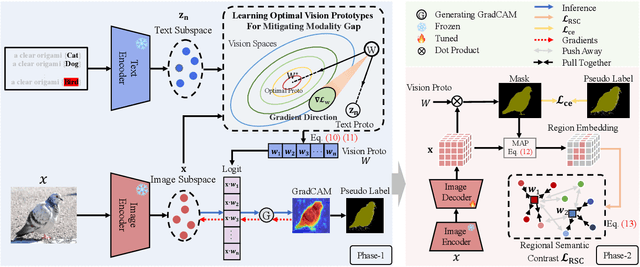
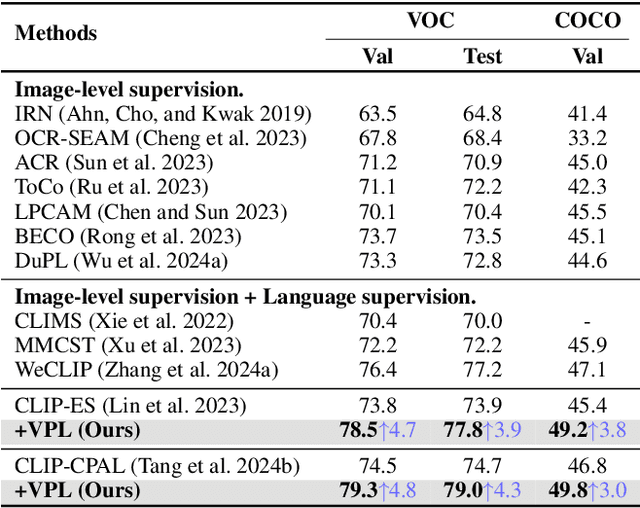
The application of Contrastive Language-Image Pre-training (CLIP) in Weakly Supervised Semantic Segmentation (WSSS) research powerful cross-modal semantic understanding capabilities. Existing methods attempt to optimize input text prompts for improved alignment of images and text, by finely adjusting text prototypes to facilitate semantic matching. Nevertheless, given the modality gap between text and vision spaces, the text prototypes employed by these methods have not effectively established a close correspondence with pixel-level vision features. In this work, our theoretical analysis indicates that the inherent modality gap results in misalignment of text and region features, and that this gap cannot be sufficiently reduced by minimizing contrast loss in CLIP. To mitigate the impact of the modality gap, we propose a Vision Prototype Learning (VPL) framework, by introducing more representative vision prototypes. The core of this framework is to learn class-specific vision prototypes in vision space with the help of text prototypes, for capturing high-quality localization maps. Moreover, we propose a regional semantic contrast module that contrasts regions embedding with corresponding prototypes, leading to more comprehensive and robust feature learning. Experimental results show that our proposed framework achieves state-of-the-art performance on two benchmark datasets.