 Add to Chrome
 Add to Firefox
 Add to Edge
KAT-Coder-V2.5 Technical Report
Jul 06, 2026
We present KAT-Coder-V2.5, a coding-focused agentic model trained to act autonomously inside real, executable repositories rather than as a single-turn code generator. Its capability is bottlenecked less by model scale than by the scarcity of reproducible environments, verifiable rewards, and high-value trajectories, which we address with an end-to-end agentic post-training framework. AutoBuilder reconstructs multilingual repositories into sandboxed environments with fail-to-pass and pass-to-pass verification at scale, from which we regenerate self-contained task specifications, recover near-miss trajectories, and distill supervision through process-aware filtering, while KwaiClawEnv synthesizes large-scale tool-use trajectories from executable services and real task seeds. We further scale reinforcement learning with harness randomization, a reliability-hardened sandbox, an asymmetric actor--critic PPO with hindsight-augmented value estimation, and a harness-oriented reward framework, and unify SWE, Agent-Claw, and WebCoding experts via Multi-Teacher On-Policy Distillation. Across six software-engineering and agentic benchmarks, KAT-Coder-V2.5 delivers the best agentic tool-use result on PinchBench and ranks second only to the frontier Opus 4.8 on repository-level software engineering. Our service is available at https://streamlake.com/product/kat-coder.

KAT-Coder-V2 Technical Report
Mar 29, 2026We present KAT-Coder-V2, an agentic coding model developed by the KwaiKAT team at Kuaishou. KAT-Coder-V2 adopts a "Specialize-then-Unify" paradigm that decomposes agentic coding into five expert domains - SWE, WebCoding, Terminal, WebSearch, and General - each undergoing independent supervised fine-tuning and reinforcement learning, before being consolidated into a single model via on-policy distillation. We develop KwaiEnv, a modular infrastructure sustaining tens of thousands of concurrent sandbox instances, and scale RL training along task complexity, intent alignment, and scaffold generalization. We further propose MCLA for stabilizing MoE RL training and Tree Training for eliminating redundant computation over tree-structured trajectories with up to 6.2x speedup. KAT-Coder-V2 achieves 79.6% on SWE-bench Verified (vs. Claude Opus 4.6 at 80.8%), 88.7 on PinchBench (surpassing GLM-5 and MiniMax M2.7), ranks first across all three frontend aesthetics scenarios, and maintains strong generalist scores on Terminal-Bench Hard (46.8) and tau^2-Bench (93.9). Our model is publicly available at https://streamlake.com/product/kat-coder.
SRPO: A Cross-Domain Implementation of Large-Scale Reinforcement Learning on LLM
Apr 22, 2025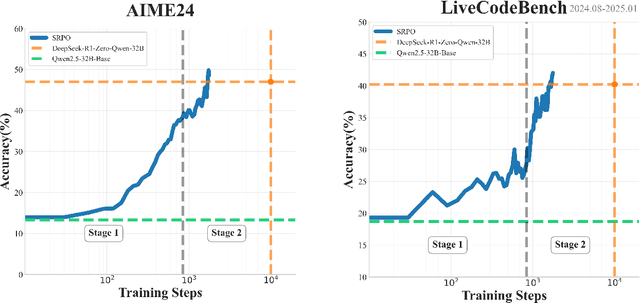

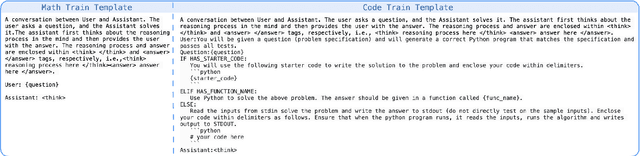
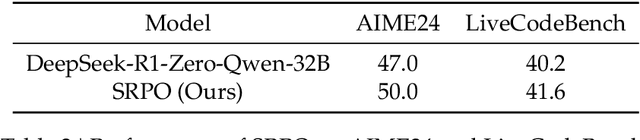
Recent advances of reasoning models, exemplified by OpenAI's o1 and DeepSeek's R1, highlight the significant potential of Reinforcement Learning (RL) to enhance the reasoning capabilities of Large Language Models (LLMs). However, replicating these advancements across diverse domains remains challenging due to limited methodological transparency. In this work, we present two-Staged history-Resampling Policy Optimization (SRPO), which surpasses the performance of DeepSeek-R1-Zero-32B on the AIME24 and LiveCodeBench benchmarks. SRPO achieves this using the same base model as DeepSeek (i.e. Qwen2.5-32B), using only about 1/10 of the training steps required by DeepSeek-R1-Zero-32B, demonstrating superior efficiency. Building upon Group Relative Policy Optimization (GRPO), we introduce two key methodological innovations: (1) a two-stage cross-domain training paradigm designed to balance the development of mathematical reasoning and coding proficiency, and (2) History Resampling (HR), a technique to address ineffective samples. Our comprehensive experiments validate the effectiveness of our approach, offering valuable insights into scaling LLM reasoning capabilities across diverse tasks.