 Add to Chrome
 Add to Firefox
 Add to Edge
SWE-Compass: Towards Unified Evaluation of Agentic Coding Abilities for Large Language Models
Nov 07, 2025
Evaluating large language models (LLMs) for software engineering has been limited by narrow task coverage, language bias, and insufficient alignment with real-world developer workflows. Existing benchmarks often focus on algorithmic problems or Python-centric bug fixing, leaving critical dimensions of software engineering underexplored. To address these gaps, we introduce SWE-Compass1, a comprehensive benchmark that unifies heterogeneous code-related evaluations into a structured and production-aligned framework. SWE-Compass spans 8 task types, 8 programming scenarios, and 10 programming languages, with 2000 high-quality instances curated from authentic GitHub pull requests and refined through systematic filtering and validation. We benchmark ten state-of-the-art LLMs under two agentic frameworks, SWE-Agent and Claude Code, revealing a clear hierarchy of difficulty across task types, languages, and scenarios. Moreover, by aligning evaluation with real-world developer practices, SWE-Compass provides a rigorous and reproducible foundation for diagnosing and advancing agentic coding capabilities in large language models.

SRPO: A Cross-Domain Implementation of Large-Scale Reinforcement Learning on LLM
Apr 22, 2025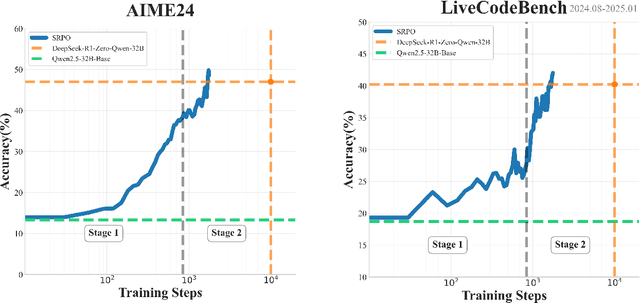

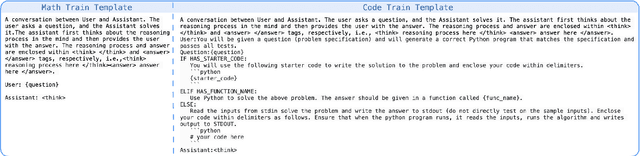
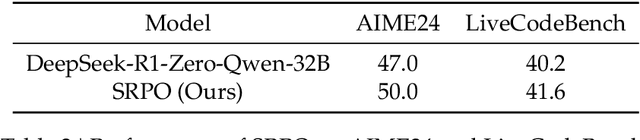
Recent advances of reasoning models, exemplified by OpenAI's o1 and DeepSeek's R1, highlight the significant potential of Reinforcement Learning (RL) to enhance the reasoning capabilities of Large Language Models (LLMs). However, replicating these advancements across diverse domains remains challenging due to limited methodological transparency. In this work, we present two-Staged history-Resampling Policy Optimization (SRPO), which surpasses the performance of DeepSeek-R1-Zero-32B on the AIME24 and LiveCodeBench benchmarks. SRPO achieves this using the same base model as DeepSeek (i.e. Qwen2.5-32B), using only about 1/10 of the training steps required by DeepSeek-R1-Zero-32B, demonstrating superior efficiency. Building upon Group Relative Policy Optimization (GRPO), we introduce two key methodological innovations: (1) a two-stage cross-domain training paradigm designed to balance the development of mathematical reasoning and coding proficiency, and (2) History Resampling (HR), a technique to address ineffective samples. Our comprehensive experiments validate the effectiveness of our approach, offering valuable insights into scaling LLM reasoning capabilities across diverse tasks.