 Add to Chrome
 Add to Firefox
 Add to Edge
Learning Highly Dynamic Skills Transition for Quadruped Jumping Through Constrained Space
Aug 20, 2026
Although legged animals are capable of performing explosive motions while traversing confined spaces, replicating this behavior in quadrupedal robots has been a longstanding challenge. Here, we propose a hierarchical reinforcement learning pipeline that empowers the robots to perform aggressive locomotion through constrained obstacles--a narrow gate. The imitation learning technique is used to train the low-level policy, which mimics the behaviors of real animals and forms a set of diverse skills. The high-level controller, having an awareness of the capability of low-level skills and acquiring the gate information via vision-based detection, determines the suitable maneuvers with collision-free trajectories to traverse it dynamically. Notably, we also verify that this framework can be extended to other highly dynamic tasks. This is one of the first works that perform autonomous and agile aerial gate traversal tasks on ground-walking robots, extending the lifelike agility of legged robots to match that of their biological counterparts.
* 15 pages, 12 figures

Co-jump: Cooperative Jumping with Quadrupedal Robots via Multi-Agent Reinforcement Learning
Feb 11, 2026While single-agent legged locomotion has witnessed remarkable progress, individual robots remain fundamentally constrained by physical actuation limits. To transcend these boundaries, we introduce Co-jump, a cooperative task where two quadrupedal robots synchronize to execute jumps far beyond their solo capabilities. We tackle the high-impulse contact dynamics of this task under a decentralized setting, achieving synchronization without explicit communication or pre-specified motion primitives. Our framework leverages Multi-Agent Proximal Policy Optimization (MAPPO) enhanced by a progressive curriculum strategy, which effectively overcomes the sparse-reward exploration challenges inherent in mechanically coupled systems. We demonstrate robust performance in simulation and successful transfer to physical hardware, executing multi-directional jumps onto platforms up to 1.5 m in height. Specifically, one of the robots achieves a foot-end elevation of 1.1 m, which represents a 144% improvement over the 0.45 m jump height of a standalone quadrupedal robot, demonstrating superior vertical performance. Notably, this precise coordination is achieved solely through proprioceptive feedback, establishing a foundation for communication-free collaborative locomotion in constrained environments.
Learning Human-Like Badminton Skills for Humanoid Robots
Feb 09, 2026Realizing versatile and human-like performance in high-demand sports like badminton remains a formidable challenge for humanoid robotics. Unlike standard locomotion or static manipulation, this task demands a seamless integration of explosive whole-body coordination and precise, timing-critical interception. While recent advances have achieved lifelike motion mimicry, bridging the gap between kinematic imitation and functional, physics-aware striking without compromising stylistic naturalness is non-trivial. To address this, we propose Imitation-to-Interaction, a progressive reinforcement learning framework designed to evolve a robot from a "mimic" to a capable "striker." Our approach establishes a robust motor prior from human data, distills it into a compact, model-based state representation, and stabilizes dynamics via adversarial priors. Crucially, to overcome the sparsity of expert demonstrations, we introduce a manifold expansion strategy that generalizes discrete strike points into a dense interaction volume. We validate our framework through the mastery of diverse skills, including lifts and drop shots, in simulation. Furthermore, we demonstrate the first zero-shot sim-to-real transfer of anthropomorphic badminton skills to a humanoid robot, successfully replicating the kinetic elegance and functional precision of human athletes in the physical world.
Safety-Assured Speculative Planning with Adaptive Prediction
Jul 21, 2023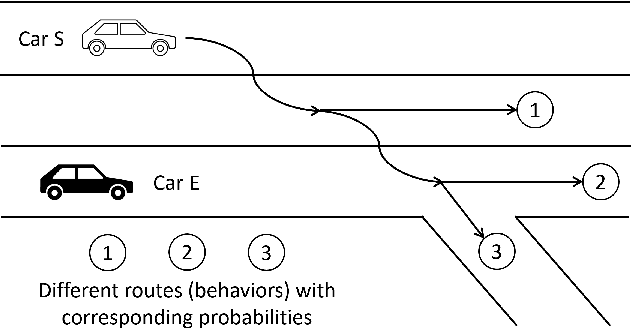
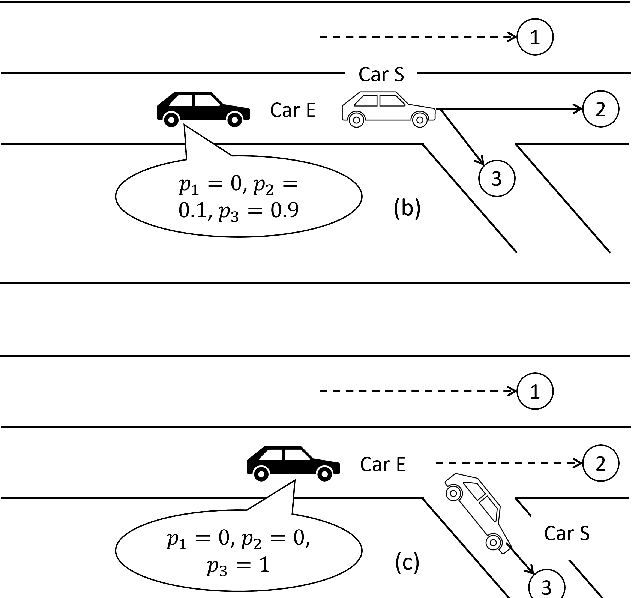
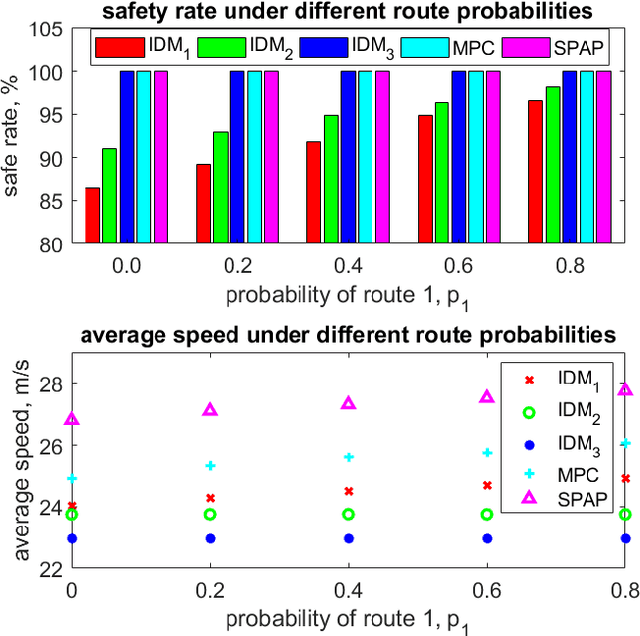
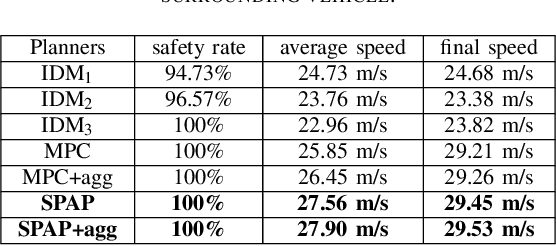
Recently significant progress has been made in vehicle prediction and planning algorithms for autonomous driving. However, it remains quite challenging for an autonomous vehicle to plan its trajectory in complex scenarios when it is difficult to accurately predict its surrounding vehicles' behaviors and trajectories. In this work, to maximize performance while ensuring safety, we propose a novel speculative planning framework based on a prediction-planning interface that quantifies both the behavior-level and trajectory-level uncertainties of surrounding vehicles. Our framework leverages recent prediction algorithms that can provide one or more possible behaviors and trajectories of the surrounding vehicles with probability estimation. It adapts those predictions based on the latest system states and traffic environment, and conducts planning to maximize the expected reward of the ego vehicle by considering the probabilistic predictions of all scenarios and ensure system safety by ruling out actions that may be unsafe in worst case. We demonstrate the effectiveness of our approach in improving system performance and ensuring system safety over other baseline methods, via extensive simulations in SUMO on a challenging multi-lane highway lane-changing case study.