 Add to Chrome
 Add to Firefox
 Add to Edge
AgentSchool: An LLM-Powered Multi-Agent Simulation for Education
May 28, 2026
Despite the rapid deployment of LLMs into classrooms, validating educational AI remains uniquely intractable: interventions act on developing learners whose cognitive and social trajectories are irreversibly shaped, while real-world trials are slow, ethically constrained, and institutionally locked. LLM-based educational simulators have emerged as a potential remedy, but many still collapse learning into persona-conditioned role-play and, when optimized only to reproduce existing classrooms, can structurally penalize the institutional novelty that pedagogical reform requires. In this work, we introduce AgentSchool, an LLM-driven multi-agent simulator that models learning as state transition rather than prompted behavior. AgentSchool couples cognitively growable student agents -- equipped with weighted subject knowledge graphs, thinking-workflow pools, and explicit misconceptions -- with adaptive teacher agents that plan, scaffold, and reflect along the Zone of Proximal Development, embedded in a configurable scenery generator that situates instruction within both formal and informal learning fields, and a multi-scale simulator that decouples interaction scale, temporal granularity, and simulation duration. Experiments show that structured student agents produce more differentiated mastery and misconception traces than a baseline simulator, while teacher-agent comparisons show backbone-dependent patterns consistent with ZPD-informed adaptation. Further, AgentSchool generates plausible traces of peripheral participation, clique formation, aggressor-induced cohesion, and opinion-leader emergence consistent with classroom social theories. Beyond its role as an educational research instrument, AgentSchool frames education as a socially meaningful testbed for long-horizon memory, multi-agent coordination, and future institutional reasoning under organizational pressure.

Sidelink Positioning: Standardization Advancements, Challenges and Opportunities
Dec 31, 2025With the integration of cellular networks in vertical industries that demand precise location information, such as vehicle-to-everything (V2X), public safety, and Industrial Internet of Things (IIoT), positioning has become an imperative component for future wireless networks. By exploiting a wider spectrum, multiple antennas and flexible architectures, cellular positioning achieves ever-increasing positioning accuracy. Still, it faces fundamental performance degradation when the distance between user equipment (UE) and the base station (BS) is large or in non-line-of-sight (NLoS) scenarios. To this end, the 3rd generation partnership project (3GPP) Rel-18 proposes to standardize sidelink (SL) positioning, which provides unique opportunities to extend the positioning coverage via direct positioning signaling between UEs. Despite the standardization advancements, the capability of SL positioning is controversial, especially how much spectrum is required to achieve the positioning accuracy defined in 3GPP. To this end, this article summarizes the latest standardization advancements of 3GPP on SL positioning comprehensively, covering a) network architecture; b) positioning types; and c) performance requirements. The capability of SL positioning using various positioning methods under different imperfect factors is evaluated and discussed in-depth. Finally, according to the evolution of SL in 3GPP Rel-19, we discuss the possible research directions and challenges of SL positioning.
Accelerating 3D MULTIPLEX MRI Reconstruction with Deep Learning
May 17, 2021
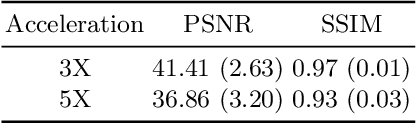
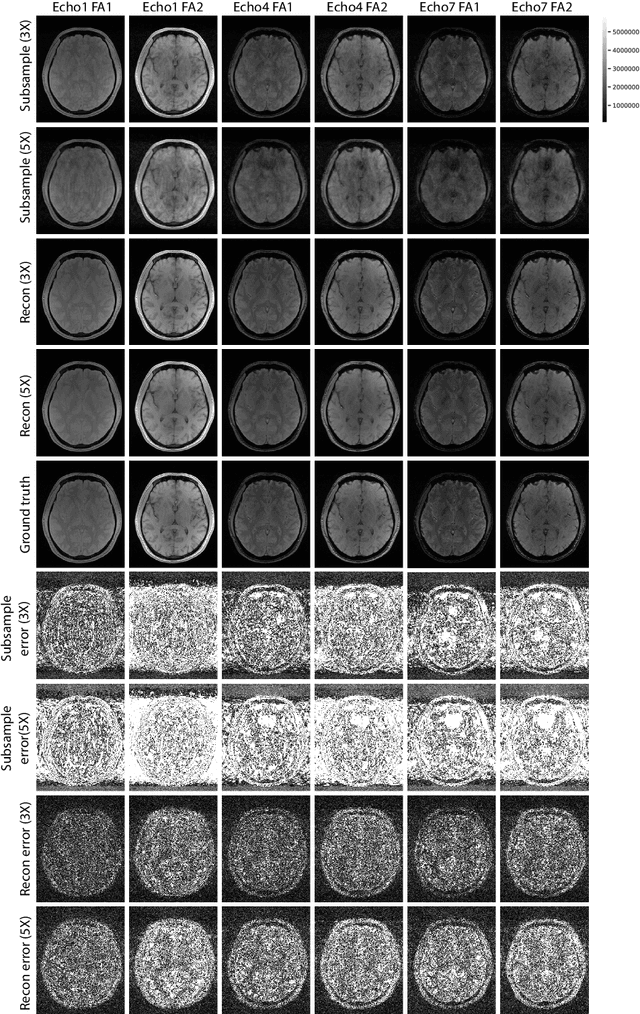
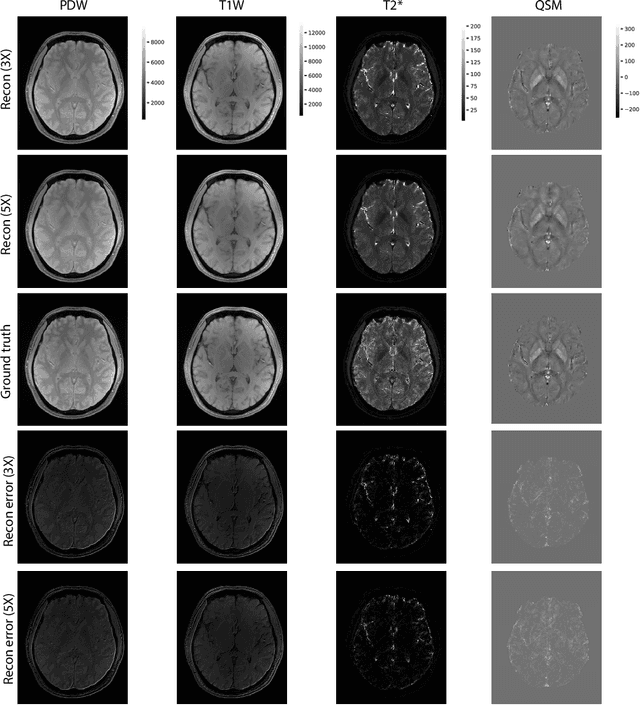
Multi-contrast MRI images provide complementary contrast information about the characteristics of anatomical structures and are commonly used in clinical practice. Recently, a multi-flip-angle (FA) and multi-echo GRE method (MULTIPLEX MRI) has been developed to simultaneously acquire multiple parametric images with just one single scan. However, it poses two challenges for MULTIPLEX to be used in the 3D high-resolution setting: a relatively long scan time and the huge amount of 3D multi-contrast data for reconstruction. Currently, no DL based method has been proposed for 3D MULTIPLEX data reconstruction. We propose a deep learning framework for undersampled 3D MRI data reconstruction and apply it to MULTIPLEX MRI. The proposed deep learning method shows good performance in image quality and reconstruction time.