 Add to Chrome
 Add to Firefox
 Add to Edge
AgentSchool: An LLM-Powered Multi-Agent Simulation for Education
May 28, 2026
Despite the rapid deployment of LLMs into classrooms, validating educational AI remains uniquely intractable: interventions act on developing learners whose cognitive and social trajectories are irreversibly shaped, while real-world trials are slow, ethically constrained, and institutionally locked. LLM-based educational simulators have emerged as a potential remedy, but many still collapse learning into persona-conditioned role-play and, when optimized only to reproduce existing classrooms, can structurally penalize the institutional novelty that pedagogical reform requires. In this work, we introduce AgentSchool, an LLM-driven multi-agent simulator that models learning as state transition rather than prompted behavior. AgentSchool couples cognitively growable student agents -- equipped with weighted subject knowledge graphs, thinking-workflow pools, and explicit misconceptions -- with adaptive teacher agents that plan, scaffold, and reflect along the Zone of Proximal Development, embedded in a configurable scenery generator that situates instruction within both formal and informal learning fields, and a multi-scale simulator that decouples interaction scale, temporal granularity, and simulation duration. Experiments show that structured student agents produce more differentiated mastery and misconception traces than a baseline simulator, while teacher-agent comparisons show backbone-dependent patterns consistent with ZPD-informed adaptation. Further, AgentSchool generates plausible traces of peripheral participation, clique formation, aggressor-induced cohesion, and opinion-leader emergence consistent with classroom social theories. Beyond its role as an educational research instrument, AgentSchool frames education as a socially meaningful testbed for long-horizon memory, multi-agent coordination, and future institutional reasoning under organizational pressure.

It Takes Two to Tango: A Holistic Simulator for Joint Order Scheduling and Multi-Agent Path Finding in Robotic Warehouses
Feb 15, 2026The prevailing paradigm in Robotic Mobile Fulfillment Systems (RMFS) typically treats order scheduling and multi-agent pathfinding as isolated sub-problems. We argue that this decoupling is a fundamental bottleneck, masking the critical dependencies between high-level dispatching and low-level congestion. Existing simulators fail to bridge this gap, often abstracting away heterogeneous kinematics and stochastic execution failures. We propose WareRover, a holistic simulation platform that enforces a tight coupling between OS and MAPF via a unified, closed-loop optimization interface. Unlike standard benchmarks, WareRover integrates dynamic order streams, physics-aware motion constraints, and non-nominal recovery mechanisms into a single evaluation loop. Experiments reveal that SOTA algorithms often falter under these realistic coupled constraints, demonstrating that WareRover provides a necessary and challenging testbed for robust, next-generation warehouse coordination. The project and video is available at https://hhh-x.github.io/WareRover/.
DOTA-ME-CS: Daily Oriented Text Audio-Mandarin English-Code Switching Dataset
Jan 21, 2025
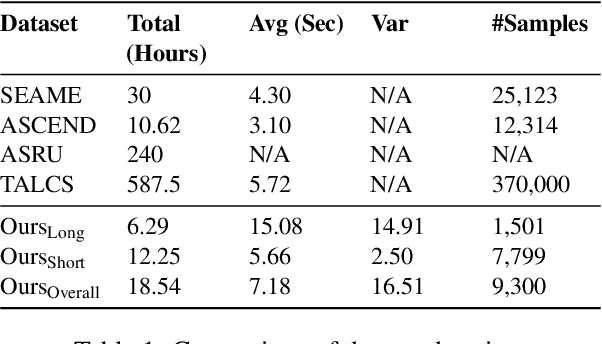
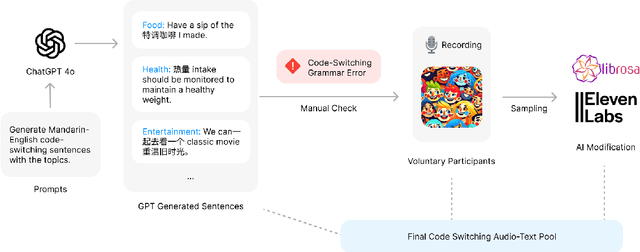

Code-switching, the alternation between two or more languages within communication, poses great challenges for Automatic Speech Recognition (ASR) systems. Existing models and datasets are limited in their ability to effectively handle these challenges. To address this gap and foster progress in code-switching ASR research, we introduce the DOTA-ME-CS: Daily oriented text audio Mandarin-English code-switching dataset, which consists of 18.54 hours of audio data, including 9,300 recordings from 34 participants. To enhance the dataset's diversity, we apply artificial intelligence (AI) techniques such as AI timbre synthesis, speed variation, and noise addition, thereby increasing the complexity and scalability of the task. The dataset is carefully curated to ensure both diversity and quality, providing a robust resource for researchers addressing the intricacies of bilingual speech recognition with detailed data analysis. We further demonstrate the dataset's potential in future research. The DOTA-ME-CS dataset, along with accompanying code, will be made publicly available.