 Add to Chrome
 Add to Firefox
 Add to Edge
AgentSchool: An LLM-Powered Multi-Agent Simulation for Education
May 28, 2026
Despite the rapid deployment of LLMs into classrooms, validating educational AI remains uniquely intractable: interventions act on developing learners whose cognitive and social trajectories are irreversibly shaped, while real-world trials are slow, ethically constrained, and institutionally locked. LLM-based educational simulators have emerged as a potential remedy, but many still collapse learning into persona-conditioned role-play and, when optimized only to reproduce existing classrooms, can structurally penalize the institutional novelty that pedagogical reform requires. In this work, we introduce AgentSchool, an LLM-driven multi-agent simulator that models learning as state transition rather than prompted behavior. AgentSchool couples cognitively growable student agents -- equipped with weighted subject knowledge graphs, thinking-workflow pools, and explicit misconceptions -- with adaptive teacher agents that plan, scaffold, and reflect along the Zone of Proximal Development, embedded in a configurable scenery generator that situates instruction within both formal and informal learning fields, and a multi-scale simulator that decouples interaction scale, temporal granularity, and simulation duration. Experiments show that structured student agents produce more differentiated mastery and misconception traces than a baseline simulator, while teacher-agent comparisons show backbone-dependent patterns consistent with ZPD-informed adaptation. Further, AgentSchool generates plausible traces of peripheral participation, clique formation, aggressor-induced cohesion, and opinion-leader emergence consistent with classroom social theories. Beyond its role as an educational research instrument, AgentSchool frames education as a socially meaningful testbed for long-horizon memory, multi-agent coordination, and future institutional reasoning under organizational pressure.

See, Plan, Snap: Evaluating Multimodal GUI Agents in Scratch
Feb 11, 2026Block-based programming environments such as Scratch play a central role in low-code education, yet evaluating the capabilities of AI agents to construct programs through Graphical User Interfaces (GUIs) remains underexplored. We introduce ScratchWorld, a benchmark for evaluating multimodal GUI agents on program-by-construction tasks in Scratch. Grounded in the Use-Modify-Create pedagogical framework, ScratchWorld comprises 83 curated tasks spanning four distinct problem categories: Create, Debug, Extend, and Compute. To rigorously diagnose the source of agent failures, the benchmark employs two complementary interaction modes: primitive mode requires fine-grained drag-and-drop manipulation to directly assess visuomotor control, while composite mode uses high-level semantic APIs to disentangle program reasoning from GUI execution. To ensure reliable assessment, we propose an execution-based evaluation protocol that validates the functional correctness of the constructed Scratch programs through runtime tests within the browser environment. Extensive experiments across state-of-the-art multimodal language models and GUI agents reveal a substantial reasoning--acting gap, highlighting persistent challenges in fine-grained GUI manipulation despite strong planning capabilities.
SafeWork-R1: Coevolving Safety and Intelligence under the AI-45$^{\circ}$ Law
Jul 24, 2025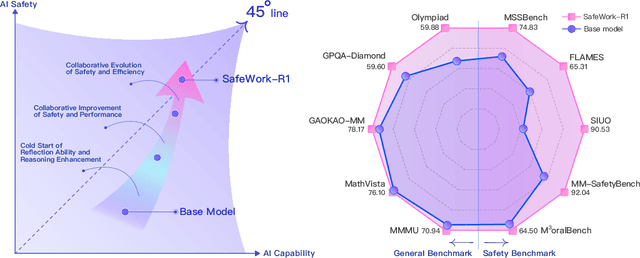
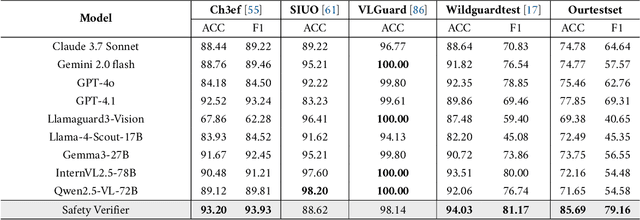
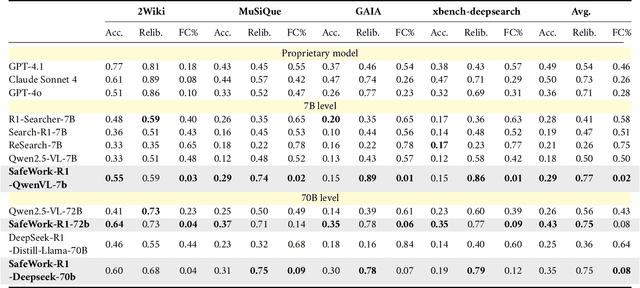
We introduce SafeWork-R1, a cutting-edge multimodal reasoning model that demonstrates the coevolution of capabilities and safety. It is developed by our proposed SafeLadder framework, which incorporates large-scale, progressive, safety-oriented reinforcement learning post-training, supported by a suite of multi-principled verifiers. Unlike previous alignment methods such as RLHF that simply learn human preferences, SafeLadder enables SafeWork-R1 to develop intrinsic safety reasoning and self-reflection abilities, giving rise to safety `aha' moments. Notably, SafeWork-R1 achieves an average improvement of $46.54\%$ over its base model Qwen2.5-VL-72B on safety-related benchmarks without compromising general capabilities, and delivers state-of-the-art safety performance compared to leading proprietary models such as GPT-4.1 and Claude Opus 4. To further bolster its reliability, we implement two distinct inference-time intervention methods and a deliberative search mechanism, enforcing step-level verification. Finally, we further develop SafeWork-R1-InternVL3-78B, SafeWork-R1-DeepSeek-70B, and SafeWork-R1-Qwen2.5VL-7B. All resulting models demonstrate that safety and capability can co-evolve synergistically, highlighting the generalizability of our framework in building robust, reliable, and trustworthy general-purpose AI.