 Add to Chrome
 Add to Firefox
 Add to Edge
Robotic Grasping and Placement Controlled by EEG-Based Hybrid Visual and Motor Imagery
Mar 03, 2026
We present a framework that integrates EEG-based visual and motor imagery (VI/MI) with robotic control to enable real-time, intention-driven grasping and placement. Motivated by the promise of BCI-driven robotics to enhance human-robot interaction, this system bridges neural signals with physical control by deploying offline-pretrained decoders in a zero-shot manner within an online streaming pipeline. This establishes a dual-channel intent interface that translates visual intent into robotic actions, with VI identifying objects for grasping and MI determining placement poses, enabling intuitive control over both what to grasp and where to place. The system operates solely on EEG via a cue-free imagery protocol, achieving integration and online validation. Implemented on a Base robotic platform and evaluated across diverse scenarios, including occluded targets or varying participant postures, the system achieves online decoding accuracies of 40.23% (VI) and 62.59% (MI), with an end-to-end task success rate of 20.88%. These results demonstrate that high-level visual cognition can be decoded in real time and translated into executable robot commands, bridging the gap between neural signals and physical interaction, and validating the flexibility of a purely imagery-based BCI paradigm for practical human-robot collaboration.

CineBrain: A Large-Scale Multi-Modal Brain Dataset During Naturalistic Audiovisual Narrative Processing
Mar 10, 2025

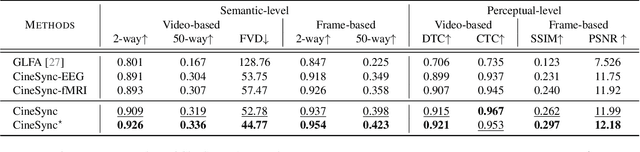
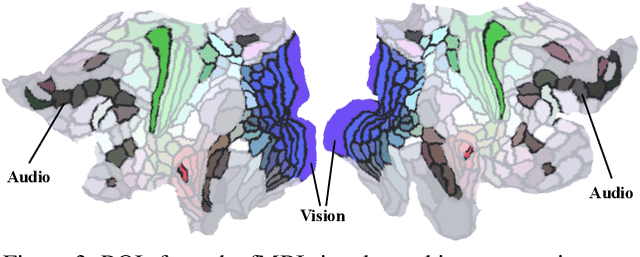
In this paper, we introduce CineBrain, the first large-scale dataset featuring simultaneous EEG and fMRI recordings during dynamic audiovisual stimulation. Recognizing the complementary strengths of EEG's high temporal resolution and fMRI's deep-brain spatial coverage, CineBrain provides approximately six hours of narrative-driven content from the popular television series The Big Bang Theory for each of six participants. Building upon this unique dataset, we propose CineSync, an innovative multimodal decoding framework integrates a Multi-Modal Fusion Encoder with a diffusion-based Neural Latent Decoder. Our approach effectively fuses EEG and fMRI signals, significantly improving the reconstruction quality of complex audiovisual stimuli. To facilitate rigorous evaluation, we introduce Cine-Benchmark, a comprehensive evaluation protocol that assesses reconstructions across semantic and perceptual dimensions. Experimental results demonstrate that CineSync achieves state-of-the-art video reconstruction performance and highlight our initial success in combining fMRI and EEG for reconstructing both video and audio stimuli. Project Page: https://jianxgao.github.io/CineBrain.