 Add to Chrome
 Add to Firefox
 Add to Edge
Smartwatch Photoplethysmography-Derived Heart Age via ECG-Guided Cross-Modal Pretraining as a Digital Biomarker of Vascular Aging
Aug 03, 2026
Digital biomarkers of cardiovascular aging, often termed heart or vascular age, have been widely studied, but most rely on resting electrocardiography (ECG), imaging, or specialized vascular assessments. Evidence linking wearable photoplethysmography (PPG) to arterial stiffness and hypertension remains limited. We developed an ECG-guided cross-modal framework that uses synchronized smartwatch ECG to enhance PPG representation learning during pretraining while requiring only PPG at inference. The study included three OPPO cohorts across China, comprising 581,804 participants and 7,452,131 recordings. The Vascular Health Study cohort supported ECG-PPG self-supervised pretraining, fine-tuning, and internal validation, while two external cohorts assessed associations with pulse wave velocity (PWV) and prevalent hypertension. Combining subject-aware learning with ECG-PPG contrastive alignment, the PPG-only model achieved subject-level mean absolute errors of 5.895 years (Pearson r=0.819) in the PWV cohort and 4.344 years (r=0.800) in the home blood pressure monitoring cohort. Aggregating repeated recordings further improved short-term stability. After adjustment for chronological age, heart age gap was associated with PWV (partial r=0.2627, P<0.001); each 1-year increase corresponded to 0.062 m/s higher PWV, and accelerated versus decelerated heart aging was associated with 0.91 m/s higher adjusted PWV. Each 1-SD increase in adjusted heart age gap was associated with greater odds of prevalent hypertension (OR 1.72, 95% CI 1.49-1.99), while the highest versus lowest quartile had an OR of 4.25. These findings support smartwatch PPG-derived heart age gap as a scalable digital biomarker of arterial stiffness and prevalent hypertension.

Constraint Latent Space Matters: An Anti-anomalous Waveform Transformation Solution from Photoplethysmography to Arterial Blood Pressure
Feb 23, 2024
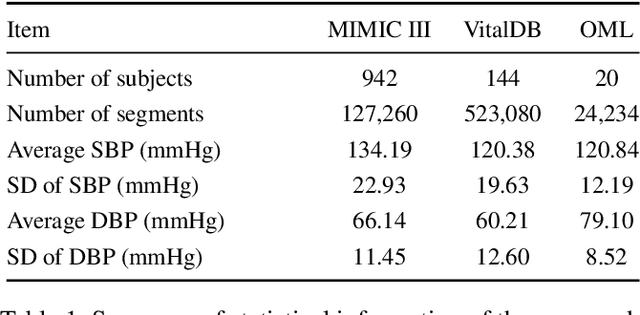
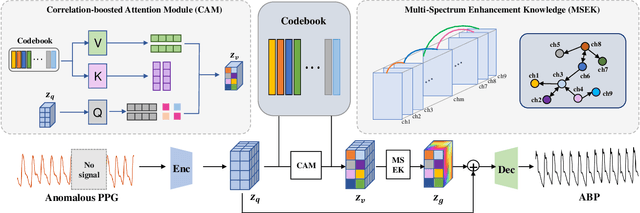
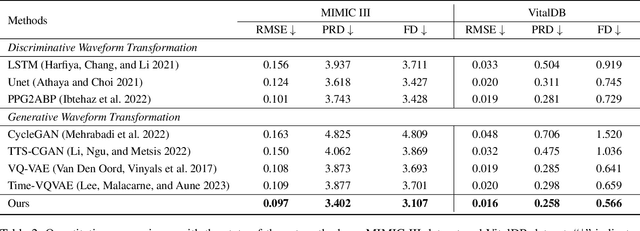
Arterial blood pressure (ABP) holds substantial promise for proactive cardiovascular health management. Notwithstanding its potential, the invasive nature of ABP measurements confines their utility primarily to clinical environments, limiting their applicability for continuous monitoring beyond medical facilities. The conversion of photoplethysmography (PPG) signals into ABP equivalents has garnered significant attention due to its potential in revolutionizing cardiovascular disease management. Recent strides in PPG-to-ABP prediction encompass the integration of generative and discriminative models. Despite these advances, the efficacy of these models is curtailed by the latent space shift predicament, stemming from alterations in PPG data distribution across disparate hardware and individuals, potentially leading to distorted ABP waveforms. To tackle this problem, we present an innovative solution named the Latent Space Constraint Transformer (LSCT), leveraging a quantized codebook to yield robust latent spaces by employing multiple discretizing bases. To facilitate improved reconstruction, the Correlation-boosted Attention Module (CAM) is introduced to systematically query pertinent bases on a global scale. Furthermore, to enhance expressive capacity, we propose the Multi-Spectrum Enhancement Knowledge (MSEK), which fosters local information flow within the channels of latent code and provides additional embedding for reconstruction. Through comprehensive experimentation on both publicly available datasets and a private downstream task dataset, the proposed approach demonstrates noteworthy performance enhancements compared to existing methods. Extensive ablation studies further substantiate the effectiveness of each introduced module.