 Add to Chrome
 Add to Firefox
 Add to Edge
Dual-Rerank: Fusing Causality and Utility for Industrial Generative Reranking
Apr 08, 2026
Kuaishou serves over 400 million daily active users, processing hundreds of millions of search queries daily against a repository of tens of billions of short videos. As the final decision layer, the reranking stage determines user experience by optimizing whole-page utility. While traditional score-and-sort methods fail to capture combinatorial dependencies, Generative Reranking offers a superior paradigm by directly modeling the permutation probability. However, deploying Generative Reranking in such a high-stakes environment faces a fundamental dual dilemma: 1) the structural trade-off where Autoregressive (AR) models offer superior Sequential modeling but suffer from prohibitive latency, versus Non-Autoregressive (NAR) models that enable efficiency but lack dependency capturing; 2) the optimization gap where Supervised Learning faces challenges in directly optimizing whole-page utility, while Reinforcement Learning (RL) struggles with instability in high-throughput data streams. To resolve this, we propose Dual-Rerank, a unified framework designed for industrial reranking that bridges the structural gap via Sequential Knowledge Distillation and addresses the optimization gap using List-wise Decoupled Reranking Optimization (LDRO) for stable online RL. Extensive A/B testing on production traffic demonstrates that Dual-Rerank achieves State-of-the-Art performance, significantly improving User satisfaction and Watch Time while drastically reducing inference latency compared to AR baselines.

Motion Control for Enhanced Complex Action Video Generation
Nov 13, 2024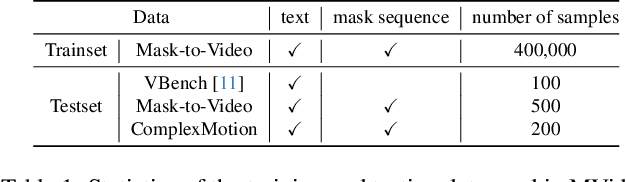
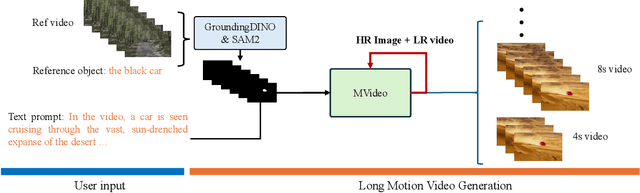
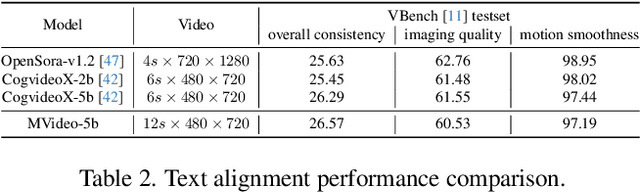
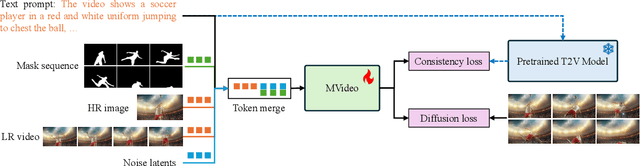
Existing text-to-video (T2V) models often struggle with generating videos with sufficiently pronounced or complex actions. A key limitation lies in the text prompt's inability to precisely convey intricate motion details. To address this, we propose a novel framework, MVideo, designed to produce long-duration videos with precise, fluid actions. MVideo overcomes the limitations of text prompts by incorporating mask sequences as an additional motion condition input, providing a clearer, more accurate representation of intended actions. Leveraging foundational vision models such as GroundingDINO and SAM2, MVideo automatically generates mask sequences, enhancing both efficiency and robustness. Our results demonstrate that, after training, MVideo effectively aligns text prompts with motion conditions to produce videos that simultaneously meet both criteria. This dual control mechanism allows for more dynamic video generation by enabling alterations to either the text prompt or motion condition independently, or both in tandem. Furthermore, MVideo supports motion condition editing and composition, facilitating the generation of videos with more complex actions. MVideo thus advances T2V motion generation, setting a strong benchmark for improved action depiction in current video diffusion models. Our project page is available at https://mvideo-v1.github.io/.