 Add to Chrome
 Add to Firefox
 Add to Edge
Lost in Reconstruction: Aligning Action Representations with Language in Vision-Language-Action Models
Aug 11, 2026
Action verbs describe not only the physical outcomes of actions, but also how those actions are performed. Yet action representations in vision-language-action models (VLAs) are typically optimized for reconstruction under L1/L2 losses in raw action space, where numerical proximity need not reflect linguistically meaningful distinctions. On BridgeV2, we show that action trajectories contain verb-grounding information beyond visual state changes, and that reconstruction-only discrete tokenization systematically erodes this information. To address this problem, we introduce SALT, a Semantically ALigned action Tokenizer that augments a VQ-VAE-style tokenizer with an auxiliary objective requiring a frozen vision-language model to recover the episode instruction from quantized action latents. Policies trained with SALT achieve 71.9% average success in SimplerEnv, compared with 42.7% for a reconstruction-only VQ-VAE tokenizer and 31.2% for FAST. SALT also develops verb-specialized codes while maintaining reconstruction fidelity. These results show that robot action trajectories provide a source of language grounding and that preserving this structure in action representations can substantially improve language-conditioned control.

Carnot: Interpretable, Interactive, and Optimized Execution of Deep Research Queries
Aug 10, 2026Enterprises increasingly seek to query data lakes using natural language via AI-driven tools like semantic operators or deep research agents. However, the latter operates as an opaque black box, hiding its intermediate reasoning and data retrieval steps, and failing to expose controls for managing API costs and execution latency. Meanwhile, the former can be prohibitively expensive for enterprise-scale data lakes. Consequently, analysts using these systems lack the agency to intercept hallucinated premises, verify intermediate results, or correct the system's trajectory. We present Carnot, an interactive execution engine for AI-driven analytics. Carnot compiles natural language requests into physical execution graphs and surfaces them through an interactive notebook interface. Rather than waiting blindly for a final output, users can critique the plan, incrementally execute operators, inspect intermediate data, or directly edit the underlying code or semantic operator instructions. Carnot's query optimizer will optimize the query with respect to cost or latency constraints provided by the user. Our demo will showcase how Carnot helps users achieve efficient and verifiable insights on workloads motivated by real enterprise use cases.
* 4 pages, 2 figures, published as a demo paper in VLDB 2026
Enabling hand gesture customization on wrist-worn devices
Mar 29, 2022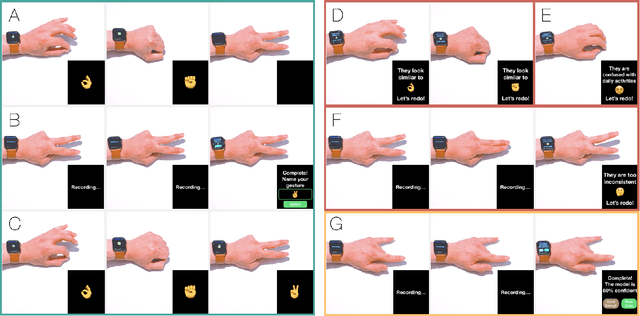
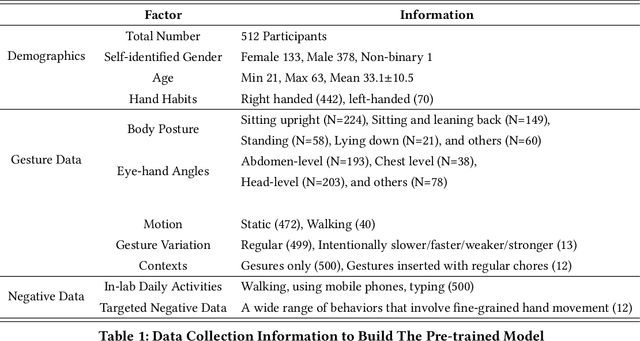
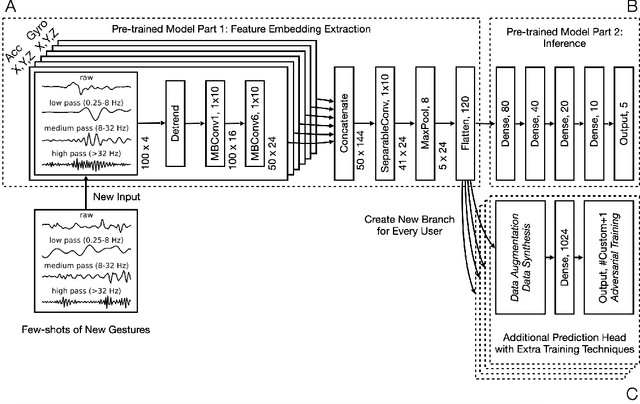
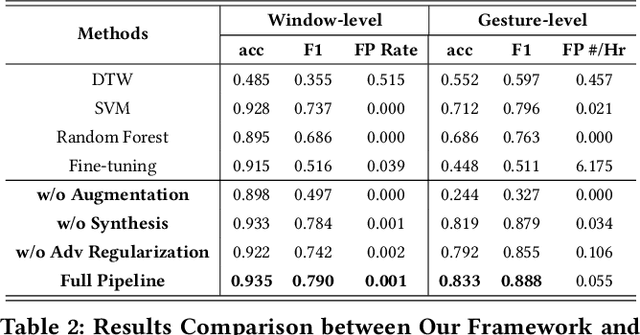
We present a framework for gesture customization requiring minimal examples from users, all without degrading the performance of existing gesture sets. To achieve this, we first deployed a large-scale study (N=500+) to collect data and train an accelerometer-gyroscope recognition model with a cross-user accuracy of 95.7% and a false-positive rate of 0.6 per hour when tested on everyday non-gesture data. Next, we design a few-shot learning framework which derives a lightweight model from our pre-trained model, enabling knowledge transfer without performance degradation. We validate our approach through a user study (N=20) examining on-device customization from 12 new gestures, resulting in an average accuracy of 55.3%, 83.1%, and 87.2% on using one, three, or five shots when adding a new gesture, while maintaining the same recognition accuracy and false-positive rate from the pre-existing gesture set. We further evaluate the usability of our real-time implementation with a user experience study (N=20). Our results highlight the effectiveness, learnability, and usability of our customization framework. Our approach paves the way for a future where users are no longer bound to pre-existing gestures, freeing them to creatively introduce new gestures tailored to their preferences and abilities.