 Add to Chrome
 Add to Firefox
 Add to Edge
Benchmarking Inductive Biases for Multivariate Time-Series Anomaly Detection with a Robust Multi-View Channel-Graph Detector
May 27, 2026
We present a unified experiment, analysis, and benchmark study of multivariate time-series (MTS) anomaly detection. Ten family-representative detectors -- spanning statistical, reconstruction, association, frequency, and generic-transformer families -- are evaluated on five datasets (SMD, MSL, SMAP, PSM, and MSDS) under effectiveness, efficiency, robustness, and cross-dataset generalisation. All methods share the same windowing, scoring, hardware, and metric protocols. Effectiveness, ablation, and robustness use three random seeds; cross-dataset transfer uses seed~0 because each extra seed requires $250$ source-target evaluations. The benchmark yields three method-independent findings: no single-bias baseline dominates; absolute perturbation VUS-ROC is more informative than retention ratios; and MSDS behaves as an event-dense deployment workload rather than a sparse point-anomaly benchmark. Under this protocol we also introduce \ours{}, an adaptive detector family combining a NOTEARS-constrained directed channel-graph view with optional patch-attention and temporal-association views. \ours{} achieves the best macro-average VUS-ROC ($0.675$, $+5.1$~pt over the second-best LSTM-AE), ranks first overall, and reaches the top-3 on all five datasets. Its wins on MSL and MSDS are narrow, while its average and robustness gains are larger: under the same three-seed robustness protocol for every method, it obtains the strongest absolute VUS-ROC across noise, channel dropout, and time-shift perturbations. We release the MSDS preprocessing protocol, configurations, scripts, and seed-level metric dumps.

KIO-planner: Attention-Guided Single-Stage Motion Planning with Dual Mapping for UAV Navigation
May 19, 2026Autonomous UAV flight in confined, wall-dense environments requires low-latency and reliable motion planning under strict safety constraints. Traditional optimization-based planners suffer from mapping latency and easily fall into local minima when navigating through dense structural obstacles. Meanwhile, existing end-to-end learning methods struggle to extract fine-grained geometric features from raw depth images and lack hard kinodynamic constraints, leading to unpredictable collisions near walls. To address these issues, we propose KIO-planner, an attention-guided single-stage trajectory planning framework. First, we integrate a Convolutional Block Attention Module (CBAM) into the perception backbone to adaptively focus on critical structural edges and traversable space. Second, we introduce a novel Dual Mapping mechanism--comprising physical bounds activation and a deterministic Geometric Safety Shield in the depth-pixel space--to enforce kinodynamic feasibility and collision-free flight without global map fusion. Extensive high-fidelity simulated experiments demonstrate that KIO-planner enables highly agile navigation at speeds up to 3.0 m/s. Compared to the state-of-the-art baseline, KIO-planner achieves lower inference latency (approximately 24 ms) and generates significantly smoother trajectories, reducing control cost by 28.4%. Most notably, our Dual Mapping substantially increases the worst-case safety margin, measured by minimum distance to obstacles, from 0.48 m to 0.76 m, ensuring fast, smooth, and safer navigation in highly constrained environments.
SAGA: A Robust Self-Attention and Goal-Aware Anchor-based Planner for Safe UAV Autonomous Navigation
May 04, 2026Agile unmanned aerial vehicle (UAV) navigation in cluttered environments demands a planning architecture that is both computationally efficient and structurally expressive enough to reason over multiple feasible motions. This paper presents SAGA, a robust self-attention and goal-aware anchor-based planner for safe UAV autonomous navigation. SAGA formulates local planning as a one-stage joint regression-and-ranking problem over a fixed lattice of motion anchors. Given a depth image and a body-frame motion state, the planner predicts refined terminal states and planning scores for all anchors in a single forward pass, after which the best candidate is decoded into a dynamically feasible trajectory. The key idea of SAGA is to transform anchor-aligned features into geometry-aware tokens and perform cross-anchor global reasoning with self-attention. To preserve directional structure in the token space, we further introduce a polar positional encoding derived from anchor yaw and pitch. In addition, a goal-aware modulation module injects velocity, acceleration, and target information into the token representation before final score prediction. Experiments in cluttered pillar-map environments under maximum speed settings of 2.0, 3.0, and 4.0~m/s show that SAGA consistently achieves a 100\% success rate, while YOPO drops from 90.91\% to 62.50\%, Ego-planner from 71.43\% to 52.63\%, and Fast-planner from 52.63\% to 38.46\%. Under the 4.0~m/s maximum speed setting, SAGA also improves average safety from 1.9843~m to 2.3888~m and minimum safety from 0.4390~m to 0.7576~m over YOPO, while reducing total flight time from 40.4631~s to 27.4901~s. The comparison with SAGA w/o PPE further shows that explicit polar positional encoding is critical for stable cross-anchor reasoning and safe passage selection in cluttered scenes.
Reasoning or Not? A Comprehensive Evaluation of Reasoning LLMs for Dialogue Summarization
Jul 02, 2025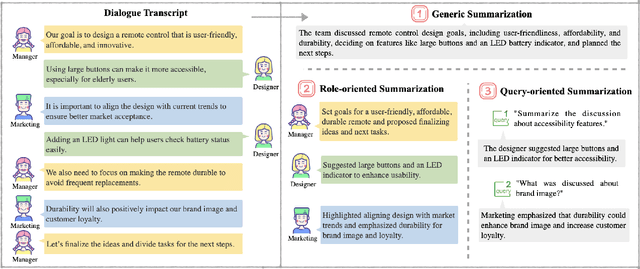
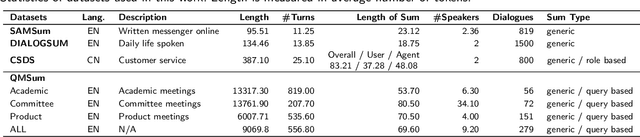
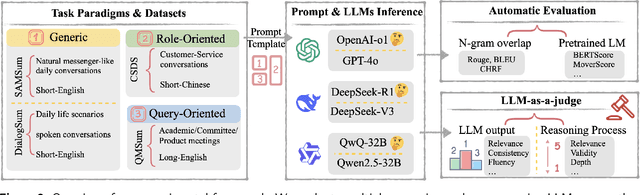
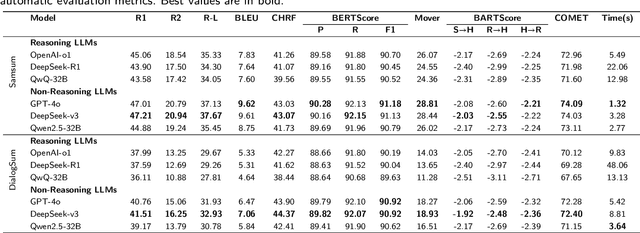
Dialogue summarization is a challenging task with significant practical value in customer service, meeting analysis, and conversational AI. Although large language models (LLMs) have achieved substantial progress in summarization tasks, the performance of step-by-step reasoning architectures-specifically Long Chain-of-Thought (CoT) implementations such as OpenAI-o1 and DeepSeek-R1-remains unexplored for dialogue scenarios requiring concurrent abstraction and conciseness. In this work, we present the first comprehensive and systematic evaluation of state-of-the-art reasoning LLMs and non-reasoning LLMs across three major paradigms-generic, role-oriented, and query-oriented dialogue summarization. Our study spans diverse languages, domains, and summary lengths, leveraging strong benchmarks (SAMSum, DialogSum, CSDS, and QMSum) and advanced evaluation protocols that include both LLM-based automatic metrics and human-inspired criteria. Contrary to trends in other reasoning-intensive tasks, our findings show that explicit stepwise reasoning does not consistently improve dialogue summarization quality. Instead, reasoning LLMs are often prone to verbosity, factual inconsistencies, and less concise summaries compared to their non-reasoning counterparts. Through scenario-specific analyses and detailed case studies, we further identify when and why explicit reasoning may fail to benefit-or even hinder-summarization in complex dialogue contexts. Our work provides new insights into the limitations of current reasoning LLMs and highlights the need for targeted modeling and evaluation strategies for real-world dialogue summarization.
Joint Task Offloading and Channel Allocation in Spatial-Temporal Dynamic for MEC Networks
May 07, 2025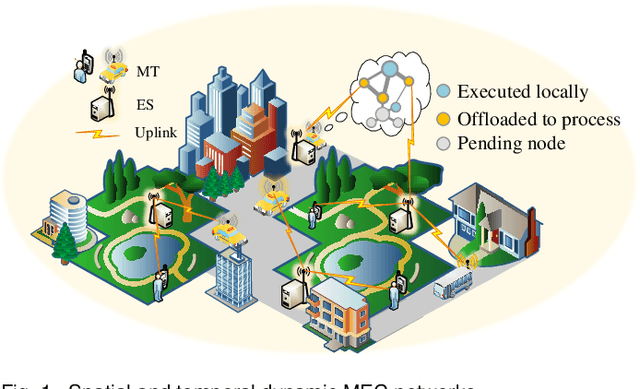
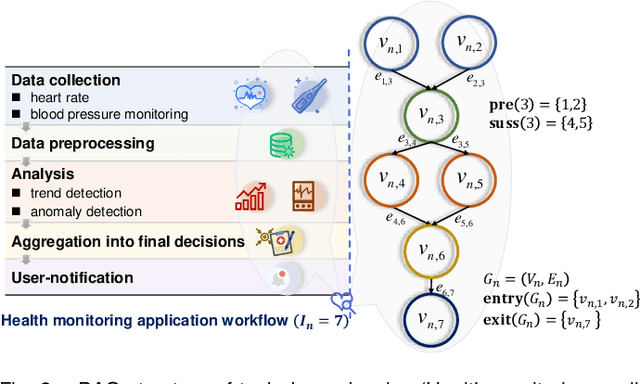
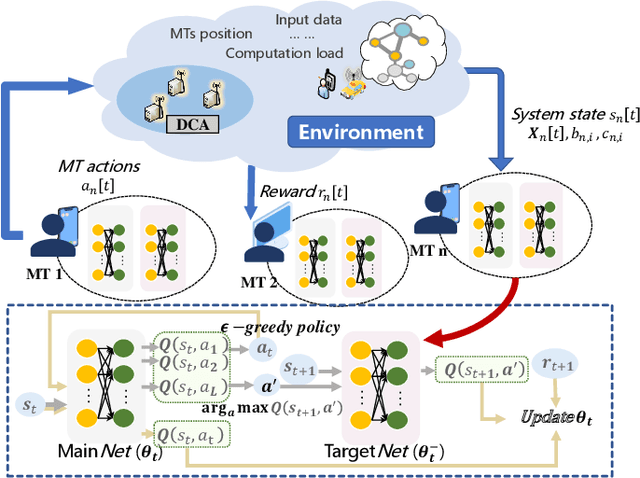
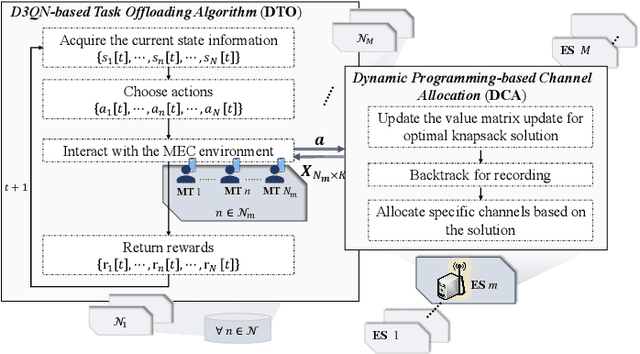
Computation offloading and resource allocation are critical in mobile edge computing (MEC) systems to handle the massive and complex requirements of applications restricted by limited resources. In a multi-user multi-server MEC network, the mobility of terminals causes computing requests to be dynamically distributed in space. At the same time, the non-negligible dependencies among tasks in some specific applications impose temporal correlation constraints on the solution as well, leading the time-adjacent tasks to experience varying resource availability and competition from parallel counterparts. To address such dynamic spatial-temporal characteristics as a challenge in the allocation of communication and computation resources, we formulate a long-term delay-energy trade-off cost minimization problem in the view of jointly optimizing task offloading and resource allocation. We begin by designing a priority evaluation scheme to decouple task dependencies and then develop a grouped Knapsack problem for channel allocation considering the current data load and channel status. Afterward, in order to meet the rapid response needs of MEC systems, we exploit the double duel deep Q network (D3QN) to make offloading decisions and integrate channel allocation results into the reward as part of the dynamic environment feedback in D3QN, constituting the joint optimization of task offloading and channel allocation. Finally, comprehensive simulations demonstrate the performance of the proposed algorithm in the delay-energy trade-off cost and its adaptability for various applications.
Free Performance Gain from Mixing Multiple Partially Labeled Samples in Multi-label Image Classification
May 24, 2024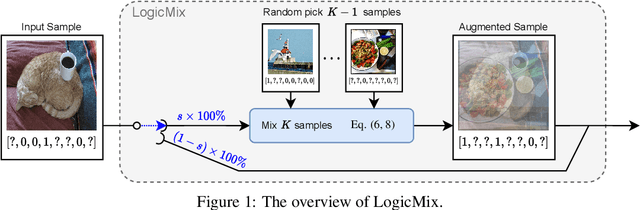
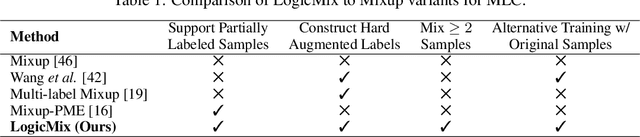

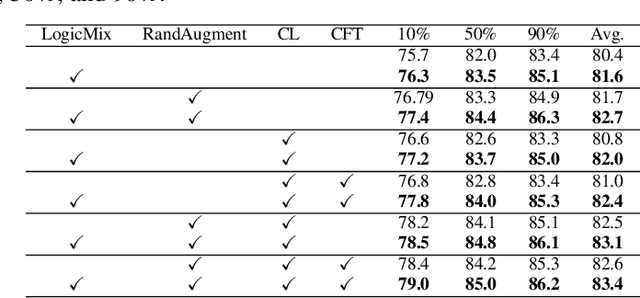
Multi-label image classification datasets are often partially labeled where many labels are missing, posing a significant challenge to training accurate deep classifiers. However, the powerful Mixup sample-mixing data augmentation cannot be well utilized to address this challenge, as it cannot perform linear interpolation on the unknown labels to construct augmented samples. In this paper, we propose LogicMix, a Mixup variant designed for such partially labeled datasets. LogicMix mixes the sample labels by logical OR so that the unknown labels can be correctly mixed by utilizing OR's logical equivalences, including the domination and identity laws. Unlike Mixup, which mixes exactly two samples, LogicMix can mix multiple ($\geq2$) partially labeled samples, constructing visually more confused augmented samples to regularize training. LogicMix is more general and effective than other compared Mixup variants in the experiments on various partially labeled dataset scenarios. Moreover, it is plug-and-play and only requires minimal computation, hence it can be easily inserted into existing frameworks to collaborate with other methods to improve model performance with a negligible impact on training time, as demonstrated through extensive experiments. In particular, through the collaboration of LogicMix, RandAugment, Curriculum Labeling, and Category-wise Fine-Tuning, we attain state-of-the-art performance on MS-COCO, VG-200, and Pascal VOC 2007 benchmarking datasets. The remarkable generality, effectiveness, collaboration, and simplicity suggest that LogicMix promises to be a popular and vital data augmentation method.
Analysis of the Two-Step Heterogeneous Transfer Learning for Laryngeal Blood Vessel Classification: Issue and Improvement
Mar 05, 2024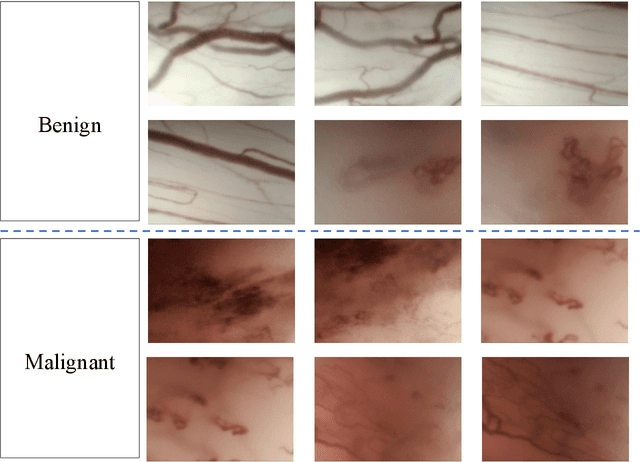


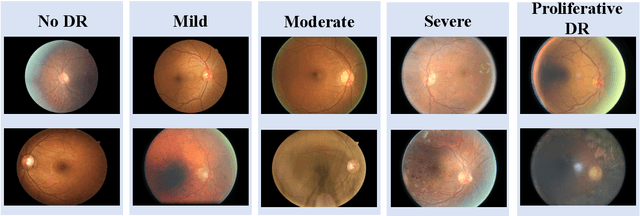
Transferring features learned from natural to medical images for classification is common. However, challenges arise due to the scarcity of certain medical image types and the feature disparities between natural and medical images. Two-step transfer learning has been recognized as a promising solution for this issue. However, choosing an appropriate intermediate domain would be critical in further improving the classification performance. In this work, we explore the effectiveness of using color fundus photographs of the diabetic retina dataset as an intermediate domain for two-step heterogeneous learning (THTL) to classify laryngeal vascular images with nine deep-learning models. Experiment results confirm that although the images in both the intermediate and target domains share vascularized characteristics, the accuracy is drastically reduced compared to one-step transfer learning, where only the last layer is fine-tuned (e.g., ResNet18 drops 14.7%, ResNet50 drops 14.8%). By analyzing the Layer Class Activation Maps (LayerCAM), we uncover a novel finding that the prevalent radial vascular pattern in the intermediate domain prevents learning the features of twisted and tangled vessels that distinguish the malignant class in the target domain. To address the performance drop, we propose the Step-Wise Fine-Tuning (SWFT) method on ResNet in the second step of THTL, resulting in substantial accuracy improvements. Compared to THTL's second step, where only the last layer is fine-tuned, accuracy increases by 26.1% for ResNet18 and 20.4% for ResNet50. Additionally, compared to training from scratch, using ImageNet as the source domain could slightly improve classification performance for laryngeal vascular, but the differences are insignificant.
Category-wise Fine-Tuning: Resisting Incorrect Pseudo-Labels in Multi-Label Image Classification with Partial Labels
Jan 30, 2024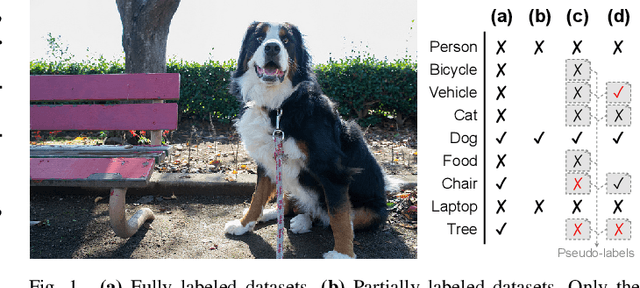
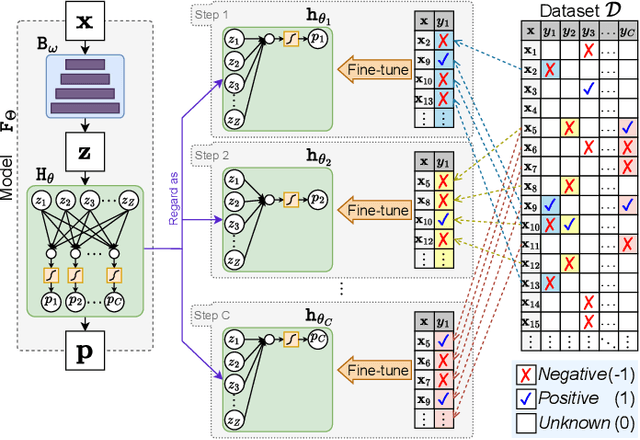
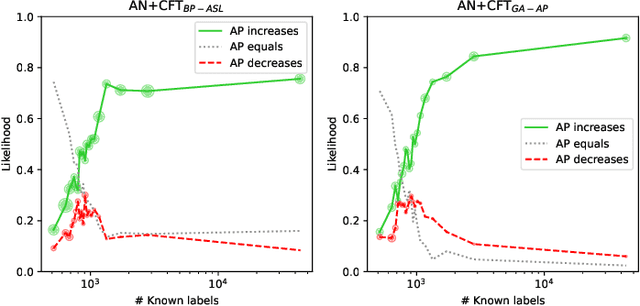
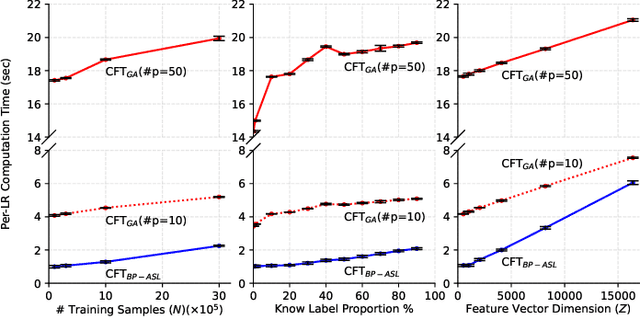
Large-scale image datasets are often partially labeled, where only a few categories' labels are known for each image. Assigning pseudo-labels to unknown labels to gain additional training signals has become prevalent for training deep classification models. However, some pseudo-labels are inevitably incorrect, leading to a notable decline in the model classification performance. In this paper, we propose a novel method called Category-wise Fine-Tuning (CFT), aiming to reduce model inaccuracies caused by the wrong pseudo-labels. In particular, CFT employs known labels without pseudo-labels to fine-tune the logistic regressions of trained models individually to calibrate each category's model predictions. Genetic Algorithm, seldom used for training deep models, is also utilized in CFT to maximize the classification performance directly. CFT is applied to well-trained models, unlike most existing methods that train models from scratch. Hence, CFT is general and compatible with models trained with different methods and schemes, as demonstrated through extensive experiments. CFT requires only a few seconds for each category for calibration with consumer-grade GPUs. We achieve state-of-the-art results on three benchmarking datasets, including the CheXpert chest X-ray competition dataset (ensemble mAUC 93.33%, single model 91.82%), partially labeled MS-COCO (average mAP 83.69%), and Open Image V3 (mAP 85.31%), outperforming the previous bests by 0.28%, 2.21%, 2.50%, and 0.91%, respectively. The single model on CheXpert has been officially evaluated by the competition server, endorsing the correctness of the result. The outstanding results and generalizability indicate that CFT could be substantial and prevalent for classification model development. Code is available at: https://github.com/maxium0526/category-wise-fine-tuning.
Aurora:Activating Chinese chat capability for Mixtral-8x7B sparse Mixture-of-Experts through Instruction-Tuning
Jan 01, 2024


Existing research has demonstrated that refining large language models (LLMs) through the utilization of machine-generated instruction-following data empowers these models to exhibit impressive zero-shot capabilities for novel tasks, without requiring human-authored instructions. In this paper, we systematically investigate, preprocess, and integrate three Chinese instruction-following datasets with the aim of enhancing the Chinese conversational capabilities of Mixtral-8x7B sparse Mixture-of-Experts model. Through instruction fine-tuning on this carefully processed dataset, we successfully construct the Mixtral-8x7B sparse Mixture-of-Experts model named "Aurora." To assess the performance of Aurora, we utilize three widely recognized benchmark tests: C-Eval, MMLU, and CMMLU. Empirical studies validate the effectiveness of instruction fine-tuning applied to Mixtral-8x7B sparse Mixture-of-Experts model. This work is pioneering in the execution of instruction fine-tuning on a sparse expert-mixed model, marking a significant breakthrough in enhancing the capabilities of this model architecture. Our code, data and model are publicly available at https://github.com/WangRongsheng/Aurora
Computing Offloading and Semantic Compression for Intelligent Computing Tasks in MEC Systems
Jul 06, 2023
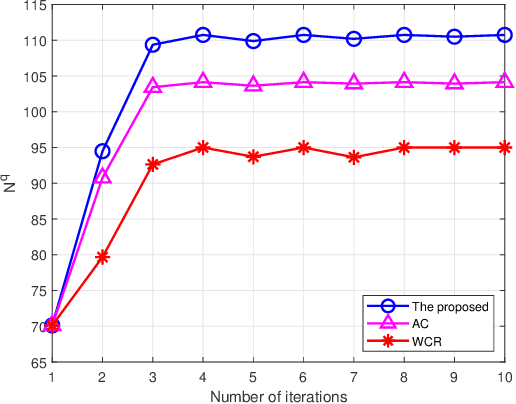
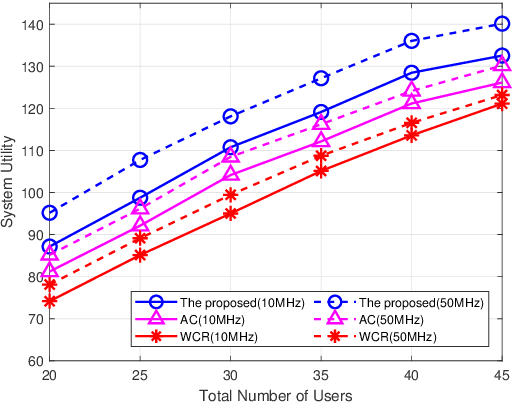
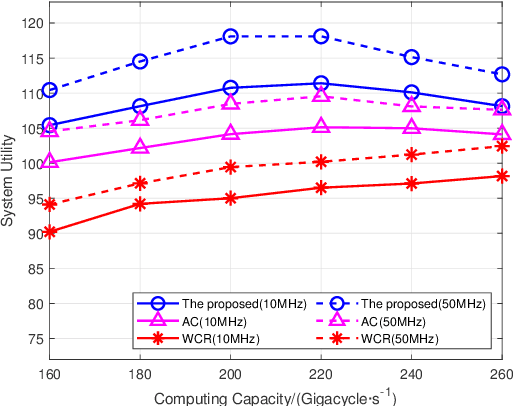
This paper investigates the intelligent computing task-oriented computing offloading and semantic compression in mobile edge computing (MEC) systems. With the popularity of intelligent applications in various industries, terminals increasingly need to offload intelligent computing tasks with complex demands to MEC servers for computing, which is a great challenge for bandwidth and computing capacity allocation in MEC systems. Considering the accuracy requirement of intelligent computing tasks, we formulate an optimization problem of computing offloading and semantic compression. We jointly optimize the system utility which are represented as computing accuracy and task delay respectively to acquire the optimized system utility. To solve the proposed optimization problem, we decompose it into computing capacity allocation subproblem and compression offloading subproblem and obtain solutions through convex optimization and successive convex approximation. After that, the offloading decisions, computing capacity and compressed ratio are obtained in closed forms. We design the computing offloading and semantic compression algorithm for intelligent computing tasks in MEC systems then. Simulation results represent that our algorithm converges quickly and acquires better performance and resource utilization efficiency through the trend with total number of users and computing capacity compared with benchmarks.