 Add to Chrome
 Add to Firefox
 Add to Edge
DriveFix: Spatio-Temporally Coherent Driving Scene Restoration
Mar 17, 2026
Recent advancements in 4D scene reconstruction, particularly those leveraging diffusion priors, have shown promise for novel view synthesis in autonomous driving. However, these methods often process frames independently or in a view-by-view manner, leading to a critical lack of spatio-temporal synergy. This results in spatial misalignment across cameras and temporal drift in sequences. We propose DriveFix, a novel multi-view restoration framework that ensures spatio-temporal coherence for driving scenes. Our approach employs an interleaved diffusion transformer architecture with specialized blocks to explicitly model both temporal dependencies and cross-camera spatial consistency. By conditioning the generation on historical context and integrating geometry-aware training losses, DriveFix enforces that the restored views adhere to a unified 3D geometry. This enables the consistent propagation of high-fidelity textures and significantly reduces artifacts. Extensive evaluations on the Waymo, nuScenes, and PandaSet datasets demonstrate that DriveFix achieves state-of-the-art performance in both reconstruction and novel view synthesis, marking a substantial step toward robust 4D world modeling for real-world deployment.

FAR-Drive: Frame-AutoRegressive Video Generation in Closed-Loop Autonomous Driving
Mar 16, 2026Despite rapid progress in autonomous driving, reliable training and evaluation of driving systems remain fundamentally constrained by the lack of scalable and interactive simulation environments. Recent generative video models achieve remarkable visual fidelity, yet most operate in open-loop settings and fail to support fine-grained frame-level interaction between agent actions and environment evolution. Building a learning-based closed-loop simulator for autonomous driving poses three major challenges: maintaining long-horizon temporal and cross-view consistency, mitigating autoregressive degradation under iterative self-conditioning, and satisfying low-latency inference constraints. In this work, we propose FAR-Drive, a frame-level autoregressive video generation framework for autonomous driving. We introduce a multi-view diffusion transformer with fine-grained structured control, enabling geometrically consistent multi-camera generation. To address long-horizon consistency and iterative degradation, we design a two-stage training strategy consisting of adaptive reference horizon conditioning and blend-forcing autoregressive training, which progressively improves consistency and robustness under self-conditioning. To meet low-latency interaction requirements, we further integrate system-level efficiency optimizations for inference acceleration. Experiments on the nuScenes dataset demonstrate that our method achieves state-of-the-art performance among existing closed-loop autonomous driving simulation approaches, while maintaining sub-second latency on a single GPU.
Parallelized Planning-Acting for Efficient LLM-based Multi-Agent Systems
Mar 05, 2025Recent advancements in Large Language Model(LLM)-based Multi-Agent Systems(MAS) have demonstrated remarkable potential for tackling complex decision-making tasks. However, existing frameworks inevitably rely on serialized execution paradigms, where agents must complete sequential LLM planning before taking action. This fundamental constraint severely limits real-time responsiveness and adaptation, which is crucial in dynamic environments with ever-changing scenarios. In this paper, we propose a novel parallelized planning-acting framework for LLM-based MAS, featuring a dual-thread architecture with interruptible execution to enable concurrent planning and acting. Specifically, our framework comprises two core threads:(1) a planning thread driven by a centralized memory system, maintaining synchronization of environmental states and agent communication to support dynamic decision-making; and (2) an acting thread equipped with a comprehensive skill library, enabling automated task execution through recursive decomposition. Extensive experiments on challenging Minecraft demonstrate the effectiveness of the proposed framework.
SuperGPQA: Scaling LLM Evaluation across 285 Graduate Disciplines
Feb 20, 2025Large language models (LLMs) have demonstrated remarkable proficiency in mainstream academic disciplines such as mathematics, physics, and computer science. However, human knowledge encompasses over 200 specialized disciplines, far exceeding the scope of existing benchmarks. The capabilities of LLMs in many of these specialized fields-particularly in light industry, agriculture, and service-oriented disciplines-remain inadequately evaluated. To address this gap, we present SuperGPQA, a comprehensive benchmark that evaluates graduate-level knowledge and reasoning capabilities across 285 disciplines. Our benchmark employs a novel Human-LLM collaborative filtering mechanism to eliminate trivial or ambiguous questions through iterative refinement based on both LLM responses and expert feedback. Our experimental results reveal significant room for improvement in the performance of current state-of-the-art LLMs across diverse knowledge domains (e.g., the reasoning-focused model DeepSeek-R1 achieved the highest accuracy of 61.82% on SuperGPQA), highlighting the considerable gap between current model capabilities and artificial general intelligence. Additionally, we present comprehensive insights from our management of a large-scale annotation process, involving over 80 expert annotators and an interactive Human-LLM collaborative system, offering valuable methodological guidance for future research initiatives of comparable scope.
Odyssey: Empowering Agents with Open-World Skills
Jul 22, 2024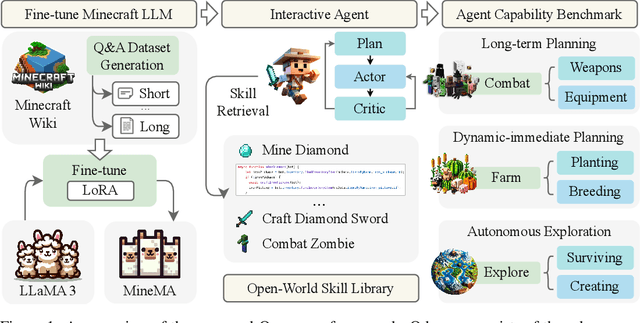
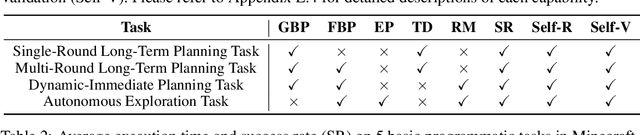
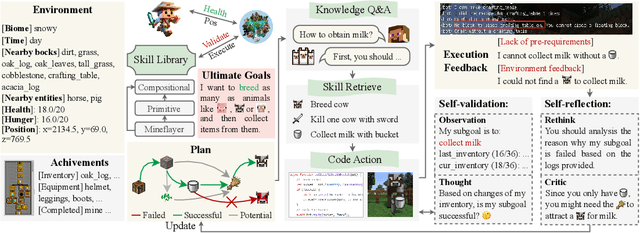
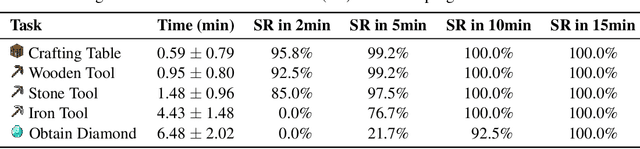
Recent studies have delved into constructing generalist agents for open-world embodied environments like Minecraft. Despite the encouraging results, existing efforts mainly focus on solving basic programmatic tasks, e.g., material collection and tool-crafting following the Minecraft tech-tree, treating the ObtainDiamond task as the ultimate goal. This limitation stems from the narrowly defined set of actions available to agents, requiring them to learn effective long-horizon strategies from scratch. Consequently, discovering diverse gameplay opportunities in the open world becomes challenging. In this work, we introduce ODYSSEY, a new framework that empowers Large Language Model (LLM)-based agents with open-world skills to explore the vast Minecraft world. ODYSSEY comprises three key parts: (1) An interactive agent with an open-world skill library that consists of 40 primitive skills and 183 compositional skills. (2) A fine-tuned LLaMA-3 model trained on a large question-answering dataset with 390k+ instruction entries derived from the Minecraft Wiki. (3) A new open-world benchmark includes thousands of long-term planning tasks, tens of dynamic-immediate planning tasks, and one autonomous exploration task. Extensive experiments demonstrate that the proposed ODYSSEY framework can effectively evaluate the planning and exploration capabilities of agents. All datasets, model weights, and code are publicly available to motivate future research on more advanced autonomous agent solutions.