 Add to Chrome
 Add to Firefox
 Add to Edge
Physical Layer Security Performance of Pinching-Antenna Systems With In-Waveguide Attenuation
Apr 16, 2026
Pinching antenna (PA) systems have recently gained significant attention. While their physical-layer security (PLS) is being explored, most studies rely on idealized lossless models, ignoring practical waveguide attenuation. In this paper, we investigate the PLS performance of PA systems under a more realistic attenuation-incorporated waveguide model. Specifically, we investigate a PA system-based secure communication scenario consisting of a base station (BS), a legitimate user, and a passive eavesdropper. We derive expressions for closed-form upper and lower bounds on both the secrecy outage probability (SOP) and ergodic secrecy capacity (ESC). The results indicate that the PA system outperforms conventional fixed-antenna systems.

Single-Waveguide Multiple-Pinching-Antenna Systems: OMA versus NOMA
Apr 01, 2026This paper investigates the performance of a pinching-antenna (PA) system with a signal waveguide and multiple pinching antennas to serve users distributed across multiple rooms. The performance of the system is evaluated through a comparative analysis under both orthogonal multiple access (OMA) and non-orthogonal multiple access (NOMA) schemes. Specifically, this paper derives closed-form expressions for the outage probability (OP) and ergodic rate (ER) in each scheme. Furthermore, asymptotic analyses are conducted to characterize the system behavior in the high signal-to-noise ratio (SNR) regime. Extensive Monte Carlo simulations are utilized to validate the accuracy of the analytical derivations. The comparative results can be summarized as follows: 1) in the downlink fixed-rate scenario, whether OMA or NOMA achieves better outage performance depends on system parameters, such as the number of users and power allocation coefficients; 2) in the uplink fixed-rate scenario, the outage performance of NOMA is inferior to that of OMA in the high-SNR regime, and the decay rate of the OP for NOMA users depends on the rate thresholds; and 3) for both uplink and downlink adaptive-rate scenarios, the rate performance comparison of the two schemes depends on system parameters in the low-SNR regime, whereas OMA generally outperforms NOMA in the high-SNR regime.
Simultaneous Secrecy and Covert Communications (SSACC) in Mobility-Aware RIS-Aided Networks
Dec 18, 2025


In this paper, we propose a simultaneous secrecy and covert communications (SSACC) scheme in a reconfigurable intelligent surface (RIS)-aided network with a cooperative jammer. The scheme enhances communication security by maximizing the secrecy capacity and the detection error probability (DEP). Under a worst-case scenario for covert communications, we consider that the eavesdropper can optimally adjust the detection threshold to minimize the DEP. Accordingly, we derive closedform expressions for both average minimum DEP (AMDEP) and average secrecy capacity (ASC). To balance AMDEP and ASC, we propose a new performance metric and design an algorithm based on generative diffusion models (GDM) and deep reinforcement learning (DRL). The algorithm maximizes data rates under user mobility while ensuring high AMDEP and ASC by optimizing power allocation. Simulation results demonstrate that the proposed algorithm achieves faster convergence and superior performance compared to conventional deep deterministic policy gradient (DDPG) methods, thereby validating its effectiveness in balancing security and capacity performance.
Economics of Semantic Communication System in Wireless Powered Internet of Things
Oct 04, 2021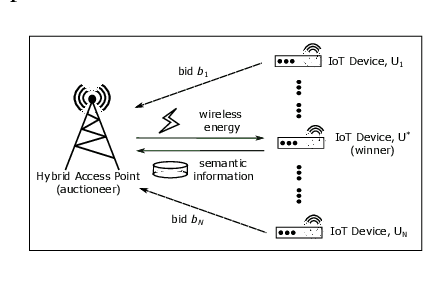
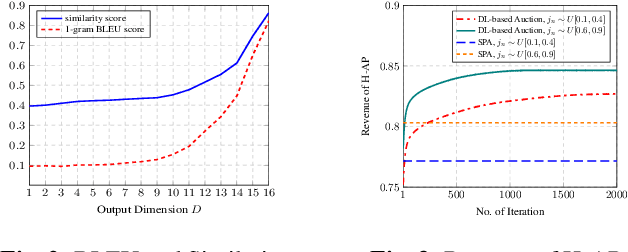
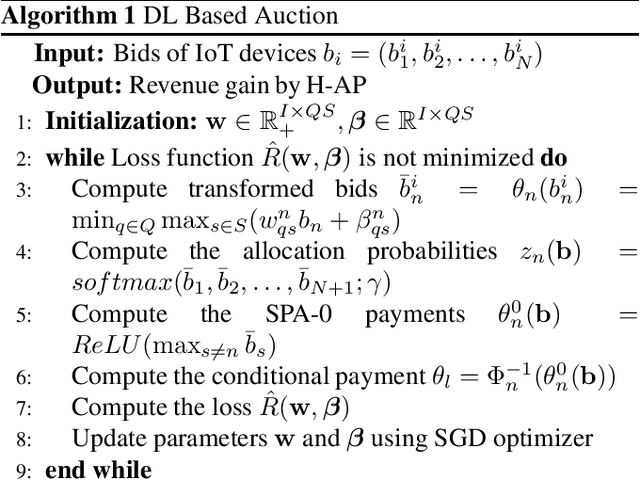
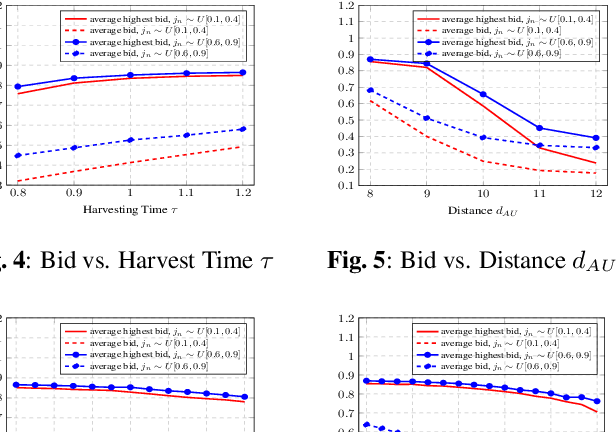
The semantic communication system enables wireless devices to communicate effectively with the semantic meaning of the data. Wireless powered Internet of Things (IoT) that adopts the semantic communication system relies on harvested energy to transmit semantic information. However, the issue of energy constraint in the semantic communication system is not well studied. In this paper, we propose a semantic-based energy valuation and take an economic approach to solve the energy allocation problem as an incentive mechanism design. In our model, IoT devices (bidders) place their bids for the energy and power transmitter (auctioneer) decides the winner and payment by using deep learning based optimal auction. Results show that the revenue of wireless power transmitter is maximized while satisfying Individual Rationality (IR) and Incentive Compatibility (IC).