 Add to Chrome
 Add to Firefox
 Add to Edge
ZhuLong: Execution-Grounded LLM Agent for EDA Scripting with Offline API Self-Exploration
Aug 08, 2026
EDA scripting with tool-specific, often undocumented APIs remains a long-tail bottleneck that existing LLMs fail to address. This paper presents ZhuLong, an execution-grounded LLM coding agent for PyAether and SKILL that combines API retrieval, documentation inspection, and sandbox execution via unified MCP tools, augmented by an offline API self-exploration mechanism that infers undocumented API behaviors through counterfactual experimentation. We evaluate ZhuLong on EDA-Eval-PyAether, a benchmark of 158 real-world tasks with assertion-based execution, where the complete system achieves 78.5% Pass@1 in the commercial Empyrean Aether environment, substantially outperforming a pure LLM baseline (23.6%). Ablation studies identify sandbox execution as the dominant performance driver (41.2 pp drop when removed), with the self-exploration mechanism contributing an additional 3.2 pp accuracy gain and a 22.1% reduction in per-task tool calls. On 20 interactive tasks involving unsaved layouts and schematics, ZhuLong achieves 60.0% Pass@1 for PyAether and 50.0% for SKILL.

HiFi-Mesh: High-Fidelity Efficient 3D Mesh Generation via Compact Autoregressive Dependence
Jan 29, 2026High-fidelity 3D meshes can be tokenized into one-dimension (1D) sequences and directly modeled using autoregressive approaches for faces and vertices. However, existing methods suffer from insufficient resource utilization, resulting in slow inference and the ability to handle only small-scale sequences, which severely constrains the expressible structural details. We introduce the Latent Autoregressive Network (LANE), which incorporates compact autoregressive dependencies in the generation process, achieving a $6\times$ improvement in maximum generatable sequence length compared to existing methods. To further accelerate inference, we propose the Adaptive Computation Graph Reconfiguration (AdaGraph) strategy, which effectively overcomes the efficiency bottleneck of traditional serial inference through spatiotemporal decoupling in the generation process. Experimental validation demonstrates that LANE achieves superior performance across generation speed, structural detail, and geometric consistency, providing an effective solution for high-quality 3D mesh generation.
WDFFU-Mamba: A Wavelet-guided Dual-attention Feature Fusion Mamba for Breast Tumor Segmentation in Ultrasound Images
Dec 19, 2025Breast ultrasound (BUS) image segmentation plays a vital role in assisting clinical diagnosis and early tumor screening. However, challenges such as speckle noise, imaging artifacts, irregular lesion morphology, and blurred boundaries severely hinder accurate segmentation. To address these challenges, this work aims to design a robust and efficient model capable of automatically segmenting breast tumors in BUS images.We propose a novel segmentation network named WDFFU-Mamba, which integrates wavelet-guided enhancement and dual-attention feature fusion within a U-shaped Mamba architecture. A Wavelet-denoised High-Frequency-guided Feature (WHF) module is employed to enhance low-level representations through noise-suppressed high-frequency cues. A Dual Attention Feature Fusion (DAFF) module is also introduced to effectively merge skip-connected and semantic features, improving contextual consistency.Extensive experiments on two public BUS datasets demonstrate that WDFFU-Mamba achieves superior segmentation accuracy, significantly outperforming existing methods in terms of Dice coefficient and 95th percentile Hausdorff Distance (HD95).The combination of wavelet-domain enhancement and attention-based fusion greatly improves both the accuracy and robustness of BUS image segmentation, while maintaining computational efficiency.The proposed WDFFU-Mamba model not only delivers strong segmentation performance but also exhibits desirable generalization ability across datasets, making it a promising solution for real-world clinical applications in breast tumor ultrasound analysis.
Text2Traffic: A Text-to-Image Generation and Editing Method for Traffic Scenes
Nov 17, 2025With the rapid advancement of intelligent transportation systems, text-driven image generation and editing techniques have demonstrated significant potential in providing rich, controllable visual scene data for applications such as traffic monitoring and autonomous driving. However, several challenges remain, including insufficient semantic richness of generated traffic elements, limited camera viewpoints, low visual fidelity of synthesized images, and poor alignment between textual descriptions and generated content. To address these issues, we propose a unified text-driven framework for both image generation and editing, leveraging a controllable mask mechanism to seamlessly integrate the two tasks. Furthermore, we incorporate both vehicle-side and roadside multi-view data to enhance the geometric diversity of traffic scenes. Our training strategy follows a two-stage paradigm: first, we perform conceptual learning using large-scale coarse-grained text-image data; then, we fine-tune with fine-grained descriptive data to enhance text-image alignment and detail quality. Additionally, we introduce a mask-region-weighted loss that dynamically emphasizes small yet critical regions during training, thereby substantially enhancing the generation fidelity of small-scale traffic elements. Extensive experiments demonstrate that our method achieves leading performance in text-based image generation and editing within traffic scenes.
MoEdit: On Learning Quantity Perception for Multi-object Image Editing
Mar 13, 2025Multi-object images are prevalent in various real-world scenarios, including augmented reality, advertisement design, and medical imaging. Efficient and precise editing of these images is critical for these applications. With the advent of Stable Diffusion (SD), high-quality image generation and editing have entered a new era. However, existing methods often struggle to consider each object both individually and part of the whole image editing, both of which are crucial for ensuring consistent quantity perception, resulting in suboptimal perceptual performance. To address these challenges, we propose MoEdit, an auxiliary-free multi-object image editing framework. MoEdit facilitates high-quality multi-object image editing in terms of style transfer, object reinvention, and background regeneration, while ensuring consistent quantity perception between inputs and outputs, even with a large number of objects. To achieve this, we introduce the Feature Compensation (FeCom) module, which ensures the distinction and separability of each object attribute by minimizing the in-between interlacing. Additionally, we present the Quantity Attention (QTTN) module, which perceives and preserves quantity consistency by effective control in editing, without relying on auxiliary tools. By leveraging the SD model, MoEdit enables customized preservation and modification of specific concepts in inputs with high quality. Experimental results demonstrate that our MoEdit achieves State-Of-The-Art (SOTA) performance in multi-object image editing. Data and codes will be available at https://github.com/Tear-kitty/MoEdit.
Dynamic Entity-Masked Graph Diffusion Model for histopathological image Representation Learning
Dec 13, 2024
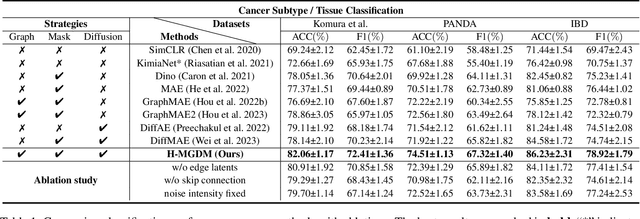


Significant disparities between the features of natural images and those inherent to histopathological images make it challenging to directly apply and transfer pre-trained models from natural images to histopathology tasks. Moreover, the frequent lack of annotations in histopathology patch images has driven researchers to explore self-supervised learning methods like mask reconstruction for learning representations from large amounts of unlabeled data. Crucially, previous mask-based efforts in self-supervised learning have often overlooked the spatial interactions among entities, which are essential for constructing accurate representations of pathological entities. To address these challenges, constructing graphs of entities is a promising approach. In addition, the diffusion reconstruction strategy has recently shown superior performance through its random intensity noise addition technique to enhance the robust learned representation. Therefore, we introduce H-MGDM, a novel self-supervised Histopathology image representation learning method through the Dynamic Entity-Masked Graph Diffusion Model. Specifically, we propose to use complementary subgraphs as latent diffusion conditions and self-supervised targets respectively during pre-training. We note that the graph can embed entities' topological relationships and enhance representation. Dynamic conditions and targets can improve pathological fine reconstruction. Our model has conducted pretraining experiments on three large histopathological datasets. The advanced predictive performance and interpretability of H-MGDM are clearly evaluated on comprehensive downstream tasks such as classification and survival analysis on six datasets. Our code will be publicly available at https://github.com/centurion-crawler/H-MGDM.