 Add to Chrome
 Add to Firefox
 Add to Edge
Reachability Is Not Realization: Tracing the Sources of LLM Benchmark Gains
Aug 04, 2026
Benchmark gains are often treated as evidence of greater LLM capability. Yet the same gain can reflect different changes in model behavior. A model may reach new answers, or produce answers that were already within reach. Aggregate scores do not distinguish these changes question by question. We establish a question-level audit under fixed budgets, temperatures, and answer formats. A question is realized when the default deployment procedure produces the correct answer. A question is reachable when a specified probe finds that answer within a fixed budget. We first test whether inference-time layer routing can expand reachability. Under a matched budget, random routes match or exceed structured search in all 43 model and task settings. Answer-blind procedures retain almost none of this gain, which instead requires access to the correct answer. We then ask why reachable answers sometimes fail to appear. Across six cases spanning 0.5B to 31B, silencing one identified MLP block repairs 68 to 92 percent of a predefined failure set. We next test whether training closes the gap by expanding reachability. In five of six matched evaluations, deployed performance rises while the reachable ceiling remains flat or falls. For DAPO, the deployed score rises by 14.7 points while the reachable ceiling falls by 13.3 points. Across the settings we audit, realization and reachability therefore do not always change together. Claims of capability expansion should report both realized performance and reachability under matched evaluation conditions. Code is available at https://github.com/LiZaiyuan0619/reachability-not-realization

Disagree to Accelerate: Closing the Loop on Diffusion Feature Forecasts
Aug 03, 2026Training-free feature forecasting accelerates diffusion sampling by predicting features at skipped denoising steps. Recent work has mainly focused on designing stronger forecasters. Yet forecast error varies sharply across steps, and open-loop caches trust the forecast in full at every skipped step. This fixed trust is what breaks as acceleration turns aggressive. The missing question is not only how to forecast better, but when and how much to trust a forecast. We show that reliability can be observed from the cache itself. Two forecasts agree where the feature trajectory is smooth, and they diverge where prediction turns hard. Their disagreement is a cheap runtime signal, and it costs no extra denoiser evaluation. Based on this signal, we introduce RACER, a training-free closed-loop controller with two responses. It continuously shrinks uncertain forecasts toward the last computed feature. At the riskiest steps, RACER refreshes the feature and repays the added evaluation by skipping a later scheduled one. We derive a deterministic error bound for the shrinkage and empirically evaluate its validity and tightness across acceleration regimes. At the same number of denoiser evaluations, RACER improves the strongest open-loop baseline across SD3.5-Large, FLUX.1-dev, Wan2.1-14B, and HunyuanVideo on DrawBench, VBench, and COCO. On SD3.5, we further show that RACER samples faster at equal quality. RACER generalizes across forecasting designs as well. For example, it recovers much of the quality lost on a Taylor base. These results show that reliable diffusion acceleration also depends on how forecasts are used. Code is available at https://github.com/LiZaiyuan0619/RACER
SkillsInjector: Dynamic Skill Context Construction for LLM Agents
May 28, 2026LLM agents now draw on growing skill libraries to handle complex tasks. However, injecting more skills does not always improve task completion and can even degrade it. Existing methods still treat skill injection as a static step, selecting skills with fixed criteria, fixing the budget in advance, and leaving descriptions unchanged. We argue that this static treatment can undermine the utility of skills, because which skills are exposed, how many are included, and how they are presented all affect downstream performance. We propose SkillsInjector, a two-stage adaptive method that jointly addresses these decisions. First, a context planner learns execution-grounded skill preferences and admits an adaptive number of skills for each task. A set-aware renderer then tailors how selected descriptions are presented relative to their co-injected neighbors. Across tau2-bench, SkillsBench, and ALFWorld, SkillsInjector achieves the highest score, improving over the strongest baseline by 3.9, 6.1, and 7.3 percentage points, respectively. Ablation studies show that skill selection, adaptive budgeting, and set-aware rendering each contribute to the gain. These results show that skill-augmented agents benefit from optimizing the injected context itself. Code will be released upon publication
DentalGPT: Incentivizing Multimodal Complex Reasoning in Dentistry
Dec 12, 2025Reliable interpretation of multimodal data in dentistry is essential for automated oral healthcare, yet current multimodal large language models (MLLMs) struggle to capture fine-grained dental visual details and lack sufficient reasoning ability for precise diagnosis. To address these limitations, we present DentalGPT, a specialized dental MLLM developed through high-quality domain knowledge injection and reinforcement learning. Specifically, the largest annotated multimodal dataset for dentistry to date was constructed by aggregating over 120k dental images paired with detailed descriptions that highlight diagnostically relevant visual features, making it the multimodal dataset with the most extensive collection of dental images to date. Training on this dataset significantly enhances the MLLM's visual understanding of dental conditions, while the subsequent reinforcement learning stage further strengthens its capability for multimodal complex reasoning. Comprehensive evaluations on intraoral and panoramic benchmarks, along with dental subsets of medical VQA benchmarks, show that DentalGPT achieves superior performance in disease classification and dental VQA tasks, outperforming many state-of-the-art MLLMs despite having only 7B parameters. These results demonstrate that high-quality dental data combined with staged adaptation provides an effective pathway for building capable and domain-specialized dental MLLMs.
Improving the Reliability for Confidence Estimation
Oct 13, 2022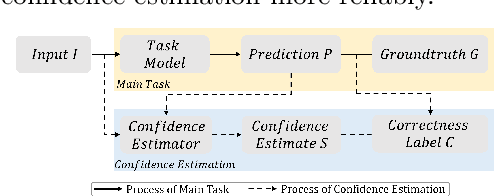
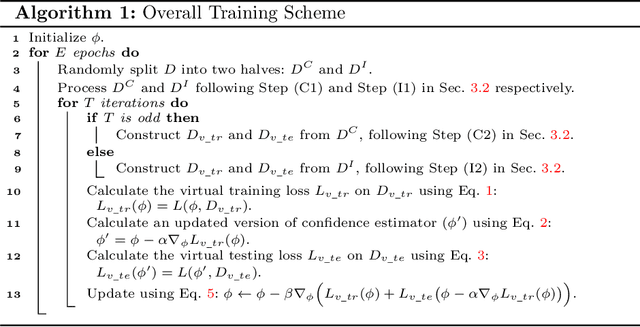
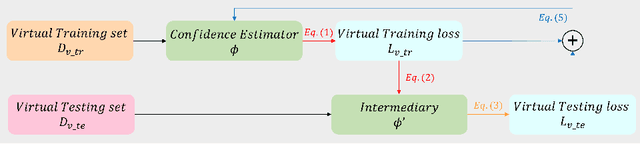
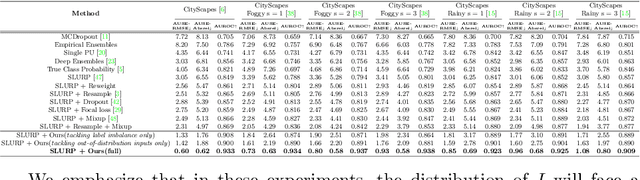
Confidence estimation, a task that aims to evaluate the trustworthiness of the model's prediction output during deployment, has received lots of research attention recently, due to its importance for the safe deployment of deep models. Previous works have outlined two important qualities that a reliable confidence estimation model should possess, i.e., the ability to perform well under label imbalance and the ability to handle various out-of-distribution data inputs. In this work, we propose a meta-learning framework that can simultaneously improve upon both qualities in a confidence estimation model. Specifically, we first construct virtual training and testing sets with some intentionally designed distribution differences between them. Our framework then uses the constructed sets to train the confidence estimation model through a virtual training and testing scheme leading it to learn knowledge that generalizes to diverse distributions. We show the effectiveness of our framework on both monocular depth estimation and image classification.