 Add to Chrome
 Add to Firefox
 Add to Edge
R4DSG: Relative 4D Scene Graph Memory for Object-Centric Question Answering in Long Egocentric Video
Aug 11, 2026
Long-horizon egocentric video is a rich substrate for wearable AI assistants, but object-centric questions such as where an item was moved, when it last changed state, or why it was relocated remain difficult because caption- and transcript-based memories rarely preserve persistent object identity or structured spatial change. Existing long-video QA methods mainly emphasize temporal grounding and clip retrieval, while prior 3D scene-graph methods typically assume stronger geometry than free-motion wearable RGB video provides, including point clouds, RGB-D input, posed views, sparse reconstruction, or reconstructed scenes. R4DSG introduces a relative 4D scene graph memory for long egocentric video. Instead of storing raw graph sequences, R4DSG converts video into compact queryable memory entries indexed by time, place, persistent objects, anchor-relative change, and local interaction context. The main idea is to separate stable anchors from dynamic objects, maintain persistent object identity across frames, and represent object state through anchor-relative transitions rather than a globally aligned world model. Built on recent RGB-only advances in promptable video segmentation, temporal propagation, and relative 3D lifting, the method produces a retrieval-ready memory directly usable for long-horizon question answering. Evaluation on a 255-question object-related subset from EgoLifeQA shows, under question-only retrieval, a 6.7-point overall gain over EgoRAG-Text and a 12.5-point gain on when questions, which highlights the value of temporally organized object memory. These results position relative 4D scene graphs as a practical memory substrate for wearable assistants, AR systems, and embodied multimedia agents. GitHub Page: https://dualtransparency.github.io/R4DSG/.

Co-VLA: Coordination-Aware Structured Action Modeling for Dual-Arm Vision-Language-Action Systems
Jun 18, 2026Vision-language-action (VLA) models show strong capabilities in single and dual-arm robotic manipulation. Prior works show coordinated bimanual behaviors can emerge from end-to-end learning, leveraging large vision-language backbones with continuous action prediction. However, as bimanual tasks become tightly coupled and execution constraints become critical, implicit coordination alone is insufficient to ensure reliable, interpretable, and stable behavior. In this work, we propose Co-VLA, a coordination-aware bimanual manipulation framework introducing explicit structural priors into VLA models. We instantiate our method on a state-of-the-art vision-language backbone by replacing its monolithic action head with a Structured Action Expert (SAE) designed for bimanual coordination. Specifically, we introduce explicit structure at the action generation level with a modular coordination-aware loss that shapes shared and residual latents according to task-specific structures. The shared latent encodes task-level coordination intent, while residual latents capture execution adjustments for each arm. At deployment, a Latent-Aware Controller (LAC) interprets the learned representations to modulate synchronization strength, execution asymmetry, smoothness, and safety constraints in real time. LAC operates at the joint-command level and remains compatible with standard control pipelines without requiring force or impedance control. Experiments across simulation and real-world benchmarks show Co-VLA significantly outperforms monolithic baselines, achieving a 27% success rate gain in tight-coordination tasks, more than doubling performance in OOD real-world scenarios (from 13% to 27%), and reducing task completion time by up to 25%.
DAM-VLA: A Dynamic Action Model-Based Vision-Language-Action Framework for Robot Manipulation
Mar 01, 2026In dynamic environments such as warehouses, hospitals, and homes, robots must seamlessly transition between gross motion and precise manipulations to complete complex tasks. However, current Vision-Language-Action (VLA) frameworks, largely adapted from pre-trained Vision-Language Models (VLMs), often struggle to reconcile general task adaptability with the specialized precision required for intricate manipulation. To address this challenge, we propose DAM-VLA, a dynamic action model-based VLA framework. DAM-VLA integrates VLM reasoning with diffusion-based action models specialized for arm and gripper control. Specifically, it introduces (i) an action routing mechanism, using task-specific visual and linguistic cues to select appropriate action models (e.g., arm movement or gripper manipulation), (ii) a dynamic action model that fuses high-level VLM cognition with low-level visual features to predict actions, and (iii) a dual-scale action weighting mechanism that enables dynamic coordination between the arm-movement and gripper-manipulation models. Across extensive evaluations, DAM-VLA achieves superior success rates compared to state-of-the-art VLA methods in simulated (SIMPLER, FurnitureBench) and real-world settings, showing robust generalization from standard pick-and-place to demanding long-horizon and contact-rich tasks.
DOR3D-Net: Dense Ordinal Regression Network for 3D Hand Pose Estimation
Mar 20, 2024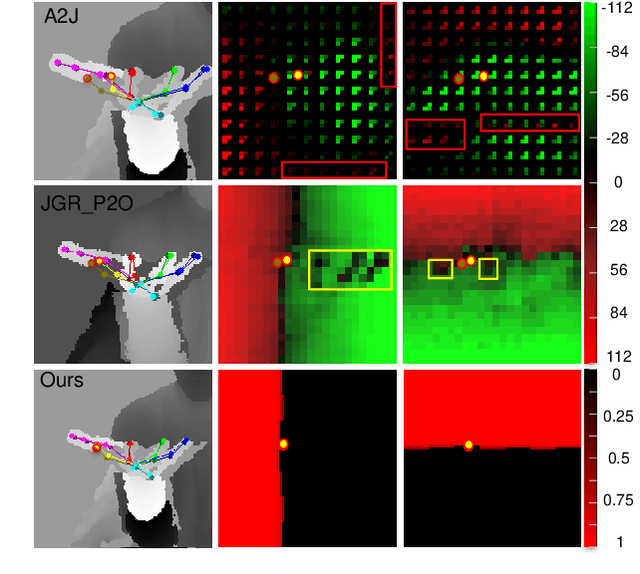
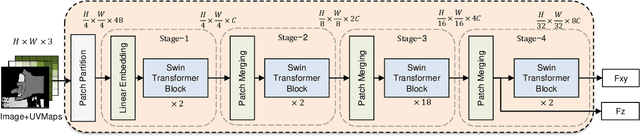
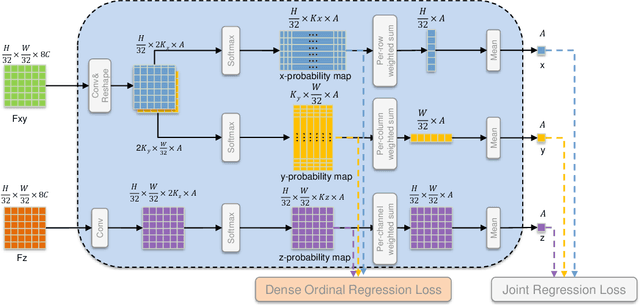
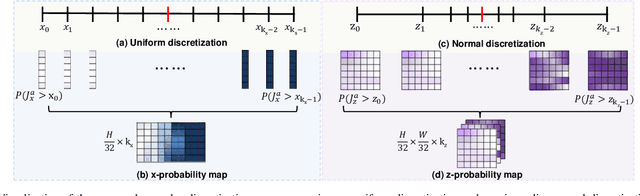
Depth-based 3D hand pose estimation is an important but challenging research task in human-machine interaction community. Recently, dense regression methods have attracted increasing attention in 3D hand pose estimation task, which provide a low computational burden and high accuracy regression way by densely regressing hand joint offset maps. However, large-scale regression offset values are often affected by noise and outliers, leading to a significant drop in accuracy. To tackle this, we re-formulate 3D hand pose estimation as a dense ordinal regression problem and propose a novel Dense Ordinal Regression 3D Pose Network (DOR3D-Net). Specifically, we first decompose offset value regression into sub-tasks of binary classifications with ordinal constraints. Then, each binary classifier can predict the probability of a binary spatial relationship relative to joint, which is easier to train and yield much lower level of noise. The estimated hand joint positions are inferred by aggregating the ordinal regression results at local positions with a weighted sum. Furthermore, both joint regression loss and ordinal regression loss are used to train our DOR3D-Net in an end-to-end manner. Extensive experiments on public datasets (ICVL, MSRA, NYU and HANDS2017) show that our design provides significant improvements over SOTA methods.