 Add to Chrome
 Add to Firefox
 Add to Edge
Bending Beam for THz Wireless Networks: Fundamental, Design Issue, and Prototype
Jul 07, 2026
Bending beams, characterized by their non diffracting and self-healing properties in the near field, offer a new approach to bypass blockage in terahertz (THz) wireless communication and sensing. However, the investigations of bend ing beams in the context of wireless communications still remain at an early stage. This article provides a state-of-the-art review of the fundamentals and key application scenarios of bending beams in THz wireless communications and sensing. We first present and compare the existing beamforming design and practical hardware implementation methods for bending beams. Next, we discuss potential applications of bending beams in wireless communica tions and sensing and identify their associated challenges, such as blocked channel modeling, bending beam training, codebook design, etc. Finally, a hardware demonstration of bending beam over THz frequency bands is presented, validating the advantages of bending beam over conventional beamfocusing.

Near-Field THz Bending Beamforming: A Convex Optimization Perspective
Mar 26, 2025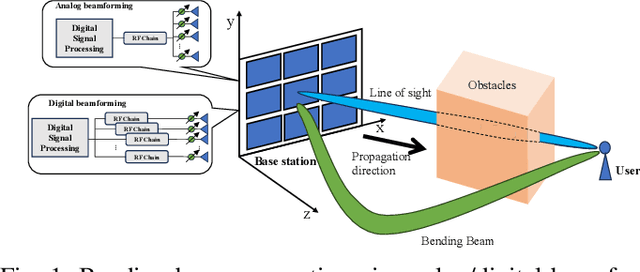
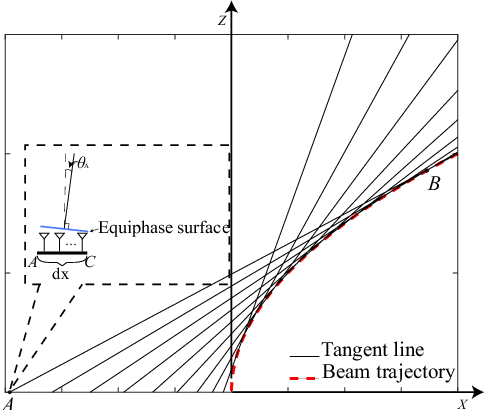
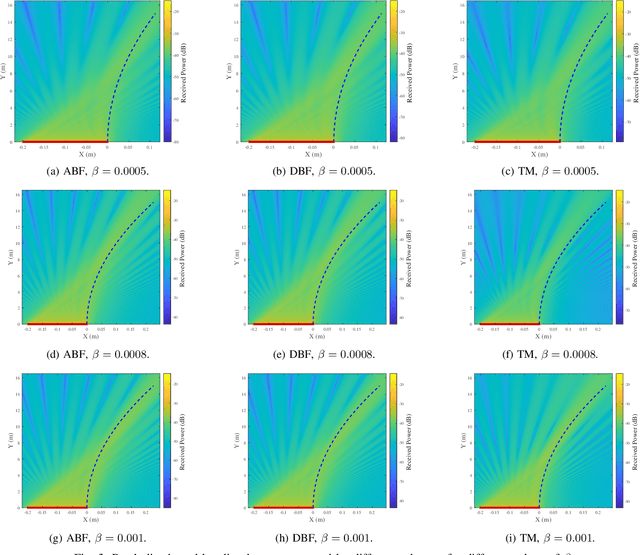
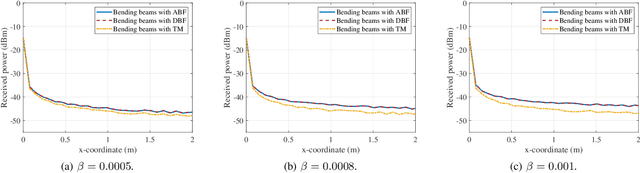
Terahertz (THz) communication systems suffer severe blockage issues, which may significantly degrade the communica tion coverage and quality. Bending beams, capable of adjusting their propagation direction to bypass obstacles, have recently emerged as a promising solution to resolve this issue by engineer ing the propagation trajectory of the beam. However, traditional bending beam generation methods rely heavily on the specific geometric properties of the propagation trajectory and can only achieve sub-optimal performance. In this paper, we propose a new and general bending beamforming method by adopting the convex optimization techniques. In particular, we formulate the bending beamforming design as a max-min optimization problem, aiming to optimize the analog or digital transmit beamforming vector to maximize the minimum received signal power among all positions along the bending beam trajectory. However, the resulting problem is non-convex and difficult to be solved optimally. To tackle this difficulty, we apply the successive convex approximation (SCA) technique to obtain a high-quality suboptimal solution. Numerical results show that our proposed bending beamforming method outperforms the traditional method and shows robustness to the obstacle in the environment.