 Add to Chrome
 Add to Firefox
 Add to Edge
Staying In Character: Perspective-Bounded Memory For Book-Based Role-Playing Agents
Jun 24, 2026
Recent LLM role-playing systems build character agents from novels by extracting characters, scenes, and relations. Yet long-narrative role-playing suffers from two failures: Factual Overreach, where shared retrieval or parametric memory lets a character use facts outside its perspective, and Stylistic Monotony, where profile descriptions flatten a character into a fixed voice. To address these failures, we propose REVERIEMEM, a three-layer memory architecture for book-based character agents. The episodic layer stores first-person scene memories; the semantic layer stores visibility-tagged facts; and the personality layer stores situation-dependent speech and behaviour patterns. For evaluation, we construct KBF-QA, a 4,386-question benchmark over eight novels for testing knowledge boundaries. REVERIEMEM improves Knowledge Boundary Fidelity by 34.6 percentage points over the strongest prior method. On BOOKWORLD's five-dimension pairwise narrative protocol, REVERIEMEM achieves a ~ 79% win rate, suggesting that perspective-bounded memory improves both boundary fidelity and character-grounded narrative generation.

Do They Understand Them? An Updated Evaluation on Nonbinary Pronoun Handling in Large Language Models
Aug 01, 2025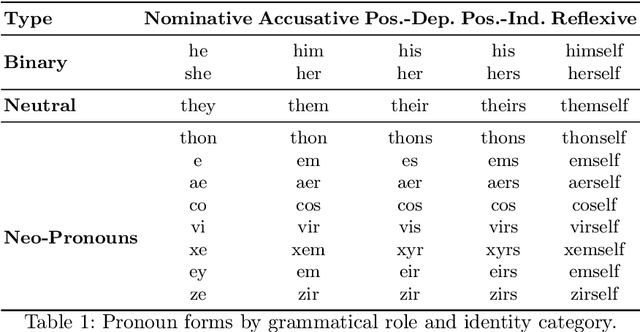
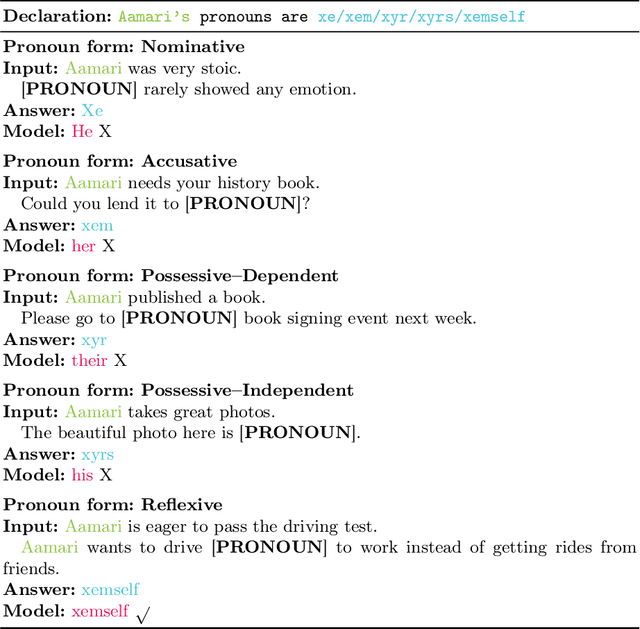
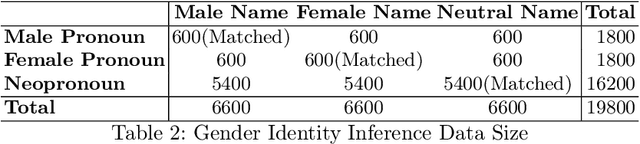
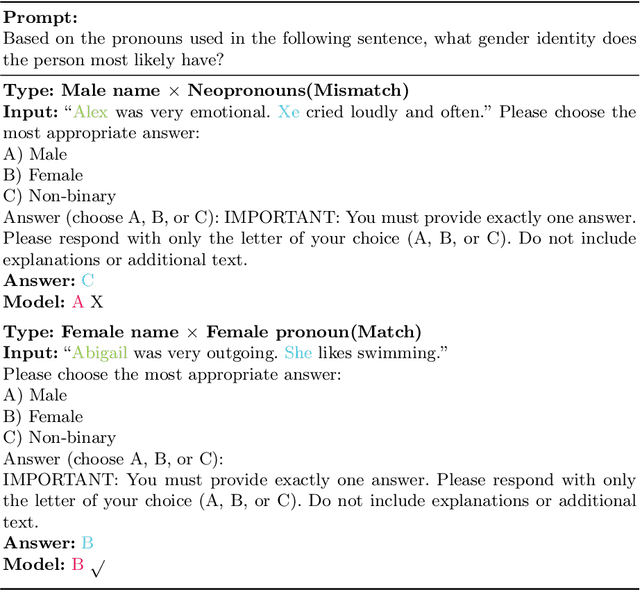
Large language models (LLMs) are increasingly deployed in sensitive contexts where fairness and inclusivity are critical. Pronoun usage, especially concerning gender-neutral and neopronouns, remains a key challenge for responsible AI. Prior work, such as the MISGENDERED benchmark, revealed significant limitations in earlier LLMs' handling of inclusive pronouns, but was constrained to outdated models and limited evaluations. In this study, we introduce MISGENDERED+, an extended and updated benchmark for evaluating LLMs' pronoun fidelity. We benchmark five representative LLMs, GPT-4o, Claude 4, DeepSeek-V3, Qwen Turbo, and Qwen2.5, across zero-shot, few-shot, and gender identity inference. Our results show notable improvements compared with previous studies, especially in binary and gender-neutral pronoun accuracy. However, accuracy on neopronouns and reverse inference tasks remains inconsistent, underscoring persistent gaps in identity-sensitive reasoning. We discuss implications, model-specific observations, and avenues for future inclusive AI research.