 Add to Chrome
 Add to Firefox
 Add to Edge
Still Camouflage, Moving Illusion: View-Induced Trajectory Manipulation in Autonomous Driving
May 12, 2026
Existing physical adversarial attacks on vision-based autonomous driving induce time-evolving perception errors, including biased object tracking or trajectory prediction, through (i) sophisticated physical patch inducing detection box drift when entering the view distance, or (ii) dynamically changing patches that cause different perception errors at different time. In both cases, viewing-angle variation is treated as a challenge, requiring adversarial patches to remain effective across frames under varying views, leading to complex multi-view optimization. In contrast, we show that viewing-angle variation itself can be turned into an attack tool. We design a new attack paradigm where a static, passive adversarial camouflage is mounted on a vehicle whose view-dependent appearance naturally evolves with relative motion, inducing consistent feature drift across frames. This causes the system to infer a physically plausible but incorrect trajectory, such as a false cut-in, which propagates to downstream decision-making and triggers unnecessary braking. Unlike prior approaches that require multi-view robustness or active intervention, our attack emerges from normal driving dynamics and is easy to deploy: a parked vehicle with a natural camouflage can induce hard braking in passing autonomous vehicles. We demonstrate the novel attack on nuScenes dataset, showing the effectiveness with an end-to-end success rate of up to 87.5%, measured by hard-braking events, and robustness across different scene backgrounds, victim vehicle speeds, and perception models.

Make-It-Vivid: Dressing Your Animatable Biped Cartoon Characters from Text
Mar 25, 2024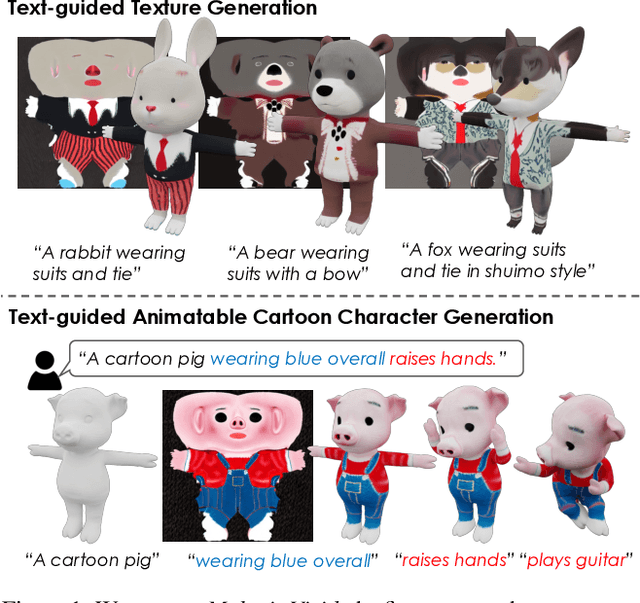
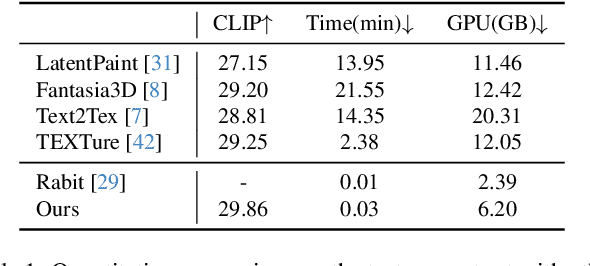
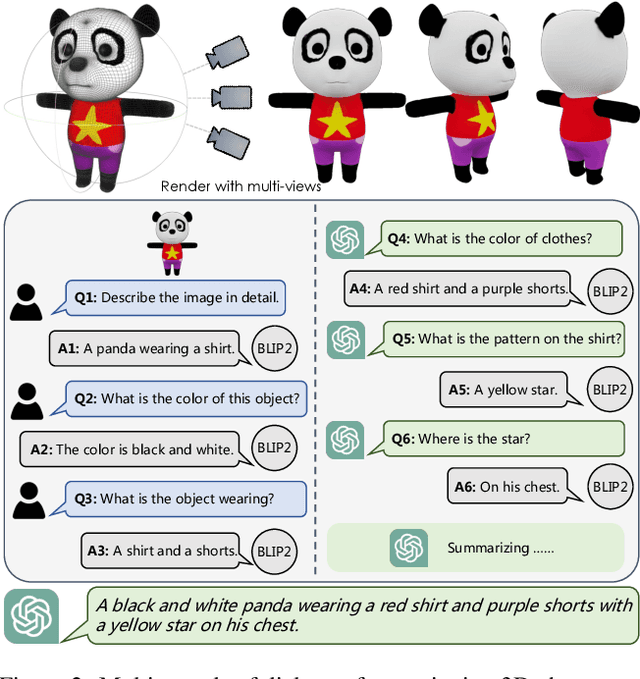
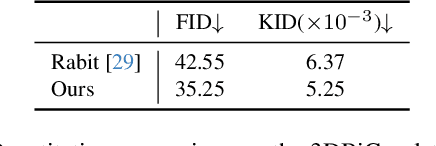
Creating and animating 3D biped cartoon characters is crucial and valuable in various applications. Compared with geometry, the diverse texture design plays an important role in making 3D biped cartoon characters vivid and charming. Therefore, we focus on automatic texture design for cartoon characters based on input instructions. This is challenging for domain-specific requirements and a lack of high-quality data. To address this challenge, we propose Make-It-Vivid, the first attempt to enable high-quality texture generation from text in UV space. We prepare a detailed text-texture paired data for 3D characters by using vision-question-answering agents. Then we customize a pretrained text-to-image model to generate texture map with template structure while preserving the natural 2D image knowledge. Furthermore, to enhance fine-grained details, we propose a novel adversarial learning scheme to shorten the domain gap between original dataset and realistic texture domain. Extensive experiments show that our approach outperforms current texture generation methods, resulting in efficient character texturing and faithful generation with prompts. Besides, we showcase various applications such as out of domain generation and texture stylization. We also provide an efficient generation system for automatic text-guided textured character generation and animation.