 Add to Chrome
 Add to Firefox
 Add to Edge
WiWorld-RealData: A Real-World Multi-Modal Dataset for 6G Wireless World Models
Jun 24, 2026
Wireless world models aim to represent, predict, and reason about wireless propagation by jointly understanding physical environments and channel responses. Realizing such models in sixth-generation (6G) digital twin channels requires datasets that capture measured wireless responses and environment states under real-world propagation conditions. This paper presents WiWorld-RealData, a real-world outdoor multi-band channel and multi-modal sensing dataset collected along campus mobile routes. WiWorld-RealData provides measured channel impulse responses (CIRs) at 3.7 GHz and 6.775 GHz, together with multi-view images, panoramic images, light detection and ranging (LiDAR) point clouds, millimeter-wave (mmWave) radar records, and global navigation satellite system (GNSS) trajectories. Through unified file organization and metadata manifests, the dataset establishes sample-level correspondences among channel responses, environment observations, timestamps, route information, antenna configurations, and quality flags. The overall measurement campaign has produced 10 TB-level multi-modal field data. The current public release provides one representative dual-band route at 3.7 GHz and 6.775 GHz with complete channel-environment alignment, while the acquisition framework supports extension to more frequency bands and scenarios. A case study on environment-assisted path-loss prediction achieves a mean absolute error (MAE) of 2.02 dB and a root mean squared error (RMSE) of 2.69 dB, indicating that the aligned environment observations contain predictive information for channel variations. The dataset is available at https://scc.bupt.edu.cn/dataset-manage/datasets/44, and a ScienceDB mirror will be provided upon release.

Image Reconstruction for Accelerated MR Scan with Faster Fourier Convolutional Neural Networks
Jun 05, 2023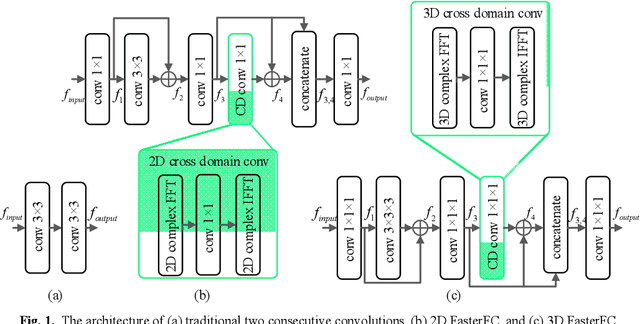
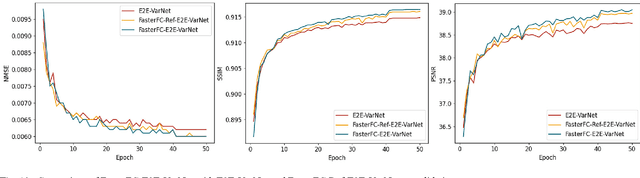

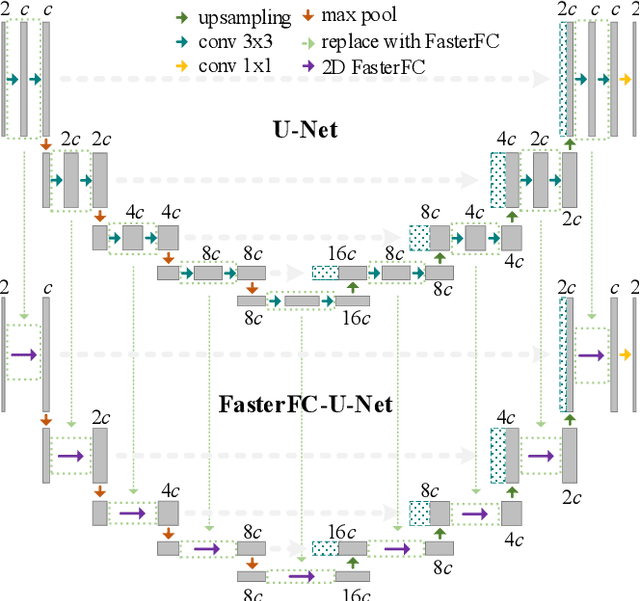
Partial scan is a common approach to accelerate Magnetic Resonance Imaging (MRI) data acquisition in both 2D and 3D settings. However, accurately reconstructing images from partial scan data (i.e., incomplete k-space matrices) remains challenging due to lack of an effectively global receptive field in both spatial and k-space domains. To address this problem, we propose the following: (1) a novel convolutional operator called Faster Fourier Convolution (FasterFC) to replace the two consecutive convolution operations typically used in convolutional neural networks (e.g., U-Net, ResNet). Based on the spectral convolution theorem in Fourier theory, FasterFC employs alternating kernels of size 1 in 3D case) in different domains to extend the dual-domain receptive field to the global and achieves faster calculation speed than traditional Fast Fourier Convolution (FFC). (2) A 2D accelerated MRI method, FasterFC-End-to-End-VarNet, which uses FasterFC to improve the sensitivity maps and reconstruction quality. (3) A multi-stage 3D accelerated MRI method called FasterFC-based Single-to-group Network (FAS-Net) that utilizes a single-to-group algorithm to guide k-space domain reconstruction, followed by FasterFC-based cascaded convolutional neural networks to expand the effective receptive field in the dual-domain. Experimental results on the fastMRI and Stanford MRI Data datasets demonstrate that FasterFC improves the quality of both 2D and 3D reconstruction. Moreover, FAS-Net, as a 3D high-resolution multi-coil (eight) accelerated MRI method, achieves superior reconstruction performance in both qualitative and quantitative results compared with state-of-the-art 2D and 3D methods.