 Add to Chrome
 Add to Firefox
 Add to Edge
Dr.Occ: Depth- and Region-Guided 3D Occupancy from Surround-View Cameras for Autonomous Driving
Mar 05, 2026
3D semantic occupancy prediction is crucial for autonomous driving perception, offering comprehensive geometric scene understanding and semantic recognition. However, existing methods struggle with geometric misalignment in view transformation due to the lack of pixel-level accurate depth estimation, and severe spatial class imbalance where semantic categories exhibit strong spatial anisotropy. To address these challenges, we propose Dr. Occ, a depth- and region-guided occupancy prediction framework. Specifically, we introduce a depth-guided 2D-to-3D View Transformer (D$^2$-VFormer) that effectively leverages high-quality dense depth cues from MoGe-2 to construct reliable geometric priors, thereby enabling precise geometric alignment of voxel features. Moreover, inspired by the Mixture-of-Experts (MoE) framework, we propose a region-guided Expert Transformer (R/R$^2$-EFormer) that adaptively allocates region-specific experts to focus on different spatial regions, effectively addressing spatial semantic variations. Thus, the two components make complementary contributions: depth guidance ensures geometric alignment, while region experts enhance semantic learning. Experiments on the Occ3D--nuScenes benchmark demonstrate that Dr. Occ improves the strong baseline BEVDet4D by 7.43% mIoU and 3.09% IoU under the full vision-only setting.

DF-Calib: Targetless LiDAR-Camera Calibration via Depth Flow
Apr 02, 2025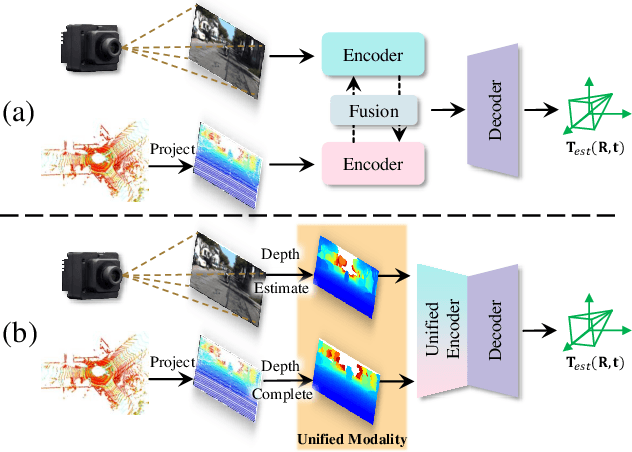
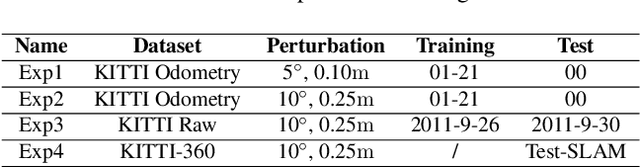
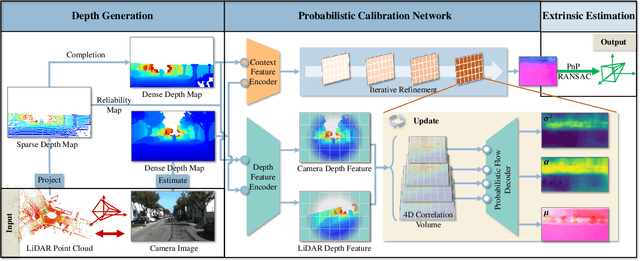
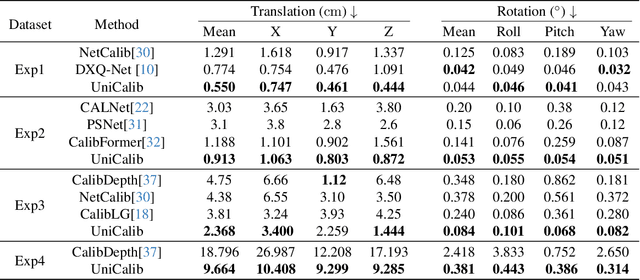
Precise LiDAR-camera calibration is crucial for integrating these two sensors into robotic systems to achieve robust perception. In applications like autonomous driving, online targetless calibration enables a prompt sensor misalignment correction from mechanical vibrations without extra targets. However, existing methods exhibit limitations in effectively extracting consistent features from LiDAR and camera data and fail to prioritize salient regions, compromising cross-modal alignment robustness. To address these issues, we propose DF-Calib, a LiDAR-camera calibration method that reformulates calibration as an intra-modality depth flow estimation problem. DF-Calib estimates a dense depth map from the camera image and completes the sparse LiDAR projected depth map, using a shared feature encoder to extract consistent depth-to-depth features, effectively bridging the 2D-3D cross-modal gap. Additionally, we introduce a reliability map to prioritize valid pixels and propose a perceptually weighted sparse flow loss to enhance depth flow estimation. Experimental results across multiple datasets validate its accuracy and generalization,with DF-Calib achieving a mean translation error of 0.635cm and rotation error of 0.045 degrees on the KITTI dataset.