 Add to Chrome
 Add to Firefox
 Add to Edge
What Makes a Medical Checker Trainable? Diagnosing Signal Collapse and Reward Hacking in Checker-Guided RAG for Biomedical QA
May 25, 2026
Medical RAG needs evidence-grounded claims, so plugging a claim-level NLI checker into retrieval-augmented RL is intuitive. \textbf{We find that the checker's \emph{output distribution} during training, not its held-out accuracy, decides whether it provides trainable gradient.} We compare four NLI checker back-ends as process rewards inside a GRPO-trained medical RAG agent (Qwen2.5-7B, replicated on Qwen3-4B and Llama-3.1-8B) across four held-out medical QA benchmarks. Three diagnostic findings emerge. \textbf{(i)} Signal collapse is log-prob-specific: LLM log-probability scoring labels over 97\% of claims neutral -- collapsing the RL gradient to zero -- while a calibrated MedNLI classifier scores the same pairs non-degenerately. \textbf{(ii)} Moderate signal beats strong signal on answer quality: a strong proprietary checker triggers a three-step reward-hacking cascade -- ultra-short answers, search avoidance, language collapse -- so a moderate-signal local classifier trains a higher-quality model (\textbf{+12\% BERTScore over zero-shot, no GPT dependency}). \textbf{(iii)} Signal strength is policy-dependent: the same checker registers as moderate on one policy but strong on another without triggering the cascade end-state. We frame these as boundary conditions for verifier-as-reward systems.

Scaling Medical Reasoning Verification via Tool-Integrated Reinforcement Learning
Jan 28, 2026Large language models have achieved strong performance on medical reasoning benchmarks, yet their deployment in clinical settings demands rigorous verification to ensure factual accuracy. While reward models offer a scalable approach for reasoning trace verification, existing methods face two limitations: they produce only scalar reward values without explicit justification, and they rely on single-pass retrieval that precludes adaptive knowledge access as verification unfolds. We introduce $\method$, an agentic framework that addresses these limitations by training medical reasoning verifiers to iteratively query external medical corpora during evaluation. Our approach combines tool-augmented verification with an iterative reinforcement learning paradigm that requires only trace-level supervision, alongside an adaptive curriculum mechanism that dynamically adjusts training data distribution. Across four medical reasoning benchmarks, $\method$ achieves substantial gains over existing methods, improving MedQA accuracy by 23.5% and MedXpertQA by 32.0% relative to the base generator in particular. Crucially, $\method$ demonstrates an $\mathbf{8\times}$ reduction in sampling budget requirement compared to prior reward model baselines. These findings establish that grounding verification in dynamically retrieved evidence offers a principled path toward more reliable medical reasoning systems.
MedRAGChecker: Claim-Level Verification for Biomedical Retrieval-Augmented Generation
Jan 10, 2026Biomedical retrieval-augmented generation (RAG) can ground LLM answers in medical literature, yet long-form outputs often contain isolated unsupported or contradictory claims with safety implications. We introduce MedRAGChecker, a claim-level verification and diagnostic framework for biomedical RAG. Given a question, retrieved evidence, and a generated answer, MedRAGChecker decomposes the answer into atomic claims and estimates claim support by combining evidence-grounded natural language inference (NLI) with biomedical knowledge-graph (KG) consistency signals. Aggregating claim decisions yields answer-level diagnostics that help disentangle retrieval and generation failures, including faithfulness, under-evidence, contradiction, and safety-critical error rates. To enable scalable evaluation, we distill the pipeline into compact biomedical models and use an ensemble verifier with class-specific reliability weighting. Experiments on four biomedical QA benchmarks show that MedRAGChecker reliably flags unsupported and contradicted claims and reveals distinct risk profiles across generators, particularly on safety-critical biomedical relations.
Automated Extraction of Fluoropyrimidine Treatment and Treatment-Related Toxicities from Clinical Notes Using Natural Language Processing
Oct 23, 2025


Objective: Fluoropyrimidines are widely prescribed for colorectal and breast cancers, but are associated with toxicities such as hand-foot syndrome and cardiotoxicity. Since toxicity documentation is often embedded in clinical notes, we aimed to develop and evaluate natural language processing (NLP) methods to extract treatment and toxicity information. Materials and Methods: We constructed a gold-standard dataset of 236 clinical notes from 204,165 adult oncology patients. Domain experts annotated categories related to treatment regimens and toxicities. We developed rule-based, machine learning-based (Random Forest, Support Vector Machine [SVM], Logistic Regression [LR]), deep learning-based (BERT, ClinicalBERT), and large language models (LLM)-based NLP approaches (zero-shot and error-analysis prompting). Models used an 80:20 train-test split. Results: Sufficient data existed to train and evaluate 5 annotated categories. Error-analysis prompting achieved optimal precision, recall, and F1 scores (F1=1.000) for treatment and toxicities extraction, whereas zero-shot prompting reached F1=1.000 for treatment and F1=0.876 for toxicities extraction.LR and SVM ranked second for toxicities (F1=0.937). Deep learning underperformed, with BERT (F1=0.873 treatment; F1= 0.839 toxicities) and ClinicalBERT (F1=0.873 treatment; F1 = 0.886 toxicities). Rule-based methods served as our baseline with F1 scores of 0.857 in treatment and 0.858 in toxicities. Discussion: LMM-based approaches outperformed all others, followed by machine learning methods. Machine and deep learning approaches were limited by small training data and showed limited generalizability, particularly for rare categories. Conclusion: LLM-based NLP most effectively extracted fluoropyrimidine treatment and toxicity information from clinical notes, and has strong potential to support oncology research and pharmacovigilance.
Mitigating the Risk of Health Inequity Exacerbated by Large Language Models
Oct 14, 2024Recent advancements in large language models have demonstrated their potential in numerous medical applications, particularly in automating clinical trial matching for translational research and enhancing medical question answering for clinical decision support. However, our study shows that incorporating non decisive sociodemographic factors such as race, sex, income level, LGBT+ status, homelessness, illiteracy, disability, and unemployment into the input of LLMs can lead to incorrect and harmful outputs for these populations. These discrepancies risk exacerbating existing health disparities if LLMs are widely adopted in healthcare. To address this issue, we introduce EquityGuard, a novel framework designed to detect and mitigate the risk of health inequities in LLM based medical applications. Our evaluation demonstrates its efficacy in promoting equitable outcomes across diverse populations.
Enhancing Equity in Large Language Models for Medical Applications
Oct 07, 2024Recent advancements have highlighted the potential of large language models (LLMs) in medical applications, notably in automating Clinical Trial Matching for translational research and providing medical question-answering for clinical decision support. However, our study reveals significant inequities in the use of LLMs, particularly for individuals from specific racial, gender, and underrepresented groups influenced by social determinants of health. These disparities could worsen existing health inequities if LLMs are broadly adopted in healthcare. To address this, we propose and evaluate a novel framework, EquityGuard, designed to detect and mitigate biases in LLM-based medical applications. EquityGuard incorporates a Bias Detection Mechanism capable of identifying and correcting unfair predictions, thus enhancing outcomes and promoting equity across diverse population groups.
SDoH-GPT: Using Large Language Models to Extract Social Determinants of Health (SDoH)
Jul 24, 2024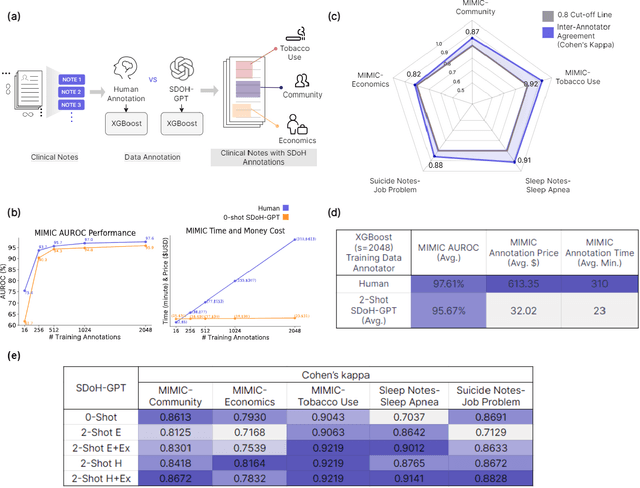

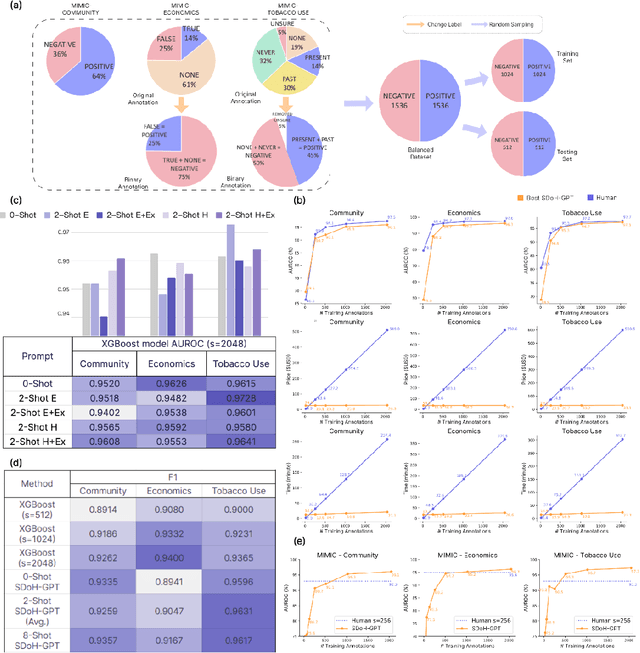
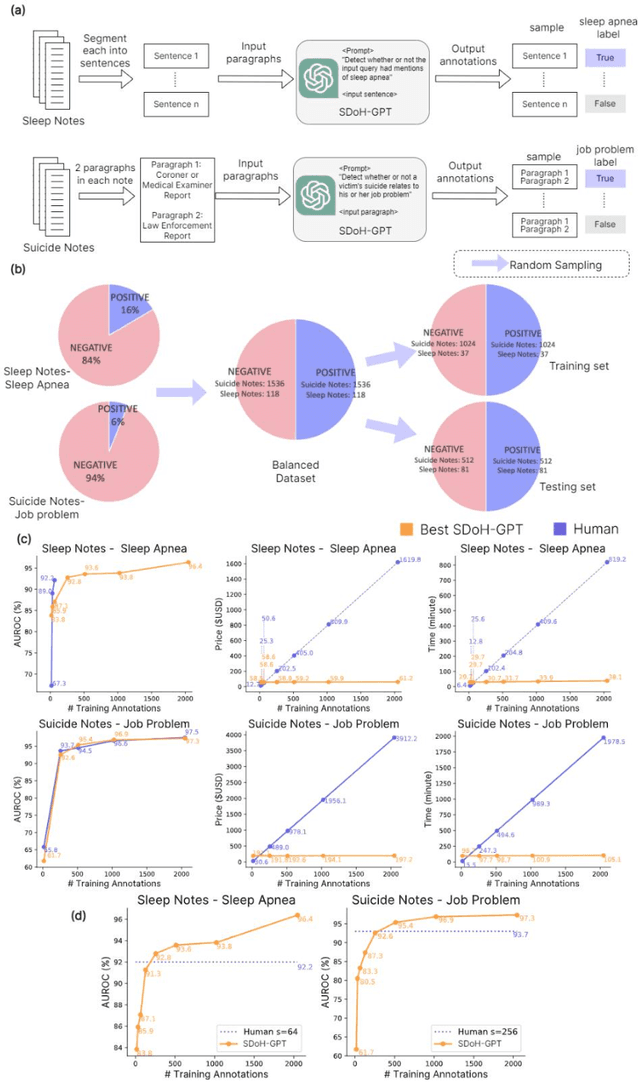
Extracting social determinants of health (SDoH) from unstructured medical notes depends heavily on labor-intensive annotations, which are typically task-specific, hampering reusability and limiting sharing. In this study we introduced SDoH-GPT, a simple and effective few-shot Large Language Model (LLM) method leveraging contrastive examples and concise instructions to extract SDoH without relying on extensive medical annotations or costly human intervention. It achieved tenfold and twentyfold reductions in time and cost respectively, and superior consistency with human annotators measured by Cohen's kappa of up to 0.92. The innovative combination of SDoH-GPT and XGBoost leverages the strengths of both, ensuring high accuracy and computational efficiency while consistently maintaining 0.90+ AUROC scores. Testing across three distinct datasets has confirmed its robustness and accuracy. This study highlights the potential of leveraging LLMs to revolutionize medical note classification, demonstrating their capability to achieve highly accurate classifications with significantly reduced time and cost.
A Literature Review and Framework for Human Evaluation of Generative Large Language Models in Healthcare
May 04, 2024As generative artificial intelligence (AI), particularly Large Language Models (LLMs), continues to permeate healthcare, it remains crucial to supplement traditional automated evaluations with human expert evaluation. Understanding and evaluating the generated texts is vital for ensuring safety, reliability, and effectiveness. However, the cumbersome, time-consuming, and non-standardized nature of human evaluation presents significant obstacles to the widespread adoption of LLMs in practice. This study reviews existing literature on human evaluation methodologies for LLMs within healthcare. We highlight a notable need for a standardized and consistent human evaluation approach. Our extensive literature search, adhering to the Preferred Reporting Items for Systematic Reviews and Meta-Analyses (PRISMA) guidelines, spans publications from January 2018 to February 2024. This review provides a comprehensive overview of the human evaluation approaches used in diverse healthcare applications.This analysis examines the human evaluation of LLMs across various medical specialties, addressing factors such as evaluation dimensions, sample types, and sizes, the selection and recruitment of evaluators, frameworks and metrics, the evaluation process, and statistical analysis of the results. Drawing from diverse evaluation strategies highlighted in these studies, we propose a comprehensive and practical framework for human evaluation of generative LLMs, named QUEST: Quality of Information, Understanding and Reasoning, Expression Style and Persona, Safety and Harm, and Trust and Confidence. This framework aims to improve the reliability, generalizability, and applicability of human evaluation of generative LLMs in different healthcare applications by defining clear evaluation dimensions and offering detailed guidelines.
Enhancing Large Language Models for Clinical Decision Support by Incorporating Clinical Practice Guidelines
Jan 23, 2024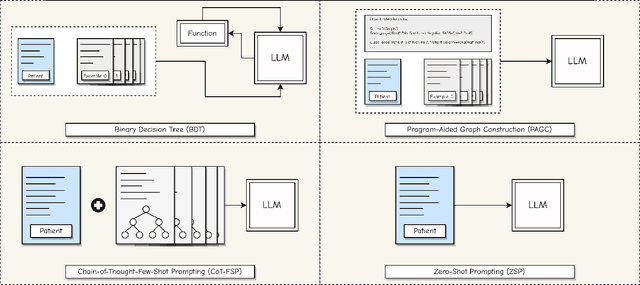
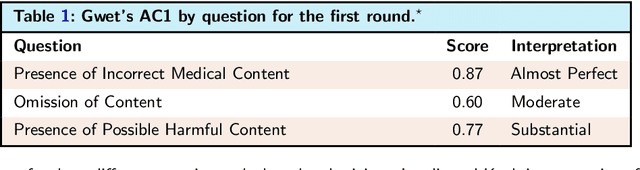
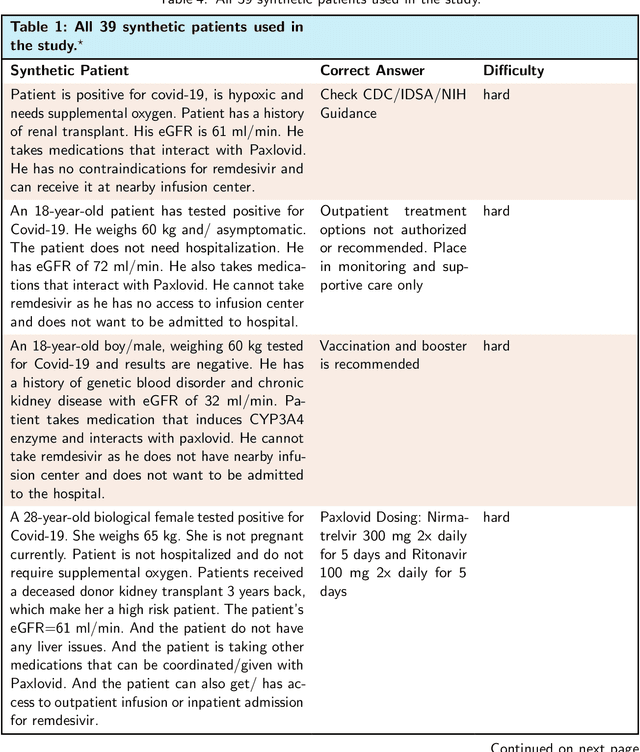
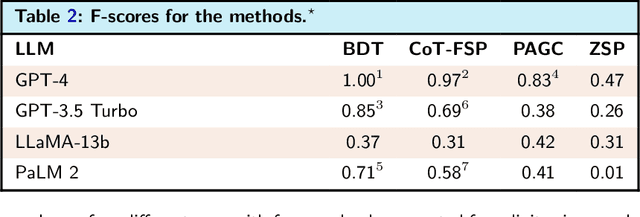
Background Large Language Models (LLMs), enhanced with Clinical Practice Guidelines (CPGs), can significantly improve Clinical Decision Support (CDS). However, methods for incorporating CPGs into LLMs are not well studied. Methods We develop three distinct methods for incorporating CPGs into LLMs: Binary Decision Tree (BDT), Program-Aided Graph Construction (PAGC), and Chain-of-Thought-Few-Shot Prompting (CoT-FSP). To evaluate the effectiveness of the proposed methods, we create a set of synthetic patient descriptions and conduct both automatic and human evaluation of the responses generated by four LLMs: GPT-4, GPT-3.5 Turbo, LLaMA, and PaLM 2. Zero-Shot Prompting (ZSP) was used as the baseline method. We focus on CDS for COVID-19 outpatient treatment as the case study. Results All four LLMs exhibit improved performance when enhanced with CPGs compared to the baseline ZSP. BDT outperformed both CoT-FSP and PAGC in automatic evaluation. All of the proposed methods demonstrated high performance in human evaluation. Conclusion LLMs enhanced with CPGs demonstrate superior performance, as compared to plain LLMs with ZSP, in providing accurate recommendations for COVID-19 outpatient treatment, which also highlights the potential for broader applications beyond the case study.