 Add to Chrome
 Add to Firefox
 Add to Edge
Physical AI Governance: From Theory to Practice Across Life Cycle
Jul 24, 2026
With the emergence of Physical AI, artificial intelligence is extending beyond screen-based applications to embodied systems that perceive, interact with, and act in the physical world. Unlike traditional AI, Physical AI operates under real-time safety constraints, continuously interacts with dynamic environments, and coexists with humans, introducing governance challenges that existing AI governance frameworks do not explicitly address. This paper presents a comprehensive survey of Physical AI governance from both scientific and operational perspectives. We synthesize existing governance principles and organize them into a unified governance framework tailored to physical AI systems. Building on this foundation, we propose a five-stage Physical AI lifecycle comprising research, design, data, model development, and deployment, and demonstrate how governance can be operationalized across each stage through concrete implementation practices. By connecting governance principles with engineering workflows, this survey provides a structured reference for researchers, developers, and policymakers to build Physical AI systems that are safe, trustworthy, and aligned with societal values.

Toward Trustworthy Evaluation of Sustainability Rating Methodologies: A Human-AI Collaborative Framework for Benchmark Dataset Construction
Feb 19, 2026Sustainability or ESG rating agencies use company disclosures and external data to produce scores or ratings that assess the environmental, social, and governance performance of a company. However, sustainability ratings across agencies for a single company vary widely, limiting their comparability, credibility, and relevance to decision-making. To harmonize the rating results, we propose adopting a universal human-AI collaboration framework to generate trustworthy benchmark datasets for evaluating sustainability rating methodologies. The framework comprises two complementary parts: STRIDE (Sustainability Trust Rating & Integrity Data Equation) provides principled criteria and a scoring system that guide the construction of firm-level benchmark datasets using large language models (LLMs), and SR-Delta, a discrepancy-analysis procedural framework that surfaces insights for potential adjustments. The framework enables scalable and comparable assessment of sustainability rating methodologies. We call on the broader AI community to adopt AI-powered approaches to strengthen and advance sustainability rating methodologies that support and enforce urgent sustainability agendas.
D2D-Enabled Data Sharing for Distributed Machine Learning at Wireless Network Edge
Jan 28, 2020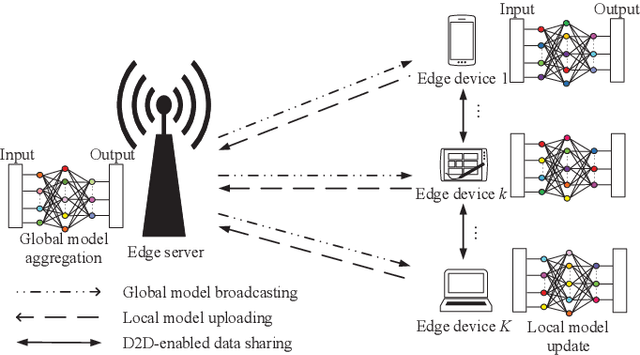
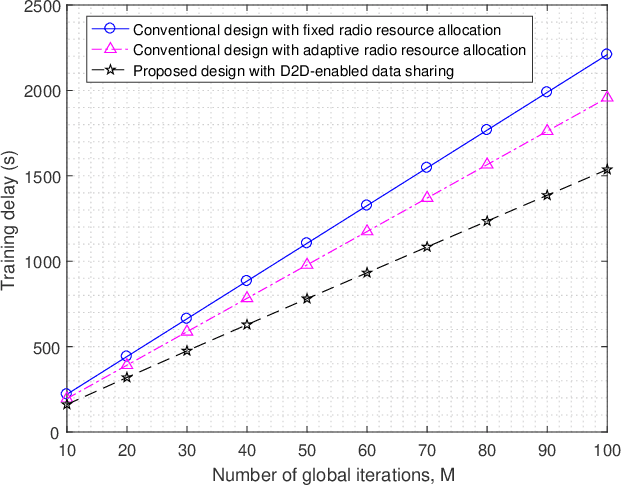
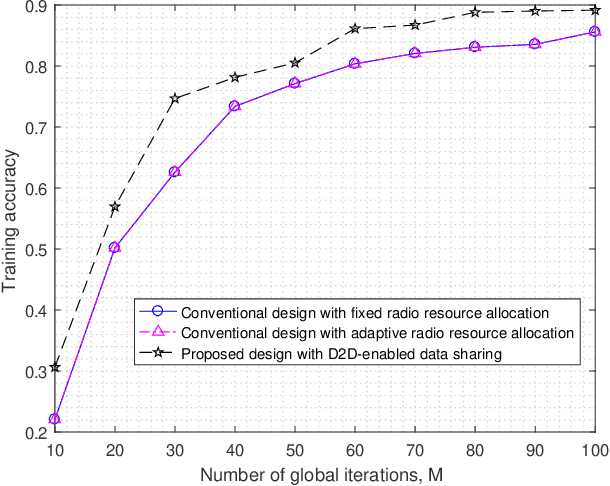
Mobile edge learning is an emerging technique that enables distributed edge devices to collaborate in training shared machine learning models by exploiting their local data samples and communication and computation resources. To deal with the straggler dilemma issue faced in this technique, this paper proposes a new device to device enabled data sharing approach, in which different edge devices share their data samples among each other over communication links, in order to properly adjust their computation loads for increasing the training speed. Under this setup, we optimize the radio resource allocation for both data sharing and distributed training, with the objective of minimizing the total training delay under fixed numbers of local and global iterations. Numerical results show that the proposed data sharing design significantly reduces the training delay, and also enhances the training accuracy when the data samples are non independent and identically distributed among edge devices.