 Add to Chrome
 Add to Firefox
 Add to Edge
Bridge the Gaps: Heterogeneous Attributed Graph Clustering via Quaternion Representation Learning
Jun 22, 2026
Attributed graph clustering partitions nodes by jointly exploiting node attributes and graph topology. It remains challenging due to attribute heterogeneity and representation degradation during graph learning. Real-world datasets often contain heterogeneous attributes, i.e., numerical and categorical attributes, complicating unified representation learning. This challenge becomes more complex in attributed graphs, where constructing a clustering-friendly graph structure from attributes and topology remains difficult. Under deep graph architectures, repeated graph propagation causes node embeddings to become overly similar, leading to the over-smoothing (OS) effect. Meanwhile, graph representation learning amplifies topological influence, making discriminative attribute information harder to exploit for clustering, an effect we refer to as over-dominating (OD). To bridge these gaps, an end-to-end framework, Any-type attributed Graph REpresentation lEarning (AGREE), is proposed. It unifies attributed graphs and any-type attributed data through multi-level alignment and similarity-based graph construction. Quaternion-based graph convolution strengthens attribute interaction to alleviate OD, while shallow graph architectures help relieve OS. The learned embeddings are jointly optimized for graph reconstruction and clustering, without requiring a predefined number of clusters during training. Experiments on diverse benchmarks show that AGREE achieves strong overall performance in accuracy, robustness, and adaptability.

Honest AI: Fine-Tuning "Small" Language Models to Say "I Don't Know", and Reducing Hallucination in RAG
Oct 13, 2024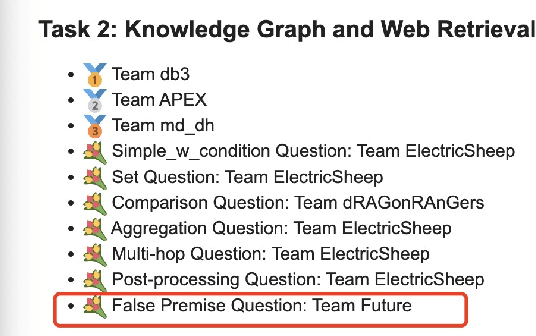
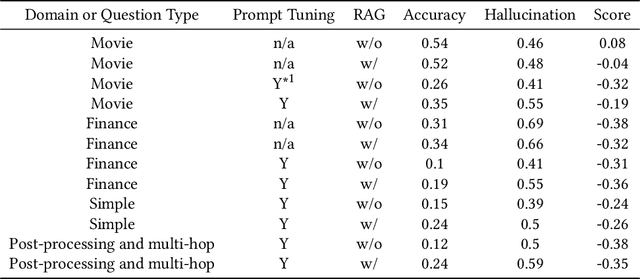

Hallucination is a key roadblock for applications of Large Language Models (LLMs), particularly for enterprise applications that are sensitive to information accuracy. To address this issue, two general approaches have been explored: Retrieval-Augmented Generation (RAG) to supply LLMs with updated information as context, and fine-tuning the LLMs with new information and desired output styles. In this paper, we propose Honest AI: a novel strategy to fine-tune "small" language models to say "I don't know" to reduce hallucination, along with several alternative RAG approaches. The solution ranked 1st in Task 2 for the false premise question. The alternative approaches include using RAG with search engine and knowledge graph results, fine-tuning base LLMs with new information and combinations of both approaches. Although all approaches improve the performance of the LLMs, RAG alone does not significantly improve the performance and fine-tuning is needed for better results. Finally, the hybrid approach achieved the highest score in the CRAG benchmark. In addition, our approach emphasizes the use of relatively small models with fewer than 10 billion parameters, promoting resource efficiency.
Mini-Giants: "Small" Language Models and Open Source Win-Win
Jul 17, 2023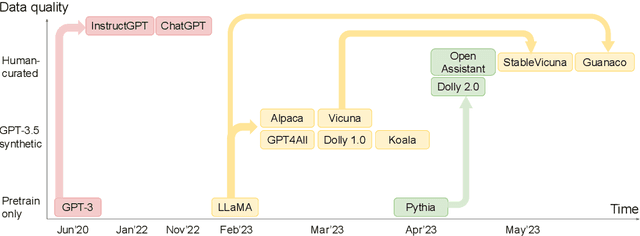
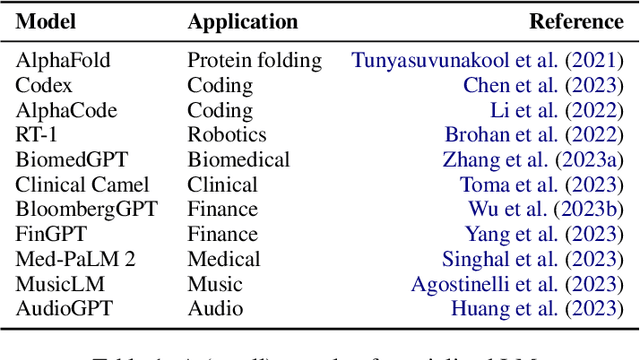
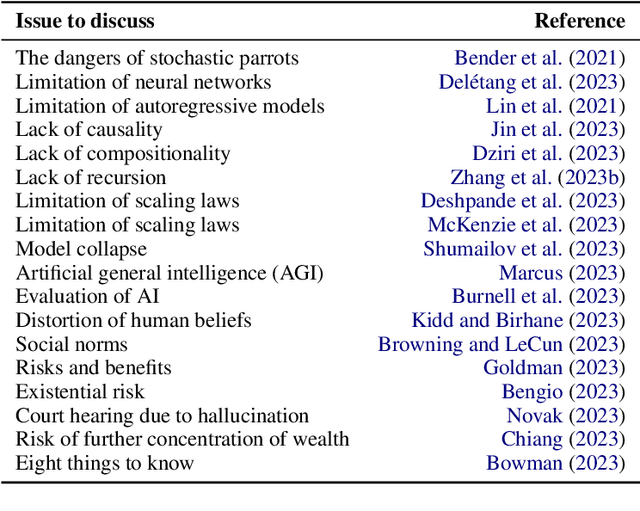
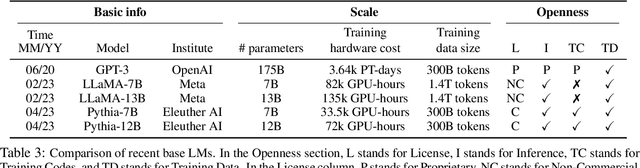
ChatGPT is phenomenal. However, it is prohibitively expensive to train and refine such giant models. Fortunately, small language models are flourishing and becoming more and more competent. We call them "mini-giants". We argue that open source community like Kaggle and mini-giants will win-win in many ways, technically, ethically and socially. In this article, we present a brief yet rich background, discuss how to attain small language models, present a comparative study of small language models and a brief discussion of evaluation methods, discuss the application scenarios where small language models are most needed in the real world, and conclude with discussion and outlook.